

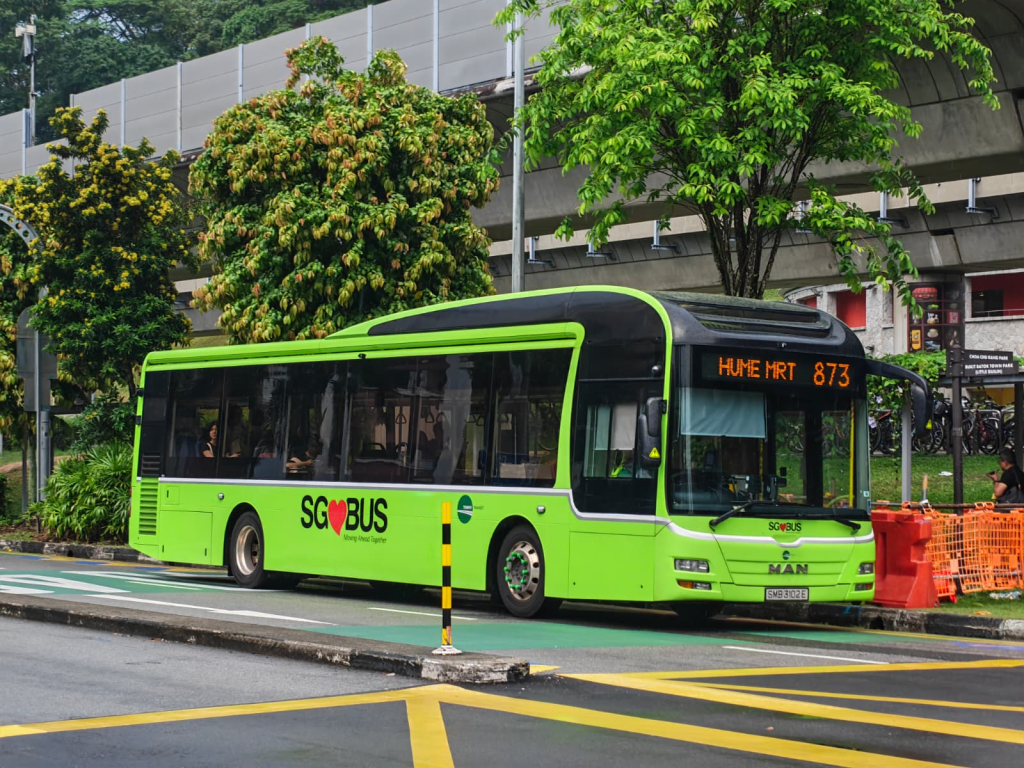
A quick piece, especially with new BCEP developments getting more and more creative with how they try to squeeze dry the toothpaste roll to introduce more new routes without a corresponding fleet increase.
Anyone who’s been observing buses for some amount of time should probably remember the former service 43M, which ran as a short-turning modified variant of its parent service 43. While it eventually gave way to new service 104 under the BCEP (which drew enough flak from Buangkok Green residents that it had to be reinstated as 43A in the morning anyway LOL), there’s another reincarnation of the practice in recent months, with the new services 873 and 873M originating from Tengah adopting a similar approach.
Those who have been reading our site for a while will remember that 43 and 43M was raised as an example of per-sector fleet allocation to enhance service frequency on critical sectors of long routes without needing to commit too much resources and risk excessive waste. Instead of a uniform seven-minute headway, GAS is able to run a bus between Punggol and Serangoon about every four and a half minutes on average* where capacity on the route was most needed.
*”on average” is doing a lot of work here, because improper scheduling meant the real experience was waiting more than 15 minutes and watching four buses show up together.
With no special bus procurement orders made for the BCEP and bus retirements coming to bite, LTA is finding itself increasingly running out of spare buses to rob for new BCEP routes (and more worryingly, alarmingly short of people to drive these new buses). Putting aside the alleged political origins of buses 873/M involving certain politicians, the phenomenon of permanent, all-day short-turn variants is likely to make a comeback to adapt to an acute operational shortage while maintaining acceptable headways for core segments.
In the case of the new services 873/M, the parent route 873 operates the full route between Tengah and the HillV2 mall / Hume station on the DTL via Bukit Gombak station on the NSL at 30-minute intervals during off-peak hours, and 20-minute intervals during peak hours. The modified variant 873M starts from Tengah and turns around at Bukit Gombak MRT, with the same headways as the parent. Combined, this produces a 15-minute bus frequency on average between Tengah and Bukit Gombak, and a 30-minute frequency between Bukit Gombak and Hume.
Similar to the all-day short-turn arrangement seen on the EWL at Joo Koon, the basic premise of these arrangements for buses is as such: by short-turning some trips of the route halfway along the line, limited bus resources can be focused on key sectors while maintaining one-seat connectivity for selected residents willing to wait longer. Departures from the anchor terminal are alternated between the full route and the short-trip parent variant, such that both routes each with a lower frequency, are combined to provide a headway acceptable for LTA’s BSRF standards, as if they haven’t been sufficiently disregarded since 2020, but anyway.
A similar concept appeared in the earlier stages of BCEP as well: existing trunk services saw the introduction of short-trip couplets, which are a corresponding pair of SWTs that cover the same segment in both directions during the same hours, providing stronger service in the middle portions of a line. Services 39A/B, 86A/B and 129A/B reflect this new planning trend. All these are commendable efforts to muster the most service out of next to nothing, but there’s an important question to be answered, for all of such sector-based headway enhancement schemes:
Coordinating staggered departures is easy from the terminal. What about ensuring consistent headways on the way back?
For the former service 43M, it is clear no second thought was given to properly staggering departures of 43 and 43M from Punggol interchange, with both buses bunching from the start being a common memory of most who lived along the route. As the main target of the short-turn variant was to attack the crowds swarming out of Serangoon MRT during the evening peak, simply spamming enough buses is a good enough result to prevent overcrowding. At such high frequencies, maintaining a strictly consistent headway becomes less important, since it’s given that a bus will be arriving soon. On less frequent routes where the short trip is explicitly intended to enhance headways, ensuring consistent arrivals becomes more important, even on the return journey. When the combined target headway is every 10 minutes, a bunched arrival means somebody along the line has been waiting for 20. If we’re still serious about upholding our world-class standards, that’s an immediate failure in service quality evaluation.
On decade-old standards, again
For short-turn variant pairs like the legacy 43/M or the new 873/M, the greatest difficulty in ensuring a consistent headway lies in the return journey where the short trip rejoins the mainline. Variance in runtimes on the full route and the short-trip mean that what was originally intended to be a perfect alternating pattern may lend itself more towards a bunched arrival sequence, making riders wait up to twice as long for the bus, defeating the purpose of the short turn service in the reverse direction. For the new 873/M, this is even trickier: both the parent and variant services are loops, meaning the parent’s arrival timings may fluctuate wildly with the cumulative effect of all factors to the looping point in Hillview and back! So far, a generously loose timetable keeps buses crawling at a snail’s pace, but still somewhat consistent.1
A quick recap: two metrics are used to evaluate service performance under the Bus Contracting Model:
- Estimated Wait Time (EWT), which tracks how far a bus deviates from a prescribed headway. For example, a bus operating on a route with a 10-minute frequency is considered “3 minutes late” if the interval with its front bus is 13 minutes. Most bus services in Singapore are evaluated based on EWT.
- On-Time Adherence (OTA), which measures bus punctuality against a fixed schedule. This is typically applied for services that do not operate full-day, or run at intervals worse than every 15 minutes. Express and City Direct services are evaluated under OTA by default. Interestingly enough, 873 and 873M are the first services to be evaluated on EWT despite individually breaching the 15-minute threshold throughout! (The previous case, 972 and M, has the M variant set to OTA due to headways above 20 min in the late morning)
From a preliminary check on services 873/M at Bukit Gombak station on a weekday afternoon in early November, buses on 873M from Tengah appear just 10 minutes ahead of the parent 873 bus, while arriving just 10 minutes behind the other 873 bus on the return journey during the afternoon pre-peak period. A more consistent pattern of 10-minute even headways was observed for the peak period, where each service arrives every 20 instead of 30.
Where syncing the short-turn trips to ensure consistent headway with the parent route is concerned, both BSRF metrices can be used to ensure proper execution of the short-turn headway management strategy.
Good ol’ OTA
The easier method to default to would be for the entire route, including both the full and short trip variants, to follow a fixed schedule. After all, if the schedule dictates that the short turn and parent serve the return journeys at regular intervals and the bus drivers follow it, it should in theory produce perfectly consistent headways. That’s what the OTA metric was intended to do, and does somewhat decently, on the (mostly infrequent) routes measured by it.
Like with everything under OTA however, this method comes with its own pitfalls. As every bus enthusiast probably is well aware of, bus services evaluated by OTA have their schedules written for the worst possible traffic congestion in mind, resulting in them being ridiculously slow-paced when the roads are clear. Unless bus priority is taken seriously enough for bus operators to not have to worry about the impact of congestion on schedule adherence, OTA-based solutions to ensuring consistent headways will always come with the unwanted side effect of significantly slowing down journeys along the line. A 15-minute bus ride from Bukit Gombak to Hume could become 20 or 25 minutes if OTA were imposed. Thank the heavens that’s not what became of service 873.
OTA-based solutions also require full service availability in order to ensure adequate service provisions, and are less adaptable to sudden operational situations (breakdowns, delays) when they occur along the line. In archaic thinking where operational responsibility falls entirely on bus drivers, this is indeed the easiest way however.
The spirit, and not the rule
Most bus services in Singapore are evaluated based on the EWT metric, which measures how consistently the bus arrives. Central to this is the elapsed interval between the bus in question, and the bus ahead of it. In other contexts this system also gets slammed for causing bus rides to be slow (although most of the time OTA services are scheduled to be much slower) because a delay cascades quickly down the line under its ideal compliance scenario, but specific to short-turn arrangements there’s another angle to this system that is worth looking at.
Headway-based systems allow for more leeway in deviance from fixed schedules, but generally fare much worse at ensuring service consistency where multiple service patterns are involved.
For the case of a bus route every 10 minutes having alternate trips turn around halfway to produce 20-minute headways on the outer segment for example, the EWT system would mark perfect service delivery even if every bus were 10 minutes delayed, so long as buses were 20 minutes apart. Here’s the fatal catch: if full-route buses were offset by half the headway, a downroute on the short-turn returning on an inserted fixed departure timing would bunch with the returning full-route bus, defeating the purpose of the alternating departure pattern between full-route and short-turn services. Under current operating frameworks, departures of downroute buses slotting in between full-route trips are fixed regardless of the actual estimated arrival times of the latter, meaning it’s entirely possible for the downroute to become “pointless” should it depart after the full-route bus rather than before, bunching behind completely empty all the way back to the terminus. That is a significant hurdle to cross for aspiring EWT-based short-turning bus services, inclusive 873/M. And on routes with the aforementioned “short-trip couplets” (eg 39A/B, 129A/B), this problem becomes more pronounced because the short-turn variant is effectively having to slot in between full-route buses as a downroute repeatedly, with no common temini to reset the alternating bus sequence! (As far as we’re aware, there’s not much effort being made to implement an alternating pattern on these SWT pair routes currenlty)
Logically, the paradigm shift needed here to ensure reliable service on these short-turning routes is to introduce flexible departure arrangements, where returning downroute buses adjust their departure times based on the estimated arrival times of its front and rear buses, to ensure a roughly consistent interval with them. This is easier to do on routes where the short-turn terminates rather than loops at the turning point, as there exists a layover period between completing the short trip and the next departure on the return downroute. Not saying arrangements like the old 43/M or the new 873/M are ineligible for this set-up — we’ll get to that in a bit.
But while that solves the problem of inconsistent departure intervals from the downroute point, it doesn’t address the inconsistency that stems from the parent and short trips acting independently of each other, resulting in inconsistent arrival timings at the downroute point. Again, this effect is more prominent if the short-turn operates as a loop service due to the lack of a layover to reset schedule and headway offsets.
Suppose the scheduled departure timings of a bus service from the downroute point are given at the 0th, 20th and 40th minutes for the parent, and 10th, 30th and 50th minutes for the returning downroute. If all the full-route buses were three minutes late, that puts them to arrive on the 3rd, 23rd and 43rd minutes. Now, if the short-turn buses all ran three minutes early, they’d arrive on the 7th, 27th and 47th minutes. Combined, that gives a sequence that shows:
3rd (F), 7th (S), 23rd (F), 27th (S), 43rd (F), 47th (S) minutes, with the downroute following just four minutes behind the parent, and then a 16-minute wait for the next parent bus. With a bit more distortion from general traffic, this becomes extremely prone to bunching, and the additional short-turn downroute becomes effectively useless in this scenario. <– This problem applies particularly for “M” short-turns, where the short-turn service runs on its own set of EWT completely separate from the parent. Single-direction short-trips of parent routes are tied to the parent service’s EWT when they are in operation.
In the scenario above, both the parent and short-turn service variants are meeting the EWT service standard, having all operating at consistent 20-minute intervals. The problem? Two different sets of EWT doing their own thing separately might not produce a similarly consistent headway when combined, due to the differing timetable variance in both service patterns. For EWT-based short-turning to work out, both the full-route and short-turn services must be on the same page, as far as schedule deviation is concerned.
What this means is a new form of EWT needed that comes with the following modified characteristics:
- Per-sector headway evaluation. (Current EWT framework imposes a fixed headway to measure against, even if short-turn and full-route buses are visible to each other through the DDU. This causes the the EWT indicator to go haywire on routes with regular short-trip departures!) This new EWT must be able to recognise that bus frequency drops by half upon exiting the short-turn sector.
- For both short-turn and full-route buses to have increased visibility of each other. EWT compliance is executed through an indicator on the driver display that changes based on headway to the front bus. To ensure outbound short-trip and full-route buses maintain consistent headway even en-route to the turnaround point, the same EWT must be used to measure both service variants, for all drivers to follow the same sequence. Not all short-turn services have this feature, due to looping short-turn variants being classed as entirely separate routes.
- Continuing from the previous point, the new EWT system should have some form of predictive capacity to predict the estimated position of the downroute bus relative to the two full-route buses it inserts between, even before the full-route buses reach the downroute point. This aids in maintaining consistent headway for downroute services, so their potential can actually be realised.
- Smart detection systems to indicate the direction of the bus, either through GPS or other on-board means. This is critical particularly to ensure the full realisation of point 2 above, because a large part of why it hasn’t been implemented is due to the inability to distinguish the direction of the short-turn bus to decide which full-route buses they should be slotting between on the EWT system.
Solutions that can provide a more flexible EWT system to accommodate short-turn arrangemnets are available on the market, based on product reviews from SITCE 2024 and SUMW 2026. These are all compelling options to bring to our buses particularly as their onboard equipment is revamped throughout this year. It would be a pity if that ship has alreadys sailed without them.
Disclaimer: Information about Bas.My Johor Bahru routes stated here remains largely speculative at this point in time. Finalised details of the revamped network are likely to be announed next year, in tandem with the RTS Link opening scheduled for March. Speculated route structures here remain educated guesswork based on information we have on the current JB bus network.
Like waiting for a train
If you’ve taken the MRT you’ll probably have chanced upon an ops movement known as a turnaround, which may be performed for purposes related to either deadheading or short-turn service patterns on certain MRT lines. To turn around in the middle of an active line, trains enter pocket tracks and wait for their turn to slot into the sequence in correct order between full-route trains, as shown in this SMRT video from 2018:
By waiting in the pocket track with no passengers, trains effectively “reset” any delays incurred and can slot into the sequence correctly upon departure. If a train on the mainline is delayed, the train waiting in the pocket track can be held until it passes, to ensure the correct alternating sequence between full-route and short-turn trips. Alternatively, the waiting train can be dispatched earlier, which jumbles up the sequence but can be done to better maintain a consistent headway if needed.
Across the border, a similar short-turn arrangement to our 873/M could possibly take shape in the upcoming 2027 network reorganisation: on the main corridor leading to Kota Tinggi, nearly 40km away from JB Sentral. Today, this connection is served by route J10, which runs every 20 minutes and is significantly well-loaded on its core segments. For those unfamiliar with the JB bus network, here’s a map attached below:
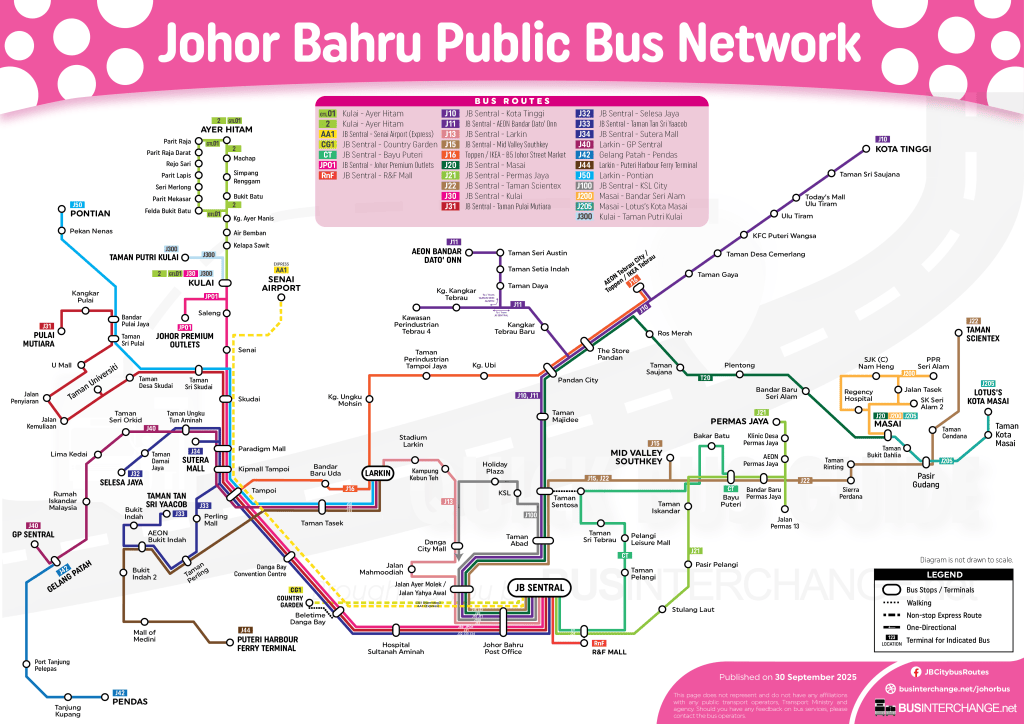
Come next March, a new route “J17” (as appeared in printed material at a press release in October) will ply the JB Sentral – Ulu Tiram leg of the current J10 route, with J10 being rerouted past the Tebrau Highway to stop at Larkin en-route to JB Sentral. Sounds oddly similar to the old T10 before the rebranding to Bas.My, but I digress. According to the same materials disseminated in October, both J10 and the new J17 will operate at 30-minute intervals. This seems like a downgrade to the current J10, but the key here is that both routes overlap significantly between Ulu Tiram and an unknown location (likely “Pandan City” marked on the map above, to connect to the feeder J101), producing a combined average frequency of 15 minutes. For the most well-used sector of the route here, this represents a service enhancement from existing levels, whilst reducing empty running miles in the far-flung sector to Kota Tinggi.
In a very twisted sense, the new J17 will effectively function as a “short-turn” variant of J10 along the Tebrau corridor, combining with it to produce more frequent service than current levels. I suspect this is a novel strategy JB is employing in its attempt to create corridors with usable frequency with a shoestring fleet size as well: to deliberately have two less frequent routes duplicate each other to create combined headways capable of rivaling bus services in Singapore. If executed well, this is an extremely powerful way of maximising limited bus resources
In a similar way, that’s how 873 and 873M function in Bukit Gombak, but there’s a big difference at work here: J17 terminates at Ulu Tiram.
This is similar to the proposed “flexible EWT” framework above, but a critical distinguishing factor with this set-up is the terminal point being able to reset issues with schedule adherence using the terminal layover, which may not be available if the short-trip is a looping service like 873M. Delays accumulated en-route to the turnaround point matters less for headway delivery under EWT, but is a headache for dispatchers to be able to more tightly control operations based on changing conditions on the ground. Bus terminals have more resources available in manpower, reserve fleet and other operations assets that can help bus operators better respond to contingency situations that affect bus service.
Take the J10 / J17 pair for example. Assuming the new J17 also belongs under Causeway Link, something they could do for this pair of routes is to implement variable departures, where dispatchers at Ulu Tiram are given some leeway to vary departure timings of J17 based on traffic conditions encountered by J10 en-route from Kota Tinggi. If the J10 is delayed, the decision can be made to hold the J17 at Ulu Tiram for a few more minutes to ensure reasonable headways for passengers waiting for bus J10 along the Tebrau corridor. On the other hand, if the J10 is observed to be ahead of schedule (as they always are when the roads are clear), the decision can be made to shift the J17 departure timings forward. Of course this is probably being a bit over-optimistic for the operational capabilities of Malaysian bus operators, but the Bas.My Johor system does indeed open up a whole host of operational possibilities to make the most use out of their limited network come 2027.
Bottom line
Whichever method is chosen to carry out short-turn arrangements on bus services, the ultimate goal is to ensure that both service patterns function as one contingent corridor, rather than two duplicating routes that do not sync with each other. Where trunk connectivity is concerned, buses are really just imperfect trains that need a bit more help in sustaining high standards of reliability and punctuality. Approaches that have been long been used on rail lines to make the most out of fleet or headway limitations should work similarly when applied to buses, with similar benefits in headway enhancement demonstrated where they’re needed the most, hopefully.
There might be a need for more routes to adopt similar short-turn practices in future if Singapore does not proactively expand its bus fleet, or do some form of bus rationalisation (please consult us first!) to free up buses for enhanced bus connectivity in an expanding catchment area. As a compromise solution, that also calls for us to rethink how we measure our bus service performance. However that is carried out, what’s utterly critical is a systematic integration of these short-turn services with their parent peers, for them to function together as one unified service entity as far as passengers are concerned.
For now, Singapore hasn’t yet shown that it can execute the short-turn approach to bus service resource management well. For our own sake, we have got to lock in.
As for legibility, which tackles the issue of how well Singaporeans understand the workings of these service patterns and how they are being presented, well that’s something for another time. That topic is particularly worth thinking about, given the savviness of Singaporeans around public transport lexicon in recent years…
Interested in building a better future for Singapore’s transport? Join the STC community on Discord today!
- A thing to note: Do not cancel trips on the parent when such route arrangements are in place! Removing one trip from the parent 873 creates a 1-hour gap in service, which is not acceptable by any means in Singapore! Unconfirmed reports of missing 873 full trips early into its introduction are not a good sign for service quality! If absolutely necessary, cancelling trips on the variant 873M is less destructive, as the worst possible headway is only 30 minutes, as opposed to 1 hour. ↩︎


Leave a Reply