

By wellonooby
When a bus service is withdrawn, commuters usually find out through a poster at their bus stop, an announcement online, or a news article. There is no warning nor an opportunity to prepare. No, instead it’s a huge, sudden bombshell. BOOM
And yet, once it drops, commuters are expected to simply accept it and move on. Because when the announcement comes out, what it basically says is: the decision has already been made. Now adjust. Adjust. Adjust.
And the explanation? Often its that all too familiar reason that “the MRT is available as an alternative.” Of course, there are other reasons behind these decisions, such as low ridership or changing travel patterns. And these are legitimate reasons to review a bus service. Yes, our bus network cannot keep every route forever, especially as the MRT network expands, new towns develop, demand shifts, etc, etc…
But there is a particularly important question we should be asking:
Why does LTA get the final say on whether OUR bus service should disappear?
Is this really the right way to go about it…?
I say NO!
This process does not give us, the public, who use these services every single day, a meaningful chance to evaluate whether a bus service we depend on should be taken away. Instead, we are left in the dust after the announcement, scrambling to gather whatever last chances we have to protest and beg for the service to stay.
Why are we left to protest after the decision has already been made? Why are we not given a voice before all this chaos? Instead of LTA deciding first and informing commuters afterwards, why aren’t we given the opportunity to understand the case, weigh the trade-offs and make an informed decision before a rationalisation is finalised?
Before I continue, I wish to aver I am not arguing that every bus service should be preserved forever. In fact, rationalisation is necessary (from editor: cf our earlier post on labels). As Singapore’s MRT network expands, new
towns develop, travel patterns change and so on, some bus services will inevitably become less important. When TEL3 opened, for example, LTA reported that some bus services running parallel to the new line saw ridership fall by around 30 to 40 per cent, for which they subsequently adjusted several services to reduce duplication (which as an added bonus help to reallocate finite bus resources elsewhere, such as improving frequencies on Service 980, as
they claim)
That logic is completely fair. If an MRT line can offer a faster alternative while the buses can be put to better use elsewhere, that is a legitimate case for rationalisation. But the problem is not that LTA rationalises bus services. The problem is that commuters are expected to react only after the decision has already been made.
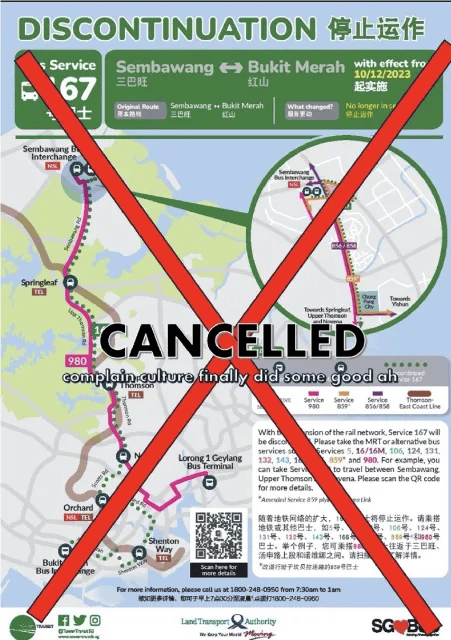
A notable recent example would be Service 167 and its planned withdrawal. LTA initially announced its withdrawal following the opening of TEL3, citing alternative connections such as Service 980 & TEL3. But it took a huge amount of public backlash, from residents of Upper Thomson & AMK West, for LTA to backtrack massively, eventually retaining Service 167 at a reduced 30-minute frequency. This, of course, gave affected commuters more time to adjust.
But we’ve seen how public feedback can alter a rationalisation so greatly even after the announcement. Why can’t commuters have a say before it?
LTA has the operational data: ridership, fleet requirements and a huge list of “alternatives”. But commuters have something even more important that numbers and data can never show: why the service matters to us commuters. A bus service is more than low ridership on the
surface, it could still serve other functions such as being a direct convenient connection for commuters who wish to avoid transfers, or who find the given alternative substantially less convenient. Besides, public engagement isn’t a new concept to LTA. the value of public input in broader transport planning is already recognised through its Land Transport Master Plan consultations. We have the power to shape our transport network’s future, but not what happens
in the now? Isn’t that ironic?
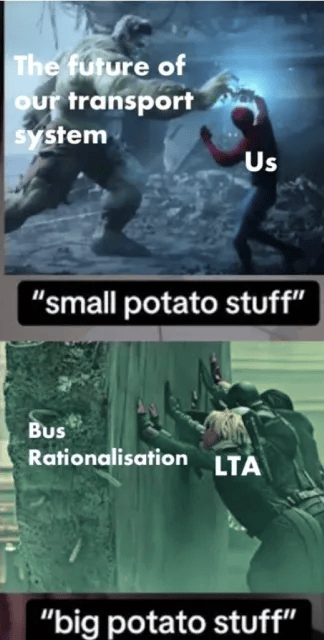
So instead of “We have decided to withdraw this service; here are your alternatives”
Why not “We are considering withdrawing this service. Here’s the data, here’s the alternatives, here’s what we could do with the resources, you decide the ultimatum.”
This is where my proposal begins.
Let’s imagine, as a completely made-up example, that LTA identifies Express Service 196e as a candidate for rationalisation under a fictional TEL4 Rationalisation. Instead of immediately announcing that 196e will be withdrawn, LTA could announce that the service is being reviewed for possible rationalisation. In this scenario, the targeted commuters affected (residents of Marine Parade/Terrace in this case) will be given a “survey” in which they have the power to decide the fate of Express 196e via a voting process (to be explained later). The public would then be given the information needed to make an informed decision: how many people
use 196e, when it is most heavily used, how many buses and resources are allocated to it, what alternative MRT and bus connections are available, how much longer those alternatives would take after accounting for walking, waiting and transfers, and, most importantly, what could be done with the resources released if 196e were withdrawn.
This last point is particularly important. Commuters should not simply be told that their bus has “low ridership”. They should be shown what the bus network could gain from withdrawing it. If the buses could instead increase the frequency of an overcrowded service, introduce a new service in a growing estate or improve connectivity somewhere else, the public must be shown
that trade-off clearly. LTA already makes such resource allocation decisions as part of its network planning. The difference now is that us commuters can now have the chance to participate in that decision.
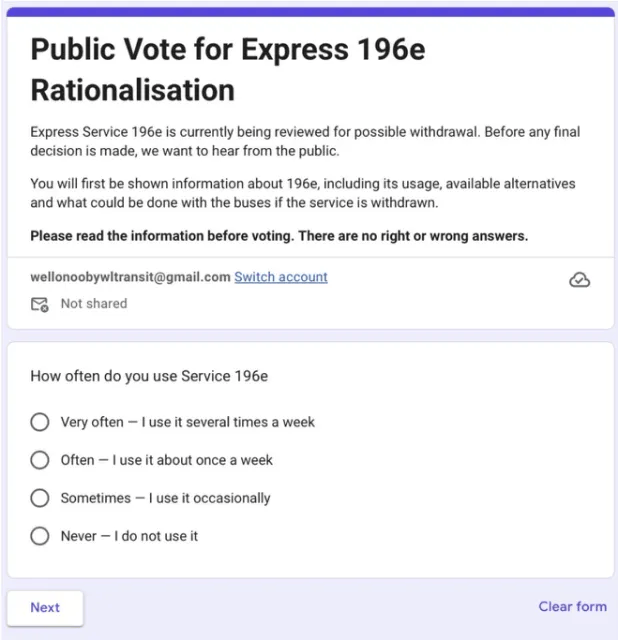
The voting process itself does not need to be complicated. The first question would simply be: “How often do you use Express 196e?” with the options of never, sometimes, often, or very often. This allows the results to distinguish between people who regularly depend on the service and people who do not. Everyone would still be allowed to vote, but they would be presented with the relevant information before making their decision based on their reliance on Express 196e, rather than group them all together and force them to make one fixed decision. Target audience matters.
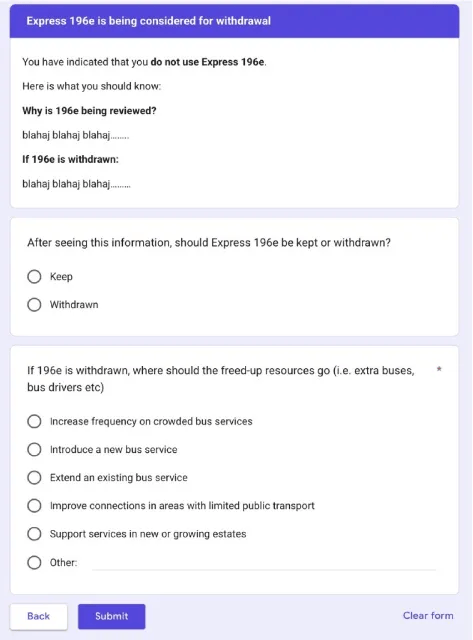
So, a commuter who does not use 196e is then told that the service is being considered for withdrawal (because of low ridership, TEL4 as alternative etc). With all the relevant data and information, hopefully simplified enough to be understandable, presented beforehand, they are asked: “After seeing this information, should Express 196e be kept or withdrawn?”. Because these people likely do not have such a strong connection to Express 196e, their decision is
much easier to make. Regardless of what option they choose (Yes or No), they would then be asked: where the freed-up resources should go if the service is withdrawn. The options could be more buses on crowded services, higher frequencies or new routes, or any others.
On the flip side, a commuter who actually does use 196e, whether frequently or not, would be given the same information, but with greater emphasis on what the withdrawal would mean for their journey. Now do note this extra bit of information is not to ram down their throat and force them into choosing the withdrawal option. This is simply to ensure that the commuter is fully aware of the practical implications of their decision and make a more informed choice. The commuter could be shown the available alternatives and how much additional walking, waiting, transferring, or traveling they would face if Express 196e is to be withdrawn. They would then be asked the same question: “After seeing this information, should Express 196e be kept or withdrawn?”
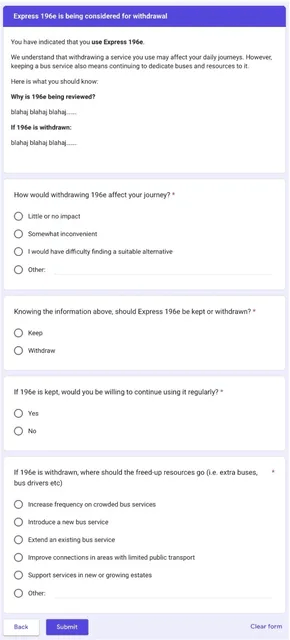
The important part is that this would not simply be a popularity contest asking people whether they “like” their bus. The public would be given the same basic evidence behind the rationalisation, understand the trade-offs, and asked whether they still believe Express 196e should remain. LTA would provide the technical information, while commuters provide their lived experience of using the service. The fate of their service lies in their hands.
However, there is the concern that commuters, simply knowing the personal value of the service, may not know what the service means for the wider network, would mean a public vote could prioritise personal attachment to a service over what is best for Singapore’s overall public transport system. It is a fair concern, but the pragmatism and scale of this proposed system make it manageable. Commuters would simply be voting on the service already identified for rationalisation, given all data, alternatives, and explanations. The only decision the public would make is deciding whether they accept the trade-off.
A 2- or 3-month consultation may seem lengthy to some, but a rationalisation affects commuters for years. Spending several months allowing the public to understand the proposal, consider the alternatives and vote is a relatively small investment compared with the potentially permanent impact of withdrawing a service without warning. This way, public participation directly complements professional transport planning.
There should also be some responsibility attached to voting to retain a service. If commuters vote overwhelmingly to keep Express 196e running, they should understand that actual patronage still matters. LTA could tell those who voted to retain it that their decision comes with a responsibility to continue supporting the service where practical. If commuters ask for a service to remain but its ridership subsequently falls even further, that should be taken into account in future reviews. Conversely, if the community actively supports the service and its ridership improves, that will provide a stronger case for keeping it.
This creates a much healthier relationship between LTA and commuters. LTA would not simply be telling the public what is best, while the public would not simply be demanding that every service be preserved. Both sides would recognise the same reality: that our bus resources are limited, and keeping one (dying) service means those resources cannot be used somewhere else more useful.
There should also be safeguards for situations where the result is extremely close. A 51–49 vote should not automatically determine the permanent fate of a bus service. If the result falls within a predetermined margin, perhaps 55–45, the service could instead enter a three-month trial period, during which LTA would continue monitoring actual ridership and publish the results. Public knowledge of data is core here: commuters should have the right to know whether their
bus service is performing well or not.
If people who voted to retain the service actually increase their usage, that would strengthen the case for keeping it. If patronage remains very low despite strong support in the poll, that would provide evidence for reconsideration. A second vote could then determine the final outcome, given the additional evidence and data.
Now, if the majority vote leans to withdrawal of the service, the decision is final. Giving the public a vote only makes sense if the result is genuinely respected. However, those who depended on the service (ie commuters who voted to keep Express 196e) should not simply be left behind. A reasonable transition period should be provided for them to better accustom to the major shift to alternative travel routes, with support such as journey-planning assistance and, where appropriate, targeted transport subsidies. The minority may have lost the vote, but that does not mean their concerns should be ignored.
Singapore already has extensive mechanisms for involving commuters in transport planning, such as LTA’s current Land Transport Master Plan refresh, involving thousands of members of the public and involving commuters in shaping Singapore’s transport future. The principle of public participation is already accepted here. The question is whether we are willing to extend that principle to a more immediate decision us commuters can face: whether the bus service they rely on will continue to exist.
There is a false dichotomy between expert planning and public opinion. We need both. LTA has access to operational data that ordinary commuters do not have. It knows how many people use a service, how many buses needed etc. But commuters know something that is arguable more important than any data: why they choose to ride that service, what makes it useful to them and what they actually experience when using the alternatives.
LTA should continue to identify services that warrant review and provide the evidence behind those reviews. But once a service has been shortlisted for rationalisation, the final decision should not simply be announced to the public. The public should be given the data, information, alternatives and trade-offs, then given a genuine opportunity to decide the final outcome.
Give commuters 2 or 3 months. Put the survey online, at bus stops, interchanges, MP Meet-The-People sessions, community events etc. Publish the results and relevant data publicly. If the vote is close, allow a trial period. If the majority votes to retain the service, give commuters the responsibility of supporting it. If the majority votes to withdraw it, provide those affected with
a fair transition.
Ultimately, this proposal emphasises trust. If LTA believes that a service should be rationalised, they should be able to make its case openly. If the public believe said service is still valuable, they should be able to make their case openly too.
For a smoother bus rationalisation, it should not simply happen like a shock to commuters. If we are expected to adapt to a changing bus network, then we should also be trusted, and given the chance to help decide what that network becomes. If the public is expected to live with the consequences of a changing bus network, then the public should be given a meaningful voice in deciding what that network becomes.
Interested in building a better future for Singapore’s transport? Join the STC community on Discord today!


Leave a Reply