

This post is made as a reading article for the YouTube video “Car-Sharing, an Introduction”. If you prefer watching over reading, do check out the video now live on YouTube
Introduction
Have you been in a rush, and transport faster than our molasses-speed public transport, while also being at your control?
Because the current COE climate makes car ownership an aspirational dream, I wager that when one needs a car, one would rent one. The high barriers of entry into car-ownership often means finance-wise, it is better to rent than to trap yourself into excessive 6-figure debts. This has caused an explosion within Singapore for car-sharing companies. A stark change where other markets find car-sharing to be a barely breaking-even, or even unprofitable endeavor. Just ask our neighbours up north. This of course, brings the question; What makes car-sharing so lucrative to people in Singapore?
Before we delve deeper, we need to ask ourselves:
What is Car-sharing?
Depending on your source, there are differing definitions of what qualifies as “car-sharing”. In general however, the common consensus I, and to more or less the whole Singapore, refers to it as a system of car rental permitting people to rent cars for short periods of time, usually by the hour often contactless from human personnel.
And within Mainland Singapore; we are fortunate to have multiple service providers for car-sharing where other countries have mere monopolies. The four horseless headmen of the car-sharing cabal are GetGo, Tribecar, Carlite and Flexar. There are a few special exceptions in this realm (Drivelah – the AirBnB for cars and: LoadUp – Van-Sharing) but that would be for another video. For the main car-sharing providers, each of them has their own unique selling points to rent with them, and drawbacks that make none of them perfect for all situations. A quick summary off their strengths and weaknesses are listed as such below:
| Company | Unique Selling Points | Disadvantages |
 GetGo GetGo | Largest Fleet size (3000+ Vehicles) No deposit Mileage system | Mileage system = Expensive For long rentals Most Expensive rentals |
 Tribecar Tribecar | Malaysian Entry 2nd largest fleet (1,300 cars) | High Deposit E-wallet system |
 Car Lite Car Lite | Cheapest 15-minute intervals Best weekday promotions | High Deposit E-wallet system Abysmal Car Selection Miniscule Fleet. |
 Flexar Flexar | Point A to B provider No deposit | Full Day rentals will drain you dry |
Benefits of Car-Sharing
Finally, you might be asking, how do I benefit from using car-sharing services compared to renting from a brick-and-mortar company?
Now picture this, you are part of the 66% of households that do not own a car, and you need to drive your movement-impaired relative to multiple destinations, maybe explore places which Public Transport can never reach. As a potential customer, which do you choose? To rent from established car-rental companies, or use a car-sharing application?
In my experience, there are three key factors that car-sharing does better than the brick and mortar rental model, location, duration and flexibility. What do each of them mean?
Let’s start with location, for instance, if you live in CCK Central, and need to rent a car, if you go for conventional rental:
| Conventional | Car-Sharing | |
| Location – Where is the vehicle collected and returned? | They often require car collection at a set company site: which can be far for customers; Industrial Parks, Airports. And if there is included delivery, it likely is driving up the base rental cost as a result. The nearest car rental company I could find is located in Bukit Batok [1], a 1/2 hour PT ride away! | Often located nearby residential locations, HDB Carparks, MRT Stations, even condo carparks (GetGo). Even though you won’t find delivery services, car collection is always a step up than conventional rental. In the case of CCK Central, it has cars in its HDB Multi-story Carparks Avaliable [1] |
| Duration – How are the durations charged? | Conventional Rental is often locked to daily slots; meaning you have to book them in blocks of 24 hours. Want to rent for a few hours? You will pay the daily rate! Booking for a day and a few hours (e.g. 26 hours)? That counts as a 2nd day of booking and you will be paying for 48 hours worth of use! | Booked by-the-hour, thereby saving you money from not booking unused time periods. Short booking durations gives flexibility for simple errands, such as a quick trip to purchase groceries, doctor appointments, and impromptu trips to haul heavy loads. |
| Flexibility – how accommodative the service is to your schedule | Collection/Return only during office hours. Which you have to plan your schedule around. You cannot return or pick up the car whenever you please. And be sure to return the car on time sans the additional charges. Quite the irony to cars “providing freedom”, and don’t forget you still need to take Public Transport back after returning! | 24/7 availability, offering unmatched spontaneous flexibility to pick-up/return the car as your discretion Able to pick up at odd hours You can also extend your booking in a pinch for unexpected incidents, be it an extra errand, or a traffic jam. |
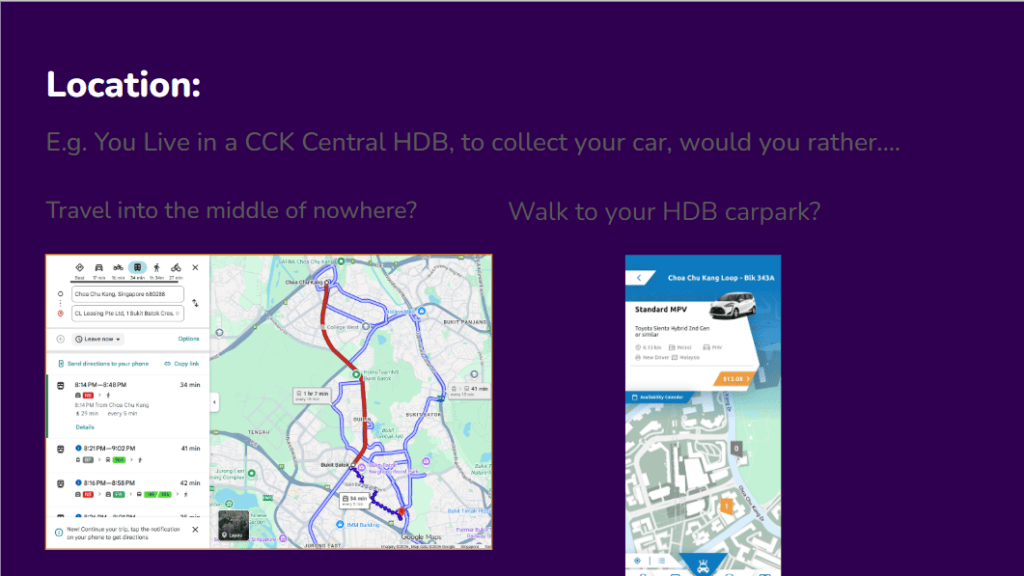
Overall, for one-day bookings or shorter, especially impromptu ones, car-sharing is essentially a silver bullet, that saves the user time, effort and offers exclusive perks you don’t enjoy with human limitations.
Thank you all for reading until the end, and I hope I had sparked a curiosity for you to try out car-sharing, do leave in the comments any specific topics of car sharing you want me to discuss. I will see you around!
Interested in building a better future for Singapore’s transport? Join the STC community on Discord today!
 Singapore Transport Collective
Leave a comment