

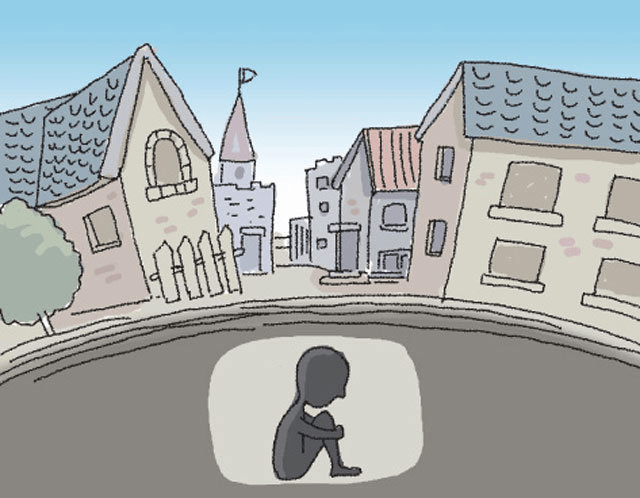
Cover pic: PG rendering of the tortured basement child that sustains the utopian Omelas
The 1973 book The Ones Who Walk Away from Omelas by Ursula K. Le Guin posits a utopian society whose inhabitants live with prosperity, equality, freedom and wisdom, and are shielded from the worldly horrors of pain, suffering and power. This desirable lifestyle comes with a price tag attached which many consider the defining moral dilemma of the story — the serendipity of the Omelas is built upon the extreme suffering inflicted on a child locked away in the basement. Freeing that child, the story describes, would also spell the end of the Omelas as known for their utopian setting.
That book was written primarily to illustrate the dangerous fantasy of utopian worlds both in fiction and the real world. What the book is not meant to be used for however, is being a manual to guide real-life policy targets. More often than not however, policy targets unknowingly become real-life manifestations of the Omelas, even if not to the same exaggerated scale depicted in the original novel. Lofty policy goals promising to improve the lives of many end up going unfelt for those who need it the most. Maybe it’s because the relevant agencies deemed certain segments of the population too much effort for meeting their KPIs, or for other reasons.
Upon closer inspection however, these situations reveal a common underlying factor: the absence of a negative control factor in designing policy goals. Typically in policy goal-setting, a baseline is established as the ideal in assessing achievement. More often than not, out of practical consideration, not the whole population can meet this defined baseline, and thus the policy goal often only targets a certain percentage of the population to be deemed as successful. This is the positive control factor, and is what promotional materials will always push to you, the prospective beneficiary of such policy. Where it falls short however, is the lack of a tolerable lower limit defined for those who are unable to meet the policy baseline.
Suppose we had a (nonsensical for purposes of demonstration) goal of reducing the ambient temperature of schools and workplaces to 25 °C and below, in the name of better productivity at temperatures below those of our tropical environment. For various reasons that you may feel free to think of*, let the success criteria be defined as just 60% of classrooms and offices installed with climate control that can reduce the temperature to 25 °C and below. When everything is done and dusted in line with this goal, the fortunate 60% (or more) will be guaranteed a comfortable room to work or study in. However, for those who fall outside this group, it’s anybody’s guess what kind of environment they could be working in. Even a poorly-ventilated room cooking its occupants at ambient temperatures above 40 °C would be considered mission success in the eyes of policymakers, so long as somewhere out there, 60% of rooms were 25 °C or cooler.
*you might realise that this is exactly the status quo today, particularly in lower tiers of education where most classrooms remain without air-conditioning
Travel time still matters
Edit: As I was slowly working on this post ST also published their own piece regarding the same issue of excessively long commuting times for fringe towns in Singapore too. Their post also comes with a boatload of insightful data, which I do recommend looking into.
By now there’s sufficient acknowledgement that Singapore public transport has a slowness problem, where it just takes too much time to get somewhere by public transport compared to driving. The typical classist response to complaints of public transport being too slow, if not the suggestion to rely extensively on ride-hailing or taxis, is almost undoubtedly the “just wake up earlier” trope, as if long commutes were the fault of the commuter in question for choosing to take public transport. It’s a common manipulation tactic to shift accountability away from the system to the individual — particularly when many factors that determine the speed of travel lie far beyond the hands of millions of public transport commuters daily.
But we’ve all experienced “waking up earlier” as students, where we were expected to report to school by around 7am. (To all who benefitted from afternoon sessions up to 2016: lucky you) For those of us without a car in the household, waking up before 6am was a staple of student life, especially in the secondary school and JC/Poly stages where schools were located further from homes. And as much as MOE denies the benefits of having schools start later in the morning, the toll of such an experience is a hefty one. As children, we could stomach it for 12 years without too great a consequence on personal health. Is this sustainable for an overworked adult over the course of a multi-decade career, however?
Nowhere is this more apparent than the fringe regions of the Singapore mainland, where residential housing is no less dense than inner fringe areas, but whose inhabitants are paying a silent price every day if they do not possess a car: the massive time tax dumped into the black hole of the public transport commute, valued at up to 4 hours or more each day.
45 minutes, for whom?
In the very early days of STC I briefly critiqued a policy goal espoused in LTMP 2040 that called, in particular for a “45-minute city”, for being overly centric on CBD-located jobs, ignoring the vast majority of workplaces and schools that lie outside this narrow margin. Some responded by stating the 45-minute goal included city fringe workplaces too. Looking back however, the real problem with it lies elsewhere — the success criterion set for public transport’s travel time goals.
Recall again the full statement of LTMP 2040’s “20/45” goal: for 90% of journeys on non-car transport modes to take no more than 45 minutes door to door.
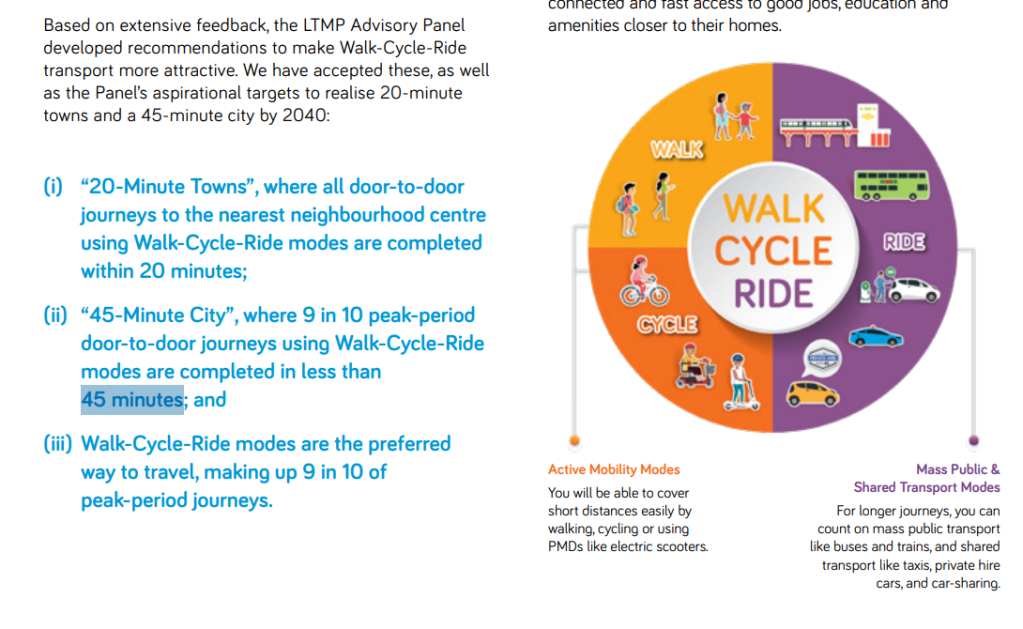
Putting aside the fact that travel times are usually advertised with less rigorous consideration for last-mile walking and wait time, the question anybody should be asking when faced with such proclamations should be: So how long will journeys be, for the remaining 10%? As you are about to see, LTA does not even have an answer to this question, and it’s an acute reality for many priced out of car ownership, living far from their schools and workplaces.
Edit 2: Isochronic mapping (which shows how far one can go in a certain amount of time) returns to Singapore with the launch of TravelTime.SG by Kulkarni Venugopal, a Computer Science undergrad at NUS. Hopefully this map is here to stay, unlike many previous mappers (also linked on the old STC site) that were very much short-lived. Better yet: this map offers journey times based on public transport, which makes it a very handy tool for illustrating this critical shortfall of our existing systems.
The state of the matter
The vast majority of non-downtown commutes fall short of meeting this 45-minute travel time goal, particularly for journeys that do not take place within the same town or region. That’s especially pronounced if your commute takes you from one end of Singapore to the other, and for the sake of argument we have chosen to take this group of commuters out of consideration. Even with the limited definition of peak journeys that start and end in the CBD area, where our largely radial public transport network is organised to favour, the 45-minute city remains a distant fantasy even after factoring upcoming plans into account. (There also remains the question of whether these projects can be feasibly delivered by the 2040 timeframe stipulated in the previous LTMP, which recent rail announcements seem to suggest otherwise)
Quick recap on what the 45-minute city goal entails, for the 90% of journeys that meet the criteria: to complete a full journey from point A to B within 45 minutes sharp, inclusive the first and last mile, itself inclusive of any walking required between different modes of transport taken. For most public transport commuters today, to achieve a 45-minute travel time on the vehicles themselves is a hard ask, let alone complete journeys within that travel time goal. The LTMP 2040 report itself pointed out that travel times on public transport alone have been on a steady rise as average commute distances increased. The figure for public transport trips (which exclude last-mile walking journeys) stood at about 51 minutes. With more BTOs being built further from the city, and even further from public transport since then, it only stands to reason that the average travel time by public transport has rebounded since then, despite its modest improvement from 2012.
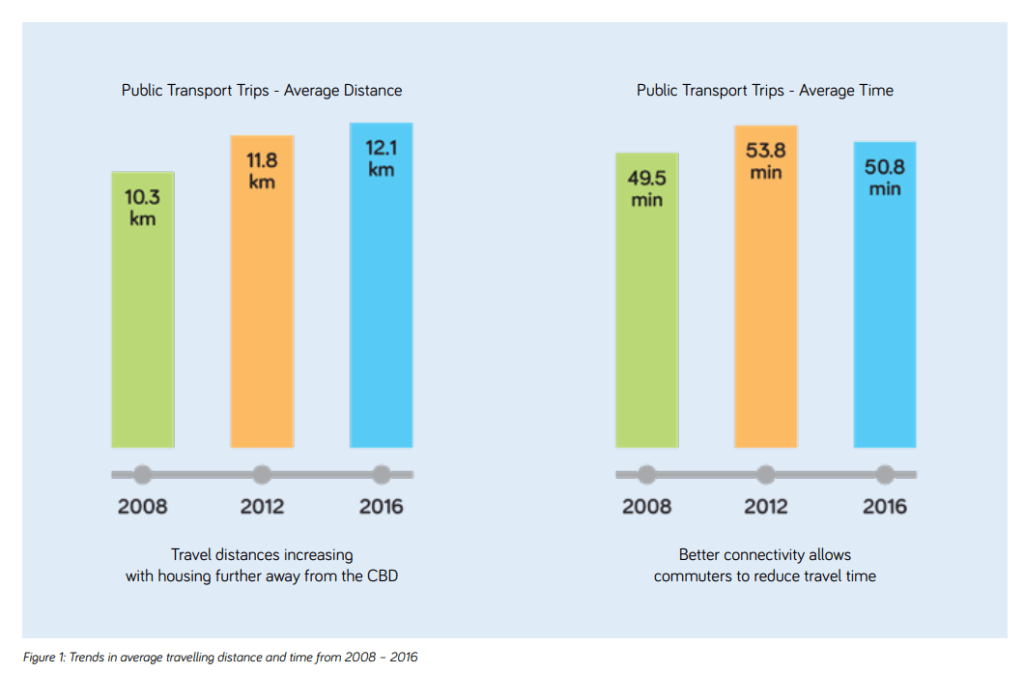
The visible lag in ensuring quality public transport connectivity for new housing estates in places like Tengah, Tampines North and Fernvale would have significantly increased the national average commute time on public transport, especially as these are areas where the bus journey to the MRT itself can take up to 30 minutes or more, let alone the long train journey to the city from a far-flung station.
Less well-known are already-established estates whose poor access by public transport hurts residents equally. Unlike upcoming estates too, little if any is planned to improve the travel time predicament in these estates too, especially since they’re located near the cardinal rail lines. Here’s a quick list of travel times from selected MRT stations to the CBD, around which the original MRT network was designed, at 7.30am on a Monday morning:
| Origin station (route) | Travel time to CBD (Destination stn.) (via Google Maps) |
| Pasir Ris (EWL) | 40 min (Raffles Place) |
| Pioneer (EWL) | 43 min (Raffles Place) |
| Bukit Gombak (NSL > EWL) | 44 min (Raffles Place) |
| Sembawang (NSL) | 44 min (Raffles Place) |
| Woodlands (TEL) | 45 min (Shenton Way) |
| Punggol (NEL > DTL) | 45 min (Downtown) |
| Yew Tee (NSL > EWL) | 52 min (Raffles Place) |
| Fernvale (SWLRT > NEL > NSL) | 52 min (Raffles Place) |
| Marsiling (NSL) | 54 min (Raffles Place) |
| Tengah (674) | 57 min (Tanjong Pagar) |
| Tampines North (299 > DTL) | 62 min (Downtown) |
Do note: All travel times listed here exclude walking and transfer times to and fro the MRT station, and between lines.
If LTA doesn’t move the goalpost to define travel time as only including time spent on public transport vehicles (which they most definitely need to do to remotely achieve their “90% of trips under 45 minutes” goal by 2040), that means vast swaths of the Singapore mainland not bounded by the Circle Line fail the 45-minute city goal, because time taken to travel to the heartland MRT station by foot or bus must also be factored into honest analysis of total travel time on “Walk-Cycle-Ride” transport modes too, and that eliminates residents living somewhat near MRT stations that otherwise clear the target on in-vehicle travel time alone.
Interestingly, the recent waves of City Directs introduced under the BCEP were never recommended as routes for any of these journeys (excepting Tengah with zero MRT connectivity nearby), and in the case of Yew Tee, a private ride-pooling option was recommended with a seven-minute advantage over the MRT! All of this does not paint a very good image of a public transport system that aims to give the vast majority of Singaporeans shorter commute times on Walk-Cycle-Ride modes in the next 15 years.
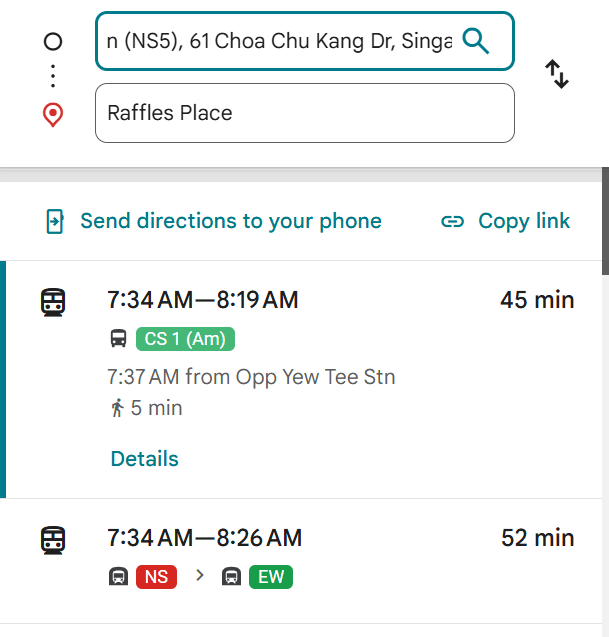
Reality check: that’s just for jobs in the CBD area only.
Not pulling decentralisation’s weight
Real people however, work and study all across Singapore. In some cases, that means far shorter travel times by finding work or education near one’s home, and that has been the Government’s intention behind various rounds of decentralisation efforts in master planning Singapore’s development. For many however, this is a compounding effect on already suboptimal commute times on public transport. Recall Acting Minister Jeffery Siow’s comments on travelling by public transport: that travel time can be up to two to three times longer than driving. What could be a 30-minute drive would last well up to an hour and a half or more with public transport, especially for journeys that the radial network was never well-suited for.
With AI being all the recent hype on the Government’s part lately, let’s take a look at public transport “accessibility” to the initiative’s main research hub. Located at 69 Ayer Rajah Crescent in one-north, the “Lorong AI” complex is flanked by NUS, Biopolis, both Science Parks and a whole host of other educational and corporate institutions. In summary, quite an important place to be.
How accessible is it by public transport to say, a resident of Simei? According to Google Maps, not very.
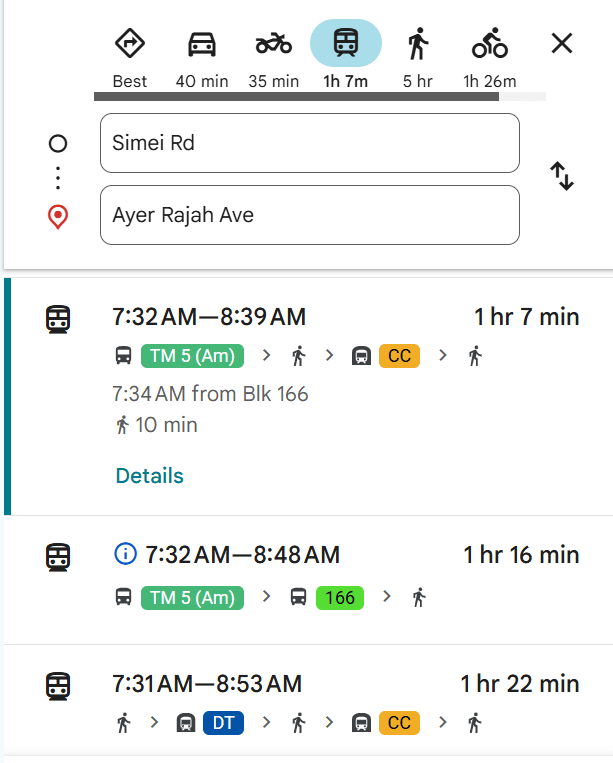
The list of “public transport” options is heavily mixed with routes involving the usage of a private vanpool service (that’s what the “TM 5 (AM)” thing is) to travel quickly from Simei to Alexandra. A route comprising entirely of standard public transport options appears as the third entry in the list, noted to be a full 15 minutes slower than the fastest available option listed. With a journey time veering dangerously near the 90-minute threshold for “supercommuters”, workers who don’t align with the desperation that corporations prey on to retain their workforce will severely rethink their employment choices. There’s already a precedent: Changi Business Park, located all the way out beside the Singapore Expo. Originally intended to attract international visitors, its failure there and the unwillingness of the local workforce to locate there mean the complex sits overwhelmingly vacated, with expansion phases entirely cancelled.
Tyranny of the majority?
Here’s the cruelty of these travel time-related policy goals: the 10% excluded from the 45-minute metric for success are almost entirely forgotten and neglected in policymaking. It simply does not matter to them how long your journey takes once you fall into the 10%; for it will no longer affect their performance metrics. Even if a resident in Pioneer spends 3 hours travelling to his workplace in Changi, the LTA policymaker couldn’t care less, because the 90% who can complete their journeys in under 45 minutes is what his performance is evaluated upon.
When the Simei resident complains that his journey on public transport takes twice that of the 45-minutes target, the cold-hearted “pwner” response is to take Grab. The LTA representative reading the complaint replies with a standard response about the 45-minute city goal encompassing 90% of all peak-hour journeys. Deep down, he knows that Simei has been consigned to the “10%” that will not enjoy the benefits of the 45-minute city set out in the LTMP. Not because it’s not possible, but because they’ve been incentivised to give up on them with the presence of a goal that is content with partial achievement. Nothing is said about how quickly the remaining 10% of peak hour journeys shall be completed, after all.
It breeds a certain type of policy laziness too — there is a positive incentive to disfavour considerations about speed in designing public transport, or turn down ideas that could shave additional minutes off peak-hour public transport journeys, all in the belief that its beneficiaries are likely a vocal minority belonging in the 10% for whom the 45-minute city goal excludes. The LTA doesn’t realise, that when 45 minutes is the goal, five minutes is a significant difference amounting to more than a tenth of the overall target travel time.
To be clear, I’m not trying to push for all peak-hour public transport journeys to be within the 45-minute goal set in LTMP 2040. Given the built geography of Singapore, that remains an extremely tall order that is out of reach for more than the next 15 years, and less needs to be said about the realism of flinging one from Tuas to Changi in 45 minutes by public transport. But rather than leaving those for whom 45 minutes may not be totally feasible with totally nothing, there should still remain some form of travel time guarantee for all as the lowest baseline.
Nothing less than 100%.
But if you cannot promise the sky for all, the least that can and should be done is to offer a baseline where everyone can look at that sky. Setting a majority-oriented goal, no matter how big that majority is, forever runs the risk of flat out neglecting the minority with no assured guarantee of service delivery. Poorly-articulated policy goals like these open up loopholes for many to fall through the cracks if not protected by a secondary goal with total coverage. Where the denominator is six million, even one percent represents 60,000 people left behind, enough to comfortably fill up a small HDB town. Ten percent of the 65% public transport mode share corresponds to a figure of 390,000, or nearly twice the population of Punggol today. That’s how many people LTA deems acceptable to let slip commute times far beyond the prescribed 45-minute target, with no other fallback policy target to benefit them.
In a climate like Singapore where public transport has a universal effect on the population, any serious policy and/or advocacy must take the 100% into account in designing a vision for travel time by public transport. Beyond just a political consideration, a vision built upon delivering quality access by public transport for every single journey is what makes public transport truly dependable in comparison to the car, or private ride-hailing. While it doesn’t have to be the tightest target set, setting a baseline for 100% of all riders provides that assurance that the journey won’t exceed a certain timeframe. To a large extent, it’s also a promise to commuters for improved journeys, and a compelling motive to make every single public transport journey count, not just those convenient to improve in the 20/45 travel time frameworks set out in the LTMP.
TM50’s Travel Time Commitment
In our Transport Manifesto 2050 (in works since last year), we reaffirmed the travel time goal as one of the manifesto’s three key commitments.
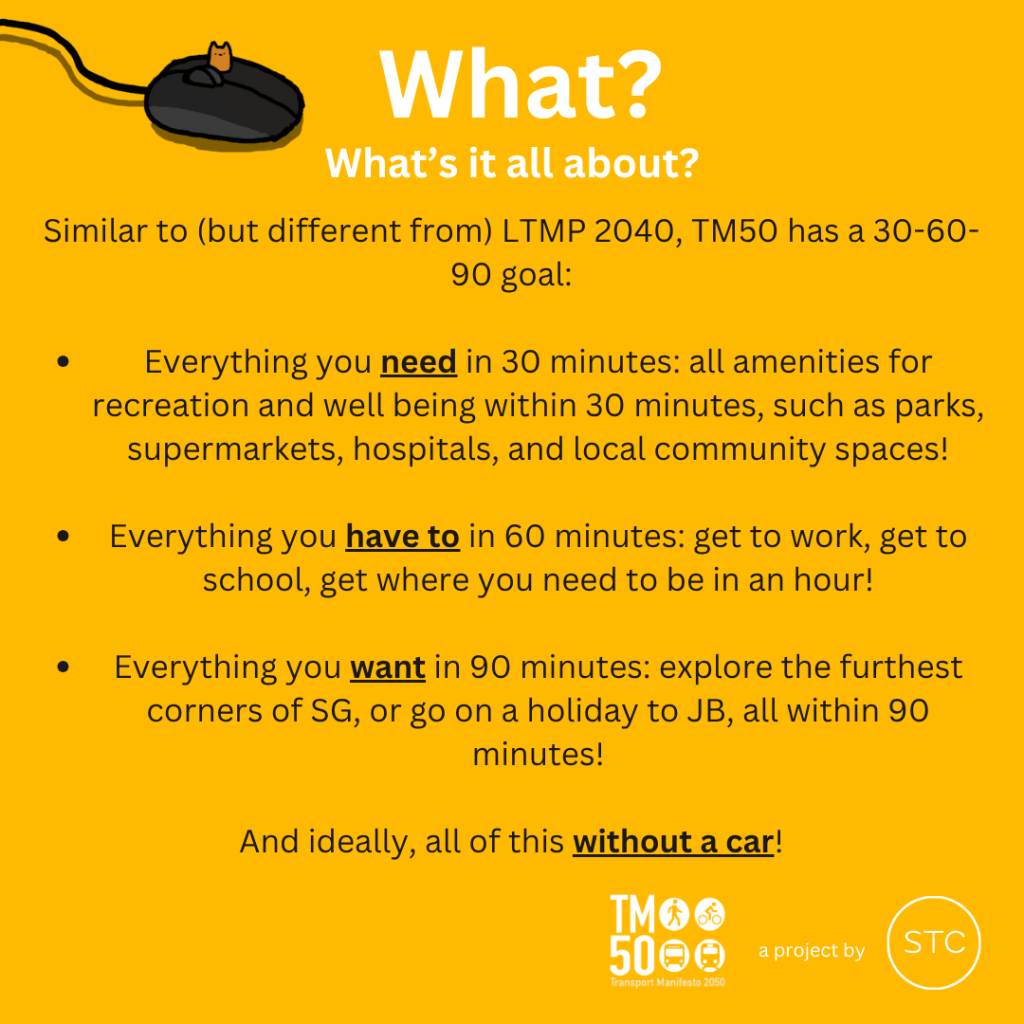
These numbers appear lax compared to the 20/45 standard applied in the LTMP, but with a catch: TM50’s 30-60-90 travel time framework is intended to be be applicable to 100% of all peak-hour public transport journeys by the year 2050, including and down to fringe case commuters. This would include as well, the hypothetical Simei resident farming money I mean engineering the next wave of Singaporean AI innovation, where solutions would be sought for his commute to also be brought down to the 60-minute range for peak-period work or school-based journeys. There’s nothing that cannot be done because of physics or geometry — man will move heaven and earth to overcome these limits, as they have demonstrated time and again.
Unlike the LTMP, TM50’s travel time commitment comprises three parts, comprising three concentric circles that make up our daily living:
- We aim for every Singaporean to be within 30 minutes of a complete set of amenities for his living and well-being.
- We aim for every Singaporean to have to travel no more than 60 minutes to get to work, or their place of education, or any other daily journey that would qualify for the definition of a regular commute.
- We aim for every Singaporean to reach every corner of Singapore and beyond for his leisurely getaway in 90 minutes or less.
- All with solely public transport, augmented with active mobility where possible.
Much of TM50’s proposals (which are releasing soon, so do stay tuned and follow the TM50 IG / our other STC social media pages!) hence focus on the question of delivering fast, reliable and high-quality public transport connectivity as soon as possible. When the baseline to meet for every single Singaporean is 60 minutes, every minute and every second counts towards fulfilling the dream of a Singapore that offers abundant access to opportunities for all, overcoming past limitations in transport and urban planning.
If you open up the mobile version of the isochronic mapper (TravelTime.SG) shared above, the app allows you to visualise up to a 150-minute isochrone from the selected location. And one will realise, that there are still certain origin-destination pairs entirely within Singapore that remain out of reach even with an allocated travel time of 2 hours, 30 minutes! Talk about making public transport a choice mode!
And we call on LTA to implement a similar baseline in their travel time frameworks as part of the LTMP review currently ongoing. Why is public transport mode share still the same 65% as it was ten or twenty years ago? You may not hear it worded this way from others, but fundamentally people fear becoming that proverbial 10% in the LTMP framework, left behind and neglected despite so much invested towards making public transport better. Transport policy shouldn’t be defined by the suffering of those whom said policy fails to adequately cover by design. By the wording of the original LTMP 2019, it’s not heading for 90% success in realising a 45-minute city. It’s heading for failure, without a maximum travel time guarantee applying to the 100%.
When that 10% is the size of two Punggols, anybody could belong there. Your close friend, a colleague, classmate or family member. Or, most terrifyingly, you.
Interested in building a better future for Singapore’s transport? Join the STC community on Discord today!


Leave a Reply