

Earlier this quarter the PTC released the findings from their various engagement methods conducted over the past year, including the 2025 Public Transport Customer Satisfaction Survey, “feedback from commuters” (probably complaint emails, if you read between the lines), and focus group dialogues held by PTC. Which btw, are independent and separate from the ones currently hosted by LTA for the LTMP refresh.
It’s certainly interesting to read about what were the primary concerns for public transport users (PTC by virtue of authority has access to a much larger treasure trove of survey / engagement data than an informal group like us can muster to collect), but what makes this particularly notable is also the way this feedback was interpreted in the final report by PTC on what needs to be done to further improve public transport, in conjunction with LTA and the various PTOs. Without spoiling it at this juncture, one really wonders if the goal is “improve public transport”, or “improve perceptions of public transport” based on the way PTC’s survey recommendations were worded in their report.
You can also read all about the summary, report and access the specific survey data through the PTC website, linked below. I’ve also saved the report and survey data on this site should it get taken down at some point in future.
Annex A (Detailed findings and recommendations into areas of concern on public transport)
Annex B (2025 PTCSS, P2PTCSS quantitative data)
A quick note, on numbers
Before moving into the real meat on the matter in the detailed findings report it’s worth looking at the brief survey data in Annex B too. Firstly, it’s worth mentioning that the 87% and 96% satisfaction rates attributed to public transport and ride-hailing modes respectively is taken based off a threshold of 6 and above, which is a very low bar despite appearing as a “neutral” boundary between satisfaction and dissatisfaction. (Five is the midpoint of 1 to 10, right? Not really.) This methodology fails to account for what’s known as the blue-seven phenomenon, where survey respondents overwhelmingly default towards seven on a scale of 1 to 10 if asked to pick at random, or are uninterested in the topic at hand. Even accounting for potential volunteer bias among the pool of respondents to the PTC survey, these satisfaction scores include the indifferent silent majority, and it’s reflected in the score breakdowns where rating of six or seven (shaded in light colour) is the predominant response, consistently taking up more than half of all responses.
A more stringent method to gauge real satisfaction (and weed out the indifferent responses who probably couldn’t be arsed to do the survey to begin with) would be to check the proportion of responses which rate the various metrics at eight or above, as these responses typically indicate the effort put in towards expressing genuine positive sentiment. These new numbers aren’t going to be the nicest for PTC to put out, but they would accurately reflect (in conjunction with the concentration of “1 to 5” responses) the AFIs for public transport, with sharp drops in responses eight and above indicating serious review needed.
It goes without saying that the aspects that generally don’t have many negative responses are those that we take for granted already in Singapore — particularly safety, around which we’ve built a steady international reputation. Where the good reviews drop off significantly are also key areas where improvement is urgently needed: in matters surrounding travel time and comfort. These also make up the three points PTC identified in its detailed findings report, however the recommendation put forward is quite… baffling, to say the least. Interestingly, waiting time for PHVs and availability of taxis also stood out as major negatives for ride-hailing too. A case of demand for Grab and taxis outstripping supply, with faltering public transport performance?
The single most eye-catching data point consistent across bus and rail is the overwhelmingly negative response on crowding levels, with crowding being the only indicator to score less than 20% satisfaction (besides taxi availability at 18%). The highest proportion of “strongly dissatisfied” responses were also found for crowding on trains, which matches the unavoidable reality that something must be done to decongest an overcrowded MRT system, today. And as soon as possible, to ready new rail lines to introduce long-overdue additional capacity in the rail network. This National Day, perhaps check out what our Transport Manifesto 2050 has to offer for rail expansion? Let’s aim for three new trunk MRT lines complete by 2035, and it can be done with the brains and resources devoted towards it.
Either way, more buses and trains are needed already, and kicking the can of network expansion down the road for long enough has brought us to the present situation. I don’t want to see a day where positive responses on crowding dip below 10%, while the angry responses rating it negatively surge past 50%. At the snail-like pace we do things however, I fear that’s exactly what the 2030 PTCSS results will look like. By LTA’s own timelines, it would still be a good 10 to 15 more years before another trunk rail line arrives…
Sharp-eyed readers may also notice that one major indicator was left out of the public transport survey (reflected in data for bus and rail). Where’s the public sentiment on fare-related issues, particularly when that is one of the few exclusive domains of the PTC? Surprisingly, matters relating to public transport fares were excluded from the survey altogether, and I suspect including that in the survey would have significantly tanked approval ratings, if the methodology for calculating overall satisfaction was the weighted combination of the various indicators on the chart shown.
Now let’s hear PTC’s conclusions on all that outreach and surveying done.
The world is changing…
The age of the average STC Team / community member is far below the average staff age in LTA, MOT or PTC. Yet they will strike our agreement when the statement in question is that the world is changing just oh-so-quickly, so much so even we start feeling old before we embark on our decades-long-careers into the future. Climate change is one of them, and while public transport has been part of the strategy to mitigate its impact on our tropical island, it’s hard to say that riding public transport today won’t shield you from its worst effects, particularly when compounded with long periods of exposure to the elements in open environments. Ambient temperature on trains and in stations was identified as a major concern for commuters, for example.
Now we definitely believe all public transport users are equally affected by a warmer climate regardless of the specific route or mode, unless one is privileged enough to have a fully enclosed and sheltered route (let us know if such routes exist!) The PTC report also cited factors such as time of day, passenger loading and personal preference to explain the survey responses. Working with LTA and rail operators to ensure air-conditioning on trains works as intended as far as possible is a positive start towards improving the quality of train rides, and might cushion the mental impact of being stuffed in an overcrowded underground metal can for an hour or so each day somewhat. But the question of addressing thermal comfort for non car-based modes definitely does not, and cannot end there.
While air-conditioning on buses was reported by commuters in a more positive light than on trains (because on buses, each seat is guaranteed its own aircon ball vent blowing freezing air at passengers throughout), the experience of waiting at bus stops and unenclosed MRT stations will continue to be a major downside of using public transport on our ever-warming sunny red dot.
Ten years ago, LTA trialled out button-activated fans at a few bus stops across the country, where pressing the button would activate the fan for a limited period of time. These were eventually withdrawn, with LTA citing limited effectiveness in improving thermal comfort and negative passenger response. A common line of reasoning also goes that if buses arrive frequently enough, the short wait of a few minutes should also be bearable, thus removing the need for these additional interventions.
But when bus frequency has been falling for years in a row due to ever-worsening manpower shortages, and with the weather becoming hotter than ever, it is time to rethink this notion and pay attention too, to the element of waiting for the nicely air-conditioned bus to show up. It doesn’t require an exercise of the mind to imagine what this feels like — try heading down to the nearest bus stop in the afternoon and wait ten minutes or so in the sweltering heat. Chances are, the short few minutes you enjoy in the air-conditioned bus aren’t enough to dry the sweat you’ve produced waiting for the bus.
There’s even been calls to air-condition bus stops in response to growing thermal discomfort during the static portions of public transport journeys too. If trains, buses, and even the underground linkways connecting them are able to control temperatures to somewhat acceptable ranges, why should passengers be left out to dry (or wet) while waiting for the bus or train? Since 2016, there’s been many different types of outdoor climate control methods that have been developed to reduce the ambient temperature of these outdoor environments, without necessarily splurging electricity or producing heat. We need to try again, to make our public transport compatible with the new environment we live in.
Hard or soft?
Describing types of solutions, of course. What were you thinking?
Fun fact: excepting the Thoughtful Bunch mascots, PTC runs most initiatives related to promoting gracious behaviour on public transport, such as the Caring Commuter Awards. It’s no surprise this aspect was highlighted in the report among the recommendations for areas of improvement, with various methods identified to address common inconsiderate behaviours on public transport.
Notably the report also included building appreciation among commuters for frontline public transport staff who keep the system running, especially bus captains driving our bus services every day. This is particularly heartening to note, amidst a backdrop of news involving the public verbally abusing bus captains for basically anything on the road where a bus is involved. Building that respect for bus captains and other staff that keep our public transport running is key to reversing the wicked problem of the manpower shortage currently faced in the industry. Subconsciously as a society, we don’t respect our blue-collar workers who do critical jobs enough, and value them for what they do, even if we claim to do so in rhetoric. Getting there is the greater half of the challenge, but it’s good to know the PTC is also acknowledging the need for the public to support the profession that is indispensable towards making our world-class public transport a reality.
The fundamental principle behind most guidelines on gracious commuter behaviour rests ultimately upon people with different needs sharing the same limited space on our buses and trains in a harmonious manner. Things like giving way to alighting passengers, giving up seats to more needy passengers like the elderly and pregnant, and on a macro policy level, to better accommodate the needs of various stakeholders like families, students, and the able-bodied majority. Encouraging pro-social behaviour on public transport users has been the default go-to for PTC and LTA to promote a kinder environment on board in the past, and it’s undeniable that the behavourial approach has raised Singaporeans’ awareness of the need to look out for one another in these shared spaces. But when space runs scarce, is behaviour alone enough to maintain a healthy balance between the many groups that share our public transport?
This brings to mind a recent debate that was opened over a trial by LTA that experimented with a “first come, first-served” basis of the wheelchair bay on buses, to enable parents with baby strollers to also utilise the wheelchair bay without having to fold them up before boarding. It’s a recent initiative to make public transport more welcoming for new families, who otherwise have to contend with lots of hassles just to use public transport like others do. And if you want to stretch it a bit further, perhaps it’s also LTA’s effort into raising the national TFR by opening up affordable public transport options to families with newborns too.
Needless to say, the community of mobility impaired individuals were not amused by the project at all, taking to social media to vent their frustration at potential loss of access to public buses if the trial proved successful.
A prominent disabled artist took to social media to rally against the experiment, calling for the old system of mandating strollers to be folded up to be reinstated on public buses:
The DPA published a formal letter of protest on social media last month to argue against the policy, advocating to safeguard the sanctity of wheelchair bays on buses for wheelchair users too:
There’s unconfirmed reports that newer buses with two wheelchair bays were also deliberately removed from the services involved in the trial, possibly to create more opportunities for these conflicts to occur to test the effectiveness of this new policy. It’s terrible implementation and optics when these experiments involve toying with the accessibility of public transport to certain segments of the population, by the way. Complaints from prominent individuals with disabilities and the organisations representing their needs should be enough to prove such too.
Both wheelchair users and families with baby strollers have equally valid needs on public transport, and there’s an argument to be made on both sides of the aisle as well. And this debate is going to intensify in the future, with more wheelchair users associated with an ageing population, and a growing need for new families to rely on public transport with access to cars increasingly curtailed. More wheelchairs and more strollers will be joining this proverbial battle for the wheelchair bay on board our buses, and soon even having two wheelchair bays on our buses may not avert us from these conflicts for limited space on public transport too.
Sadly, this is a no-win situation, unless the government chooses the path of giving the finger to either party, neither of which is a good look be it for TFR or inclusivity:
- Maintaining the previous status quo of giving wheelchairs priority over strollers would safeguard accessibility for PWDs, but at the cost of denying families the ability to use such spaces for their strollers. As it does indeed take time for strollers to be folded up and withdrawn to make way for a boarding wheelchair passenger, it makes it difficult to force families to be able to fold them up on cue, or risk incurring significant delays whenever a wheelchair user boards the bus. The latter will significantly detriment efforts to be more inclusive towards PWDs when the general impression of their presence on public transport is one of incurring significant delays when they board the bus.
- Going through with the shared priority scheme risks denying PWDs access to bus services due to the presence of families with strollers on board already. Despite buses in Singapore being generally frequent (massive question mark btw), they have the right to travel to their destination on time no less than other able-bodied passengers too.
Now I’m not saying soft solutions like encouraging gracious commuting and inculcating the notion of giving way to others are ineffective at improving the ride experience for everyone. Certainly like in the past, behavourial approaches have their merit in nudging commuters towards sparing a thought for others, when space is aplenty and sharing is but a mild personal inconvenience only. For situations like the shared priority bay trial mentioned above however, there’s no soft resolution that would not severely disadvantage one side, with greater social ramifications. To put it harshly, the conflict over wheelchair bays on buses is a thinly-veiled cover for the lack of total capacity provided by our bus services. When buses arrive only every 15 minutes, more people are packed onto each bus, reducing the space available for demographics that might need them more. Using double-decker buses, which already have very limited ground-floor space, further reduces available space that can be offered to them. Conflicts like these thus become inevitable.
In Chinese cities with extensive metro systems, bus services continue to operate very frequently in parallel to the rail lines, despite running mostly empty with smaller buses. I suspect the reasoning for such is to ensure people with disabilities or the elderly, who are more averse to the access penalty posed by underground metro stations, continue to have a more accessible option with greater comfort available to them at surface level. They run more frequently than they need to, in part to ensure that there’s enough seats and wheelchair bays to meet demand from the groups that rely disproportionately on them for urban mobility. We don’t have to follow this approach to the letter, but it’s extremely disingenuous for LTA and bus operators to claim that “there is insufficient demand” for bus services to be more frequent when the able-bodied are being endurance tested against the door, and when the disabled have to fight with parents for limited open spaces on buses.
The ancient Chinese thinker Guanzi once wrote “仓廪实,则知礼节;衣食足,则知荣辱” (The people know etiquette when the granaries are full; honour and shame are known when the people are fed and clothed) A gracious commuting culture, above all, is built in a space of abundance, when adequate service leaves sufficient room for different groups to reasonably co-exist with one another. Sometimes, the hard solution of throwing more buses and trains can improve commuter behaviour too! Remember what we said about there being a need for problem solving to take on a whole-of-system approach? Let’s not pit different commuter profiles against each other, as it’s well known that that just ends up devolving into mutual finger pointing, and a less inclusive atmosphere overall.
There’s also calls to rethink our fleet choices in buying new buses. Besides being better at delivering raw capacity, bendy buses also provide more space at street level to stow larger items such as wheelchairs, baby strollers, or even bicycles. With acute manpower shortages standing in the way of making buses more frequent, there’s also been calls for trams to be introduced in lieu of buses, although its implementation in cities worldwide has been a very mixed bag without strong transit priority safeguarding its operations.
The official PTC recommendation in promoting gracious commuting behaviour is currently to increase the outreach of their programmes to schools and other community institutions. It should also include a segment on enhancing the capacity of our public transport, a move that would benefit not just the wheelchair user or the new parent, but everyone on board who gets to breathe a little easier. And it helps with the other point in the report mentioning crowding too.
For progress, or the illusion of it?
The first pointer raised in the PTC report was waiting time for buses, alongside the relevant issue of crowding on buses and trains. I’ve left it for the last because PTC’s interpretation of commuter feedback also forms the basis of what should also be a National Day vision for Singapore overall too.
The situation of crowded public transport and the long waiting times for buses does not require further explanation for regular public transport users, who experience these drawbacks at some point during their regular daily trips. Logically, addressing these would require more buses and trains to run to meet increasing ridership demand for public transport, or figure out a way to increase their capacity to accommodate more people in the short term while we wait for new buses and MRT lines to appear over the horizon. PTC has also acknowledged the manpower deficit in the public bus industry as a significant hurdle towards achieving this vision. The report also highlighted recently-introduced measures targeting MRT crowding, such as the TSJ enhancements and new CDS routes launched last year intended to work with each other. As of mid-2026, these efforts are still struggling to meaningfully dent the ridership growth on our most crowded MRT lines, and the data is available in our (STC)’s report on CDS ridership figures, published two months ago. Some of them also falter due to inadequacies in route planning, as we’ve pointed out with regard to some of the more recently-introduced “limited stop” services under the BCEP. These are all problems that can be easily resolved, so long as there remains the intent and commitment towards strengthening the public transport network.
On the core issue of long waiting times for buses however, the PTC recommendation veers into the space of the absurd:
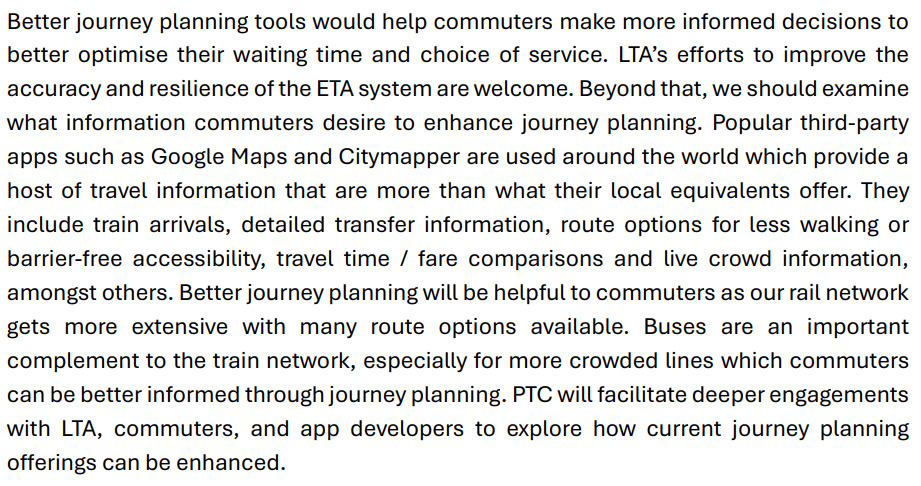
To be fair to PTC, they probably intended to highlight the point on enabling commuters to make more informed decisions through better provision of information through such apps. We’ve also called on LTA to review and enhance the reliability of bus arrival timings before, back when the entire bus ETA system was taken offline due to server cache buildup (which is a really low-level mistake for enterprise-level computing systems!), as well as bring back train ETAs, which were once available on rail operators’ webpages before they disappeared into LTA’s API. Do note: this is an entirely separate issue from the complaint of buses being infrequent and unreliable, which also surfaced as a grievance in the PTC survey and report.
But the PTC report makes the fundamental mistake of mis-associating the wrong solution with the wrong identified problem! Waiting too long for buses is a real problem. Enhancing journey planner software to help commuters make better travel decisions is also a commendable effort. Why is a better app being suggested as a solution for long waiting times for buses? There’s more to this than just an innocuous mistake by PTC confusing the wrong pair of problems and solutions. If one looks at transport policy recently, the appearance of improvement seems to be becoming a policy substitute for actual improvement in public transport. From “express feeders” that are barely faster than the parent to the deluge of City Direct services that while numerous don’t carry many, and now to the suggestion of using a better ETA app to replace actually running more buses to reduce waiting time, all of these are rooted in a belief that changing perceptions can change reality.
Building a better bus app helps passengers track when their buses are arriving and plan journeys can be a nice touch to help them shift pockets of time around to cut down on idling in sweltering bus stops for too long for a bus that comes later. But the infrequent bus is going to stay infrequent no matter how good the apps tracking them are, and when it gets infrequent enough one is forced to build their life around a bus schedule, rather than feeling empowered to travel anywhere they wish. Furthermore, you can’t tell a working adult or student to delay their start time to align their journey schedule with an infrequent bus service either. We wish that freedom exists, but it’s more realistically achieved with a public transport system that arrives often enough, and runs fast enough to get where we need to go on time. Explaining that manpower is a barrier to achieving this is one thing, and handwaving the problem away with “better trip planner apps” is an entirely different matter altogether.
Honestly, I was hoping that PTC would be discussing strategies such as autonomous vehicles and service revamps to circumvent existing manpower limitations and deliver frequent bus service. Or recommending to LTA various bus priority implementation strategies (proven abroad with decades of track record) to combat poor reliability on bus services, something that LTA has been relatively reluctant to roll out on a larger scale previously. Not to build “better trip planning apps”.
This segues somewhat into a broader commentary about Singapore itself, where perception-based thinking shapes the way we think about the country too. We call Singapore an advanced first-world city because of its skyline, and can proudly recall all the iconic landmarks that put us on the map to foreigners. For a small little red dot, Singapore records a GDP of more than S$750 billion and counting, as a testament to her economic prowess. Our institutions and systems win accolades around the world for being incorruptible and efficient. To many elsewhere, Singapore is the perfect city to live in and emulate for local municipal policy.
But it would be excessively nationalist to use Marina Bay Sands, Sentosa, Raffles Place and Jewel Changi Airport alone as the basis of assessing our progress as a country. Shiny to the eye they are, their true value to Singaporeans is measured by how the economic activity they generate eventually comes round to improving the lives of the six million living here. Thus far, a healthy balance has been struck in ensuring the proceeds from our economic growth go towards developing comprehensive social policies for the people, with how well they cover the needs of our communities left up for debate. Can this continue to be ensured in the future? That is what progress really means, and what gives meaning to Singapore’s stellar global image. And only in doing so can we look ourselves in the mirror receiving all that international praise.
Happy birthday, Singapore. This National Day, we celebrate how far we’ve come as a nation. (Just look at the photos comparing 1965 to 2026) We hope Singapore will continue to progress in the years and decades to come — real progress that benefit the millions of Singaporeans that call this place home. I don’t want Singapore to just look like she’s moving forward only, because that would be failing the millions of Singaporeans who’ve worked hard to drive the country to where it is today, striving for a better future.
Let’s hope the Singapore of 2087 will look significantly changed from the Singapore of 2026. More importantly however, we need to be living far better lives than we are today, or else the next 61 years would have been spent in vain.
Interested in building a better future for Singapore’s transport? Join the STC community on Discord today!


Leave a comment