

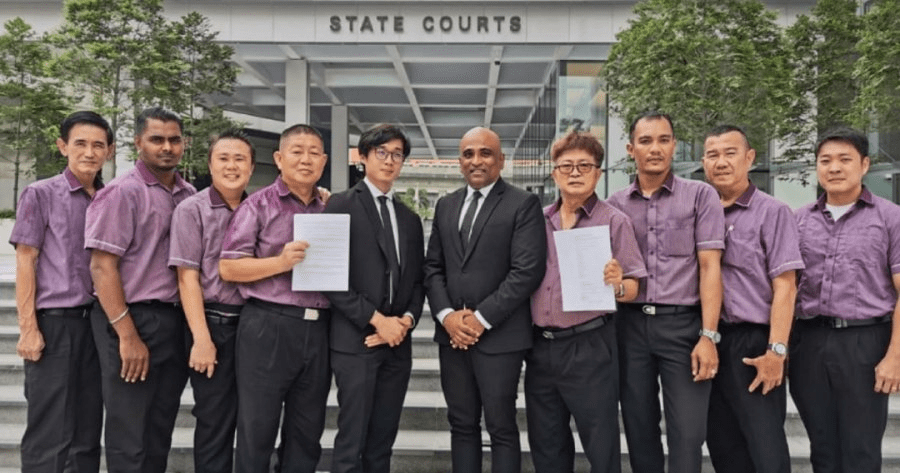
“In Japan, the CEO and board of directors will call a press conference and take a deep bow, and in the good old days, they may even commit hara-kiri“
Khaw Boon Wan (2015)
*Hara-kiri is the Japanese practice of committing ritual suicide to redeem a disgraced individual in death, typically of samurai
Post publication date backdated to commemorate the 107 tragic deaths at Amagasaki on April 25th, 2005.
A rather peculiar incident made national headlines in Japan recently, and more notable was rather the shifting attitudes in response to it, that would have been unexpected not that long ago. This is a country, whose extreme emphasis on the punctuality of its railways (due to their extreme complexity) makes it such that departing 20 seconds early triggers a public apology, and where train delays are measured in seconds with heavy penalties imposed on drivers responsible.
In this incident, a train conductor on the Tohoku Shinkansen, identified as a woman in her 20s, reportedly overslept in the staff lounge, resulting in her train departing three minutes late from Shin-Aomori station bound for Tokyo. She had been promptly replaced and relieved of her duties on the spot, according to the news report.
Now despite all the publicity going towards creating an image of flawlessly perfect punctuality on Japanese railways, delays do happen for a variety of reasons that are more often than not beyond the control of railway staff, and these do get reported on relatively often within domestic news too. The interesting part however, was the reactions to the reporting of this incident. Already in the first four months of 2026 alone, JR East (which runs the Tohoku Shinkansen and many regional/commuter rail lines in Tokyo and cities north of it) has reported a record number of major incidents and service outages, particularly on commuter rail lines in the Tokyo area that have been repeatedly hit by cascading disruptions lasting multiple hours. (Sounds familiar?) This year could well be to JR East what the turbulent years of 2011 and 2015 were to our SMRT running the ageing NSEWL back then.
With public anger at declining service standards on a sharp rise this year, you’d think another such headline would invite the same relentless criticism as many similar incidents barely weeks or months ago. It would be surprising to see that contrary to the expected cultural response to chastise the conductor for blemshing the Shinkansen’s punctuality record, the majority of Japanese netizens held an empathetic view of the situation, instead questioning the circumstances that resulted in a train delay caused by a conductor oversleeping.
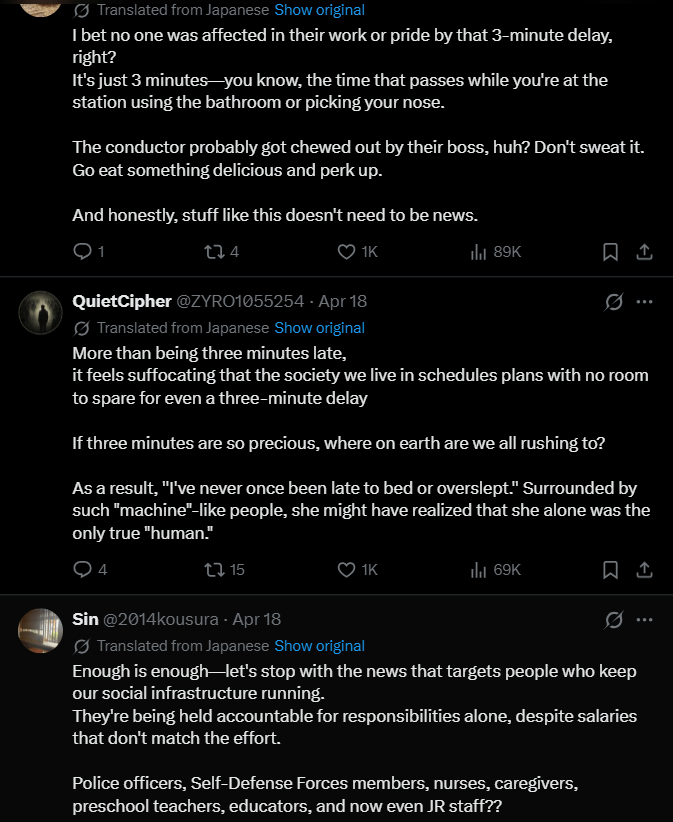
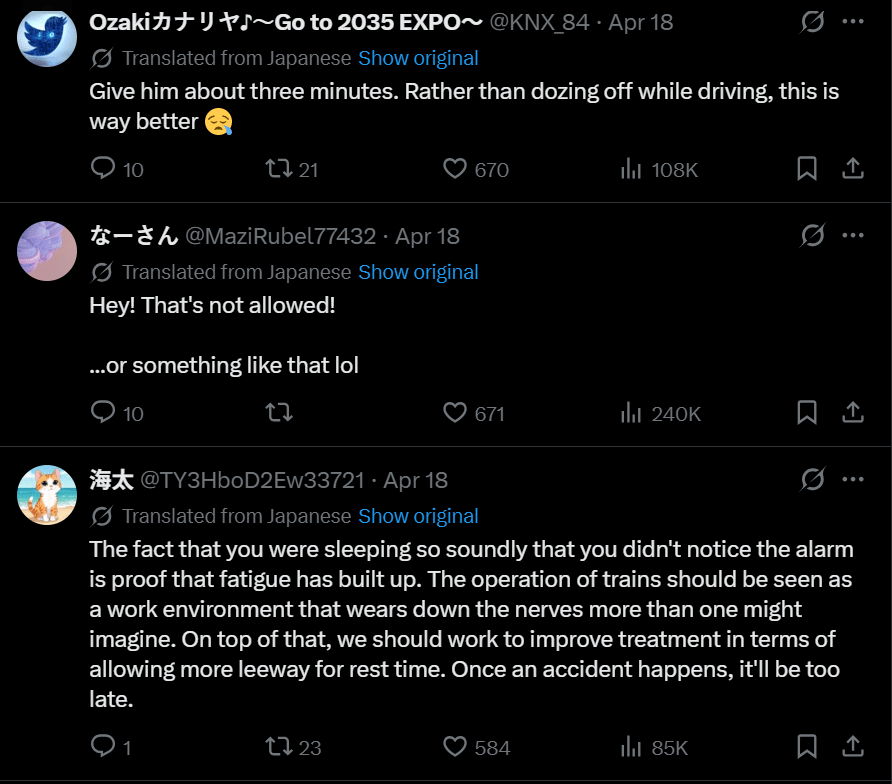
And one particular comment that harked back to a dark day in Japanese railway history:

For the longest time, Japanese railways operated on the skill and discipline of the many drivers and conductors operating on a complex set of interwoven timetables, and thrived upon pushing human operators to the limit to maintain adherence to schedules that choreographed train movements across massive networks. The recent onslaught of incidents is increasingly shattering such a mirage, and when even the Japanese start questioning their own practices, it’s time to reflect on what exactly constitutes accountability and responsibility.
At first glance, the incident of a Shinkansen conductor oversleeping on the job raises questions on the famously taxing Japanese work culture, and whether more can be done to enhance the welfare of critical frontline employees moving tens of millions of people daily. But digging deeper behind an under-rested, oversleeping employee reveals a deeper rabbit hole that undermines the very way we thinking about the keywords of accountability and responsibility.
Questioning traditional models
Historically, the expectation of quality workmanship and service was a responsiblity placed solely on the individual, who was expected to produce only the best solely out of the pride of his work. In earlier times before the advent of mechanised industry, the lower extent of technology meant that the self-discipline of singular humans were sufficient to ensure the safety of the community. When the most complex machines operated by humanity consisted of little more than handheld tools working on decentralised agriculture and small-scale handicraft, the individual wielded absolute power above the simple tools of the time. Likewise, there was little at stake if individual focus faltered in the pre-industrial era — aside from facing Mother Nature’s wrath, little else was able to cause untold amounts of death and injury in a short time. Such an environment bred the culture of skilled artisanal craftsmanship in Japan and Germany, which reflected a conception of responsibility bearing entirely on the individual. In the background of their feudal heyday, such an understanding of accountability made total perfect sense.
The mistake however, was attempting to continue enforcing it well into the modern era. Among the interesting oddities of Japan continuing to maintain habits of antiquity, this understanding of responsibility being carried into the 21st century is one of them, and as you’ll soon see, they learned things the hard way with a hefty price in human life paid. Or did they?
Exposed…
It was a typical Monday morning in April 2005… but not so residents in Hyogo, Japan. Shortly after 9am local time, all rail traffic on the Fukuchiyama Line would grind to a halt, due to the occurrence of the worst Japanese rail disaster in more than 50 years.
A rapid train on the line had derailed on a bend near Amagasaki station at nearly twice the posted speed limit for the section, sending seven train cars careening at high speed into a condominium basement carpark. 107 people, including the train driver, tragically lost their lives that morning.
Investigators calculated that a derailment was certain if a train passed over that bend above 106km/h. That fateful train, as was later discovered, had been travelling at 116km/h when it derailed. What prompted the driver to travel so far beyond the point of no return, at almost twice the posted speed limit of 70km/h? Digging along this axis led to a conclusion that would crush the godlike narrative of “Japanese efficiency” in the eyes of any sensible person.
What the Japanese railway system prided itself upon (razor-sharp precision punctuality) became the leading factor behind the tragedy, enabled by the shocking absence of systematic guardrails for a modern railway system operating at high speeds; any of which could have singlehandedly prevented the disaster had they been present.
Placed squarely in the spotlight was the JR West practice of nikkin kyoiku, a form of administrative punishment imposed on staff involving verbal abuse, pay cuts, degrading menial labour and writing of lengthy, unnecessary self-reflection reports. Just ten months before the accident, the driver had served thirteen days of what experts called “humiliation and psychological torture” for overrunning a station due to a lack of experience. (He had only been certified three months prior). In the traditional belief system of railway performance being solely the driver’s responsibility, nikkin kyoiku was a method employed to intimidate railway staff into compliance with increasingly complex and superhuman operational requirements. Balancing punctuality with safety was reserved for the driver alone with corporate systems adding to, rather than attempting to alleviate that burden.
25 minutes before the crash, the train had ran a red signal, causing the ATS to stop the train and inducing a delay; one that would continue to snowball until tragedy struck. With the important context of the highly stifling discipline system in place at JR West, it would explain passengers’ recounts of increasingly erratic driving behaviour from that point on. Four minutes before the crash, the driver had overrun the previous station by half the train length due to excess speed, further ballooning the delay to 80 seconds upon departure. Less than a minute before the crash, the train passed a local station at 120km/h in an attempt to catch up to a timed cross-platform transfer at Amagasaki station, but it would never make it there. The train passed the tight curve before Amagasaki station at 116km/h. There were no guard rails installed, or ATC to slow the train down.
These documentaries on YouTube and PBS sum up the horrific accident decently, with similar insight to the cascading system failures that lined up for the crash to happen:
While JR West acknowledges and commemorates the accident on their Japanese website, the practice of nikkin kyoiku continues to this day. In the immediate aftermath of the accident, Japanese courts also refused to rule the rail operator as guilty for causing the accident, and nobody in JR West management faced any consequences for the crash.
Far above the intense finger-pointing that ensued between prosecutors, JR West, relatives of victims and the media, the Amagasaki crash highlighted a sober reality in the industrial era: with increasingly complex, powerful and dangerous machines being operated in larger numbers and closer proximity to humans, the responsibility of delivering quality performance can simply no longer be fully tasked upon singular individuals, without the backing of a robust system behind them to enable high efficiency operations without compromising safety. In an era where big machines such as trains are capable of killing hundreds in split seconds, there is a limit to how much human operators can be expected to shoulder between the two great duties of safety and punctuality.
Back to the recent incident of the overslept Shinkansen conductor. Most Japanese netizens correctly identified the futility of conjuring a news article shaming an overworked train conductor for slipping up on the job, on the eve of the Amagasaki accident’s 21st anniversary no less. What was baffling however, was how few guardrails there were that permitted such a trivial incident to occur, let alone make national news. Granted, I’m not saying self-discipline isn’t important in the industry anymore in the new era, but in the context of a highly demanding physical and cognitive load being placed on people operating multi-ton machines carrying thousands of people in proximity to thousands more, systemic safeguards are an absolute necessity in ensuring quality performance, even more so than traditionally-touted virtues of self-discipline and respect for the profession.
Machines; complex and powerful systems constructed for the industrial age, exist as massive amplifications of human power designed to support civilisations of millions of people. It’s wishful thinking to believe that singular people alone can fully rein in the beasts of metal and concrete we’ve built with only their sheer willpower and discipline. The Amagasaki tragedy taught us, at the cost of 107 human lives, that machines must be governed by robust systems and frameworks, besides the vigilance of their direct human operators.
Why castigate the conductor for waking up late? Hundreds of Japanese netizens questioned the entire circumstance of the situation. For crying out loud, the incident occured at Shin-Aomori station — the posterior end of the Tohoku Shinkansen seeing barely three trains per hour during busy times. A three-minute delay is frankly, nothing. The bullet trains serving the line are the finest in Japan and will have no difficulty recouping the lost time. The real issue was why no failsafe protocols existed to ensure her prompt availability onsite, if she failed to turn up on her own accord. From check-ins by other stuff, to a “buddy system” and provisioning for schedule redundancy to ensure minor faults do not negatively impact train operations, it was an eye-opener to learn that the Japanese, despite putting so much emphasis on train punctuality, does none of the above at all.
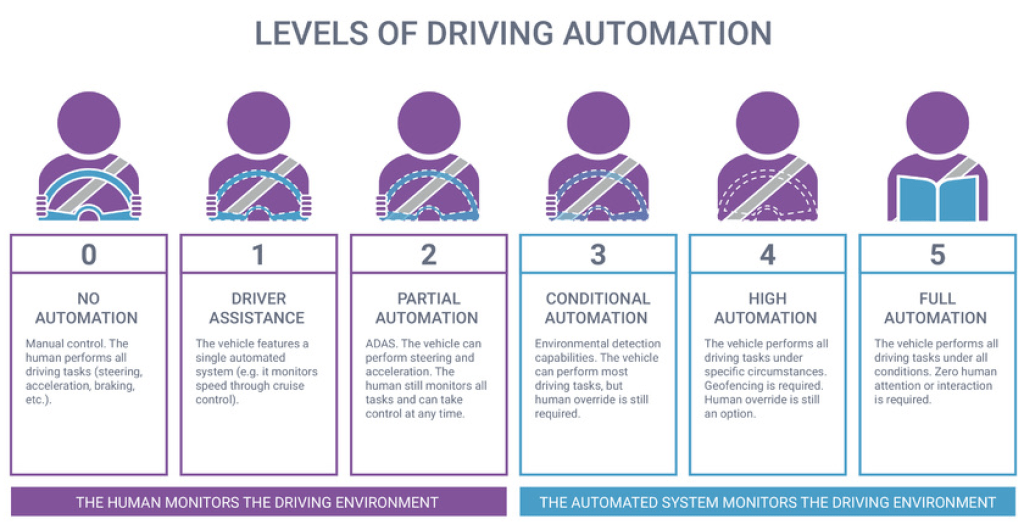
On an employee level, the absence of such systemic guardrails opens wide the possibility of (heavily manual-operated) train services being disrupted by nonpresent staff. The consequences of a glaring neglect of systemic protection on railway equipment itself are more concerning to think about. With a shortage of available manpower to keep direct watch of railway operations to prevent accidents, Japanese railway companies should have actively embraced automation long ago, the way Europe and Singapore did. Unfortunately, most railways continue to operate on Level 1 (sight-based driving with cab signalling only) automation, with anything beyond Level 2 completely unheard of across the Japanese peninsula. Heck, even China with much more abundant manpower has been making greater strides in implementing automation on mainline railways!
In case you were wondering, Singapore is fortunate to not follow such a toxic management model in ensuring service excellence on our MRT network. Rather than holding train captains to rigid schedules with little room for error, service quality on our rail network is primarily evaluated by train service delivery (TSD). Put simply, it’s expressed as a percentage of actual services miles travelled by all trains divided by the total scheduled mileage.
That is more lax than a strict punctuality metric as defined by the Japanese, but still gets to the essence of ensuring what matters gets delivered — running enough trains to meet demand (or try to, ahem) across the day. In terms of ensuring Singaporeans get the frequent train service they need, the current metrics based upon service miles delivery is adequate for the task, and can be further improved upon to address service gaps that some segments of the population continue to feel during their commutes. (Within the limits of current infrastructure; there’s an urgent need for an aggressive expansion of the rail network in the coming decades too)
The why matters
Count this a personal aside on my thoughts on Japanese railways in general. The country is renowned for expecting its trains to run perfectly on time, aligned on point with a series of time points etched on paper in ink. And as the Amagasaki tragedy has shown, rail operators (particularly the JR group) will go as far as the threat of psychological violence to ensure railway staff adhere to these timetables, pushing some to act irrationally, rashly and ultimately compromise railway safety.
But if we take a step back, what’s all this for? What’s the fundamental reason driving the Japanese obsession with punctuality? It all boils down to the same reason why LTA tracks TSD on our MRT lines: to ensure service delivery for the massive throngs of salarymen for whom the trains provide insufficient carrying capacity. In the Japanese consciousness where rail infrastructure is far too limited for the sprawling masses of high density that their urban regions are characterised by, it is customary to expect the same rail lines offering inner-urban rapid transit service to also carry the burden of long-distance regional and commuter traffic, sometimes all on a limited single pair of tracks. With the need for trains to overtake one another at stations and provision for delays from through-running, the sordid fact about Japanese railways is that the over-emphasis on punctuality is an attempt to compensate for operating headways so large that respectable rapid transit laughs it out of the room.
But even if they wanted to, the Japanese would struggle immensely to bring their railways to the same sub-120s headways that is considered the standard for frequent rapid transit around the world. When every train is still operated largely on eye power with minimal cab signalling, to run 150m long trains closely together at 100 km/h and above is a safety hazard as great, if not greater than putting employees at constant threat of psychological abuse. Pair that with the large schedule variance of manual operations and the precision needed for an overtaking manouevre where multiple tiers of stopping pattern are involved, and the reality is that the best that can be managed is three-minute headways in the Kanto and Keihanshin JR networks, or longer. It bears repeating too: for how crowded urban railways in Japan get, not a single metro system across the Japanese peninsula operates more than 12 trains per hour even during the peak, or a 5-minute headway between trains. Even our newest Thomson-East Coast Line does better than that, despite its comparatively weak ridership.
When not enough trains are being run, to obsess over how many seconds a human driver has deviated from the timetable is a fully pointless exercise befitting the petty Japanese corporate bureaucrat. At the end of the day, management and frontline staff are on the same side in fighting a battle for delivering safe and reliable train journeys day in, day out. The antiquated feudal model of responsibility espoused in the Japanese railway industry pits them against each other, leaving frontline operators to fend for themselves against high managerial expectation and the unruly multi-ton metal beasts they command.
Their self-touted world-leading punctuality, is enforced upon drivers for the sake of punctuality, rather than meaningfully delivering high service quantity, in a safe manner.
In the heyday of Japanese urban growth at the turn of the century, rail operators who profited immensely off building their own commuter markets had the perfect chance to make the transition to a smarter system that would really achieve the goal of running many more trains to meet ballooning ridership. Level 4 automation (which eliminates the human operator fully) was first introduced to heavy rail with the opening of our North-East Line in 2003. Japanese railway networks, for which their complexity suit machines better than human brains, would have been the perfect place to harness the potential of driverless technology to massively increase the carrying capacity of the notoriously overcrowded Japanese commuter railways. Calculating and controlling overtakes and through-runs down to the second would unlock much more track space, alleviating congestion more effectively AND attaining much better punctuality than they could with manual operations.
Within the physical limitations of track geometry however, a frequency-based approach might be more effective than the existing punctuality-based approach. Fewer overtaking movements enable limited track space to be used more efficiently, since more trains can be slotted in at minimum headway. Rather than needing to perfectly time a specific connection, simplified stop patterns enable each service to be operated more frequently, reducing the importance on timed transfers and absolute punctuality. Many variants of “rapid” trains in Japan save barely 10 minutes or less compared to their local peers, end to end — a travel time difference more than compensated by increasing frequency and reserving these express variants only for where they really make a significant impact on travel time.
Today, our NEL is capable of moving up to 50,000* passengers per direction per hour. The Chuo “Rapid” in Tokyo barely manages 36,000, despite running larger trains and serving bigger suburban towns. Alas, the Japanese only begin considering this technology when the impact of a shrinking workforce hits their ability to make lucrative profits off their overcrowded trains. JR East is setting its sights on automating the Yamanote line by 2035. Given the simplicity of its operations compared to other mainline railways and the meme-level overcrowding it exhibits, that should have been done in 2005 instead.
*Calculated with revised figure of 1,500 passengers per 6-car trainset, instead of the official figure of 1,920.
Chuo Line capacity calculated based off 1,564 passengers per 10-car E233-0 series trainset
Excelling with systems and ethic
In the Singapore context, the rail industry knows the importance of robust systems and procedures in delivering the required service quality. Older readers will remember that it wasn’t an easy-learnt lesson: the tears and grief of the rail network in the 2010s largely built the foundations of the MRT network as we know them today. Despite the many cracks showing in the system highlighting the need for an urgent capacity expansion, it’s been relatively peaceful otherwise, and let’s hope that learned proactive, preemptive action can spare the next generation from repeating the hardships of the last decade. For as long as the systems that were established in the wake of lapses in safety and reliability do not deteriorate*, our MRT system can remain relatively uneventful for decades to come, as the system’s creators had originally envisioned. *On the condition that increasing demand for public transport, particularly rail, is adequately matched by expansion of the rail network in a timely manner.
Where the outdated Japanese mentality of accountability finds greater relevance would be in our public bus industry, where the expectation to deliver quality bus service is not backed up by beefy infrastructure or policies aligned with these intended outcomes. With smaller vehicles and lower speed limits, the consequences are nowhere as fatal or destructive with our buses, but more acutely felt is just how far real-world bus service quality falls behind touted standards.
Ten years ago when the Bus Contracting Model launched, the LTA set in stone two KPIs for measuring bus service reliability — the schedule-based OTA and headway-based EWT, to regulate and evaluate bus service performance. It sought to address the many ills that plagued the experience of riding buses in the past: slow rides, long waiting times, inconsistent headways and unpredictable travel times in general. Today, these problems continue to persist across the bus network on a large scale, so much so that one wonders if the BCM-era BSRF has made any impact on bus service quality.
At a focus group discussion in 2022, I met a retiree who told me he would never consider the bus if there were a rail option available, even if it involved a longer journey and multiple transfers as opposed to a direct one-seat ride by bus. Despite the prospect of buses providing a faster and more direct journey, he said that he simply could not count on the bus to be predictable enough such that his journey time would remain constant, every time he made the trip. The predictability of rail meant that he could plan his day well; something that riding buses was unable to afford him. It’s been four years since these comments were made, yet if a poll were to be conducted today, I suspect similar sentiments would be widespread — many bus routes launched under the recent BCEP with the intent of providing an alternative to offload congested MRT lines remain under-utilised long after their introduction, even in situations where the new bus option is indeed time-competitive against taking the train.
A look into what exactly has been put towards ensuring bus reliability exposes the reason why service quality remains lackluster in this aspect.
Despite presenting the trappings of a system designed to support bus captains in delivering more reliable bus services, the BSRF ultimately fails to be a departure from the outdated model of responsibility (almost) entirely placed upon bus drivers who manage the expectation to space themselves equally apart and the challenging platter of road conditions across unforgiving routes. Blame shouldn’t even be heaped upon their service controllers, who also do what they can (and are also incentivised) to keep bus operations consistent despite the unpredictability of the road environments they work in. Incentivising frontline staff to maintain service consistency is great, until the flip side is considered. Just as bus captains and service controllers are rewarded for consistent, reliable service, they are similarly penalised (in terms of pay deductions) for failing to meet these service requirements. In some cases there’s a genuine case of errant driving to be made, but the vast majority of bus bunching occurrences are the result of factors beyond the bus captain’s control, such as traffic congestion, surge passenger loading, and even something as seemingly insignificant as shitty luck with a major traffic light. These are hardly things which are the bus captain’s fault, and yet existing frameworks treat it as such through its system of penalties. Rather than helping frontline staff deliver consistent, predictable service, what the BSRF actually rewards is a nasty combination of three outcomes that no sensible public transport agency wants to see: timetables bloated with wide margins of uncertainty, higher turnover rates from staff unfairly penalised for systemic failures, and an increasing tendency for reckless driving behaviour to catch up with lost time. (Does this ring a bell?)
21st century buses, 21st century thinking
The old school of thought governing bus service provision is counterproductive to long-expressed goals of ensuring buses arrive more frequently and regularly, and being able to deliver the same reliable service of rail on the bus network too. It’s 2026, and delivering high-quality bus service is an endeavour that cannot rest on purely human bodies alone. Factors beyond bus captains’ control that continue to regularly disrupt smooth bus operations are most effectively addressed through tackling the problems at their source, instead of blaming frontline staff for not trying hard enough. For a bus system that largely comes with little to no bus priority accorded at all, they have been steadfastly managing a task of disproportionate difficulty with little assistance available on hand, just as it was back in the 1980s before the advent of computerised fleet monitoring technology.
But if perfection is the standard we’re aiming for, why limit ourselves within the constraints of the last century? By this point, it should be recognised that issues surrounding travelling and waiting times on buses are not so much an issue anymore of individual competence, or mechanical prowess of our fleets. It’s an infrastructure problem, one where its underinvestment caps how far we can go in producing consistently efficient bus services. The Japanese without modern ATO and ATC find themselves unable to surpass the limit of roughly 20 trains per hour. Likewise, having barely any bus priority in Singapore is tantamount to leaving bus reliability purely to a game of chance, which remains severely damaging to any effort to decongest the rail network, or encourage bus ridership in areas that aren’t seeing rail lines anytime soon.
To bring up bus service quality to match world leading systems in Europe and East Asia, to simply impose employee KPIs without supporting them with adequate infrastructure to deliver on those expectations will land us far short of these ambitious goals in affirming the central role of public transport in our urban mobility mix. The embarrassing part for us is that the toolbox for infrastructure that enables these service reliability improvements isn’t new, and isn’t novel. For what it’s worth, many of the established concepts behind ensuring uninterrupted bus operations are actually older than LTA themselves (est. 1995), with these concepts even having been tried out at some point in our history too.
Singapore began introducing peak hour bus lanes in 1974, a concept still used to a limited extent today. In 2018, a “Smart Bus Priority” system, comprising a modified signal priority system adapted to narrow roads in Jurong East, was implemented for bus services 98 and 99. Even in its relatively-watered down form, LTG reports that affected buses spent 10.6% less time at red lights, and a 16.6% improvement in bus service reliability, before the trial was discontinued the following year. Going further back, many might remember the OG for signal priority — TIBS RapidBus 700 which offered competitive travel times to even the present-day TEL and DTL with the help of transponder technology to “rig” traffic signals in favour of buses. These are measurable enhancements that only scratch the surface of what could have been possible with the rest of the bus system, had they been implemented more widely earlier.
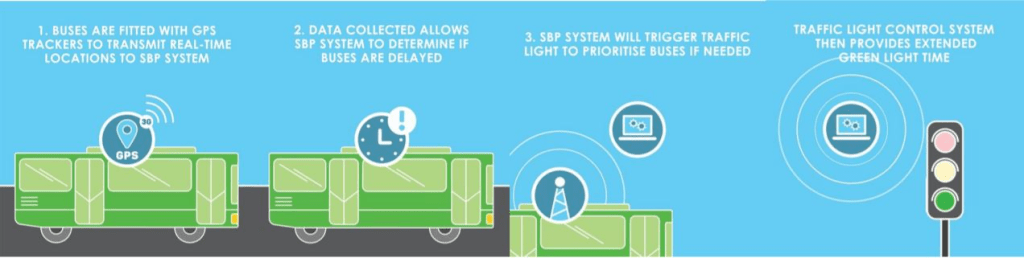
Hell, for everything I’ve said about the need to universalise all-door boarding as a means to speed up bus journeys, even that is now being implemented informally at selected bus stops and interchanges too, where boarding passenger counts are just too high for the traditional operating model to handle. It’s not like these concepts are entirely unheard of within Singapore; why then are they not being actively embraced to form a tough “exoskeleton” that enables bus captains and their control staffs to deliver the gold standard in bus reliability?
The practical and technical aspects of the question of massively expanding transit priority nationwide are explored in this article of mine from last year.
Compared to the question of how we approach the act of rolling out transit priority, the more fundamental question in need of tackling is whether we even see transit priority as necessary in the first place, and not just for the sake of itself. There’s a far more mundane motivator for seeing through the abundant provision of transit priority measures — a demand for bus service to reliable, consistent and predictable needs to be backed up by the infrastructure to substantiate such policy. To achieve the outcome of buses carrying the majority of human traffic on our roads in a dependable manner, the system itself must pull its weight alongside the efforts of bus drivers, service controllers, and timetable schedulers in delivering the best in bus service quality. And that means adopting the necessary infrastructure and policy changes to support, rather than counteract these desired outcomes in our transportation policy.
Are we saying the bus drivers don’t need to do anything to build towards service consistency? Not until they get replaced by driverless bus technology in the far future. Do the staffs working in service control need to continue exercising their due vigilance in coordinating operations along their respective networks? Yes. But their efforts would largely go to waste at the earliest onset of delays caused by unpredictable traffic conditions. There’s very little weaseling one’s way out of this problem without an infrastructure-based intervention that tackles most of these unpredictable events at their source, by isolating them from the scope of bus operations on busy streets.
Systems controlling machines
In a highly industrialised and mechanised society, the responsibility operating large contraptions is a shared task between the individual humans tasked formally with their roles, and the systems which govern them. It is the duty of the individual to exercise proficient competence in their task. But no less important, and that which should be no less overlooked, is the duty of the system to align policy such that enable individual frontline workers may discharge their duties effectively with less hindrance. That means not skimping on the necessary infrastructure needed to deliver target service objectives, implementing the correct policies to further lighten the immediate burden of frontline workers in our public transport, and building a supportive managerial environment that minimises workplace animosity. Be it the massive behemoths of Japanese mainline railways or the complexity of the Singapore bus network, adopting the systems-based approach to accountability is the necessary step forward to break out of historically insurmountable operational limitations.
We don’t lack the technology. We lack the understanding that we are able to deliver bus service as reliable as rail, and the importance of systemic approaches needed in building towards that outcome. Only the whole effort of a system can truly command machines efficiently across the scale of something as vast as our bus network, or complex as mainline railways elsewhere.
To that end, it’s reminiscent of the “Parable of the Choir” that unveils the secret behind impossibly long notes in performances. A good system is not one which punishes its human constituents for temporal human lapse at the expense of fundamental survival. A good system is one that can take over while a tired worker regains their composure, and an even better one is one that arrests the root causes of worker burnout in the first place.
A truly beautiful quote of redundancy in the heavy responsibility of moving millions of people nationwide.
A solemn reminder too, that individual responsibility no matter how virtuous, is no substitute for robust systems and frameworks of governance where the operation of heavy vehicles and machinery is concerned, in the industrial age and beyond. The new model of systemic accountability must be imbued thoroughly within our public transport operators, and the agencies regulating them shall facilitate these systemic transitions that clarify and redefine the spheres of accountability between the individual, collective, and system.
Let our systems never fail passengers of their expectation to deliver quality, reliable service. Let them never fail the employees who shoulder the heavy burden too, of moving millions every day to their destinations safely.
For the 107 tragic lives lost at Amagasaki in 2005 would have been in vain, otherwise.
Interested in building a better future for Singapore’s transport? Join the STC community on Discord today!


Leave a comment