

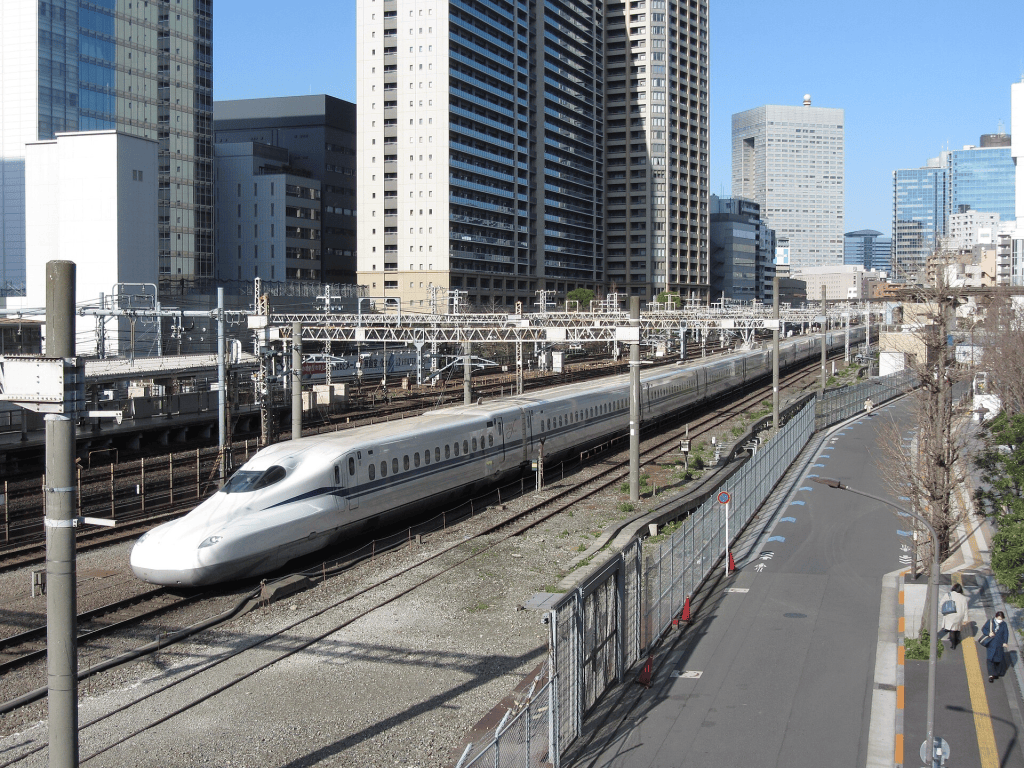
Cover pic: Train on the Tokaido Shinkansen passing a JR commuter rail station in Tokyo, Japan
Let’s play the devil’s advocate for a moment, shall we?
With significant recent discourse made about calling for faster public transport in Singapore, express modes have taken center stage as a key innovation that should be implemented in future visions of Singapore’s land transport plans. Over at TM50, we’ve also played our part by proposing the Singapore Integrated Railway, an express railway system designed for both (mainly) passenger and urban rail freight needs, serving both existing and future towns and regions, and pushing for faster bus service designs (these will be released nearer end-2026):
Express trains have been leading the discourse of ideas on speeding up public transport further, particularly with highlighting the contrast between the all-local MRT lines and road infrastructure already designed with express options in mind… for motorists.
As Singapore’s longest existing rail line stretching from east to west, the East-West Line (EWL) is naturally a target of complaints involving long travel times, particularly for journeys that cross the entire length of the line from one end of Singapore to the other. Logically, a good number of proposals for express trains in Singapore start from the EWL, with calls for express services on the EWL predating the initial launch of LTMP 2040 (2019). How long ago was that? That was a time when express services on the CRL were still being entertained as an idea worthy of study.
Generally, two possible avenues exist for introducing express rail service into an existing built-up urban region, particularly when railway infrastructure already exists. The first is to attempt retrofitting express services on existing infrastructure, which may sometimes involve the addition of new tracks or passing loops for express trains to overtake local trains stopped at minor stations, if they weren’t already built to support express services from the beginning. Running express services on existing lines is commonly practiced in Japan, and on the scale of an urban rapid transit system, the New York subway system too with a unique 3-track layout. The other method emerging recently is to build an entirely new dedicated express rapid transit line in parallel, but also connecting to existing metro lines to offer a high-speed travel option. Examples of this include Japan’s Tsukuba Express (built as an express parallel to the JR Joban Line), South Korea’s GTX, India’s RRTS and the numerous express metro lines recently opened in China I could spend the entire day listing out. There’s a reason why the latter approach is increasingly preferred in the modern day, and we will get to that shortly. All proposals involving modifications to the EWL to support express services fall into the former category.
Basic fact about railways: trains are confined to the path of the rails, and cannot freely manouvre around other trains in front without the help of additional infrastructure designed for the purpose of enabling such overtakes. On existing lines built without any provision for passing loops that enable these overtaking movements, it is extremely difficult to introduce express services without significant disruption and cost. A lot of these proposals involving shoehorning express services into the EWL struggle with feasibility for this exact reason, coupled with the demand of performing such high-risk modification work in immediate proximity to an active railway line.
This angle, while valid, misses the bigger problem with all the proposals calling for express service on the EWL: in their pursuit for express service on the EWL, they might end up hurting more people than they benefit! How is that so?
Singaporeans love to quote Japan as an exemplar for express train systems to be implemented here, but a deeper study of how they work surface larger issues. The question for us is to determine how much of these problems are worth importing to our shores, and to rethink common propositions for how express urban rail service could look like here. Let’s assume for a moment, that everything in the way of retrofitting the East-West Line for express service has been cleared and the conditions line up for its implementation. Here’s why EWL express service would still be a terrible idea, using two prominent case studies from Japan.
The Price of Japan
Japan is renowned for being a world leader in railways, but that does not translate to high frequency operations, with Europe or China frequently operating at headways that would shock Japanese industry professionals. Part of the blame lies with antiquated signalling and control infrastructure that puts too much emphasis on the driver in railway safety, but there’s another factor often overlooked when the weebs start going all out in their praise for the land of the rising sun: express services on Japan’s railways usually (not always, but most of the time!) come at the cost of high-frequency operations. In essence, most Japanese railways by design elect to sacrifice capacity for the speed of some. This sounds counterintuitive especially considering our previous Basics post mentioning that faster train services can translate to more frequent services, right? Let’s take a look at a few notable examples that illustrate this phenomenon.
The Tokyo Monorail is a two-tracked line connecting the JR Hamamatsucho station to Haneda Airport, and is widely considered an affordable time-saving alternative to the Keisei Skyliner and airport buses. It’s one of the first applications of monorail technology in heavy urban rail operations, and in terms of structure and operations, it barely differs from a standard metro line, save the additional passing loops at certain stations which can also be found in many metro systems in Japan. A full journey to Haneda Airport stopping at every station takes about 25 minutes, while the “Airport Rapid” service completes the journey in 18 minutes, saving about six or seven minutes per direction.
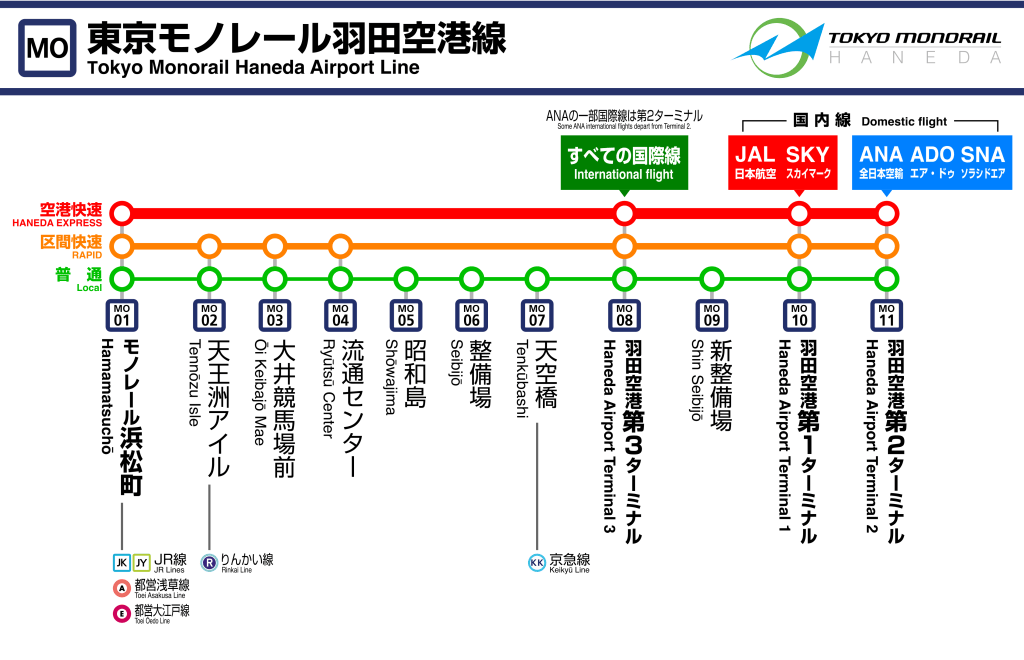
Red (“Haneda Express”) is referred here as the Airport Rapid
Orange (“Rapid”) is referred here as the Section Rapid
Noting the obvious travel time benefit for airport-to-city travellers (who still have to connect to other train services to get elsewhere within the Kanto urban area), it might come as strange to hear that the Tokyo Monorail suspends the express service altogether during peak hours. Here’s a sample timetable, with all departures during the morning and late-night peak periods operating on an all-local schedule, as compared to the alternating departure pattern during other times:
*A “Section Rapid” service typically refers to the typical rapid service with additional stops added for catchment purposes or to connect to other railway lines. See our previous article on the express-coverage tradeoff on this. There’s more to them, covered later in this article too.
Notice a few things:
- Overall train frequency for the Tokyo Monorail increases in the absence of the express service pattern during the peak hours
- When the express service is operating, local-only stations only see a train every 10 minutes, instead of every 4 when only local services operate during the peak.
- The “Section Rapid” is offered during the evening peak period (between 7pm and 8pm) as a substitute for “Airport Rapid” services to provide coverage for some local stations during the peak fringe period, while balancing with the need for faster airport connectivity.
The second point is particularly important, as it illustrates a critical point of express train operations on track infrastructure shared with local services: express services drastically reduce the frequency to stations not served by these express services. In other contexts the significant difference in primacy between express and local stations might excuse this, but would be difficult to justify in a landscape of roughly even residential density that characterises Singapore’s built environment. Debating which stations should be skipped or kept in attempts to introduce express service is just going back to the express-coverage dilemma, with all the political implications dragged into the picture. Should residents of local stations be made to put up with worse train service as a result of implementing express service? How much service degradation is tolerable, even if accepted?
For these reasons, the Tokyo Monorail elects to cancel express services during the peak hour, to ensure residents along the line remain adequately served when they need it the most. The “Section Rapids” in the evening serve as a compromise grounded in the same principle to maintain coverage for residents and businesses along local stations.
As an interesting aside, it’s interesting to note how this part of Tokyo appears to have a very strong third peak during the late night, with the late-night peak hour express cancellation carrying over to the weekends as well!
Electing the opposite choice is the world’s oldest and busiest high-speed rail line: the Tokaido Shinkansen between Tokyo and Shin-Osaka. It boasts the highest-frequency HSR operations (the Chinese transporting two billion people during the 3-week Chunyun period would beg to differ!) , managing to run trains as closely together as three minutes apart. With overwhelming ridership that’s still growing, and the pressure to run at maximum frequency to fetch record gains for JR Central, why is the Tokaido Shinkansen not running at the theoretical maximum of 20 trains per hour? As of 2026, the peak schedule allows for 17 trains per hour per direction.
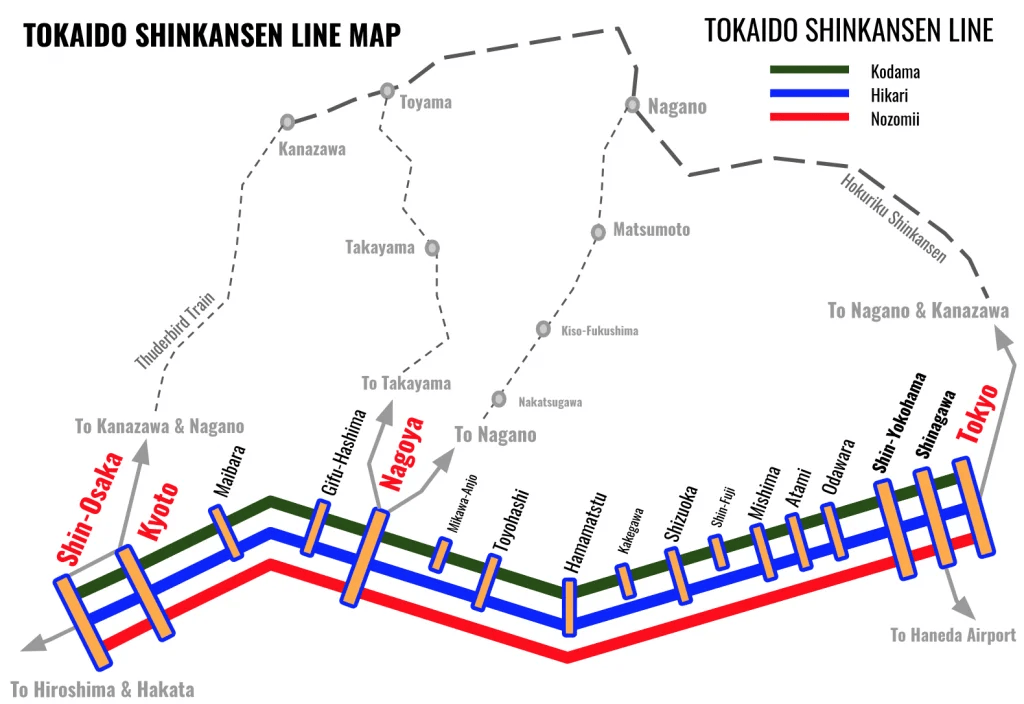
Three service patterns exist on the Tokaido Shinkansen: the express Nozomi intended strictly for direct travel between the Kanto and Keihanshin regions only, the slower Hikari services skipping the lowest-ridership stations, and the all-stops Kodama shuttle trains. With the Shinkansen holding the lion’s share of all journeys between Tokyo and Osaka, most of the line’s capacity is accordingly allocated to meet this demand. As of 2026, the peak-period timetable allocation stipulates a balance of 13 Nozomi departures per hour, together with two departures of Hikari and Kodama each slotted in between. To give you an idea of just how much the Nozomi dominates the Tokaido Shinkansen timetables, here’s a comparison of timetables at Tokyo and Odawara stations, the latter of which is skipped by the Nozomi service:
*I had to archive these timetables for reference because apparently JR East changes the links every month, but the point on the Nozomi express services squeezing out the local Hikari and Kodama services should stand regardless of timetable revisions, at least until the Chuo Shinkansen comes online from 2035.
The Tokaido Shinkansen advertises itself as the world’s most frequent high-speed railway service, with trains arriving at intervals of less than four minutes apart. That statement must be heavily caveated with the note that the vast majority of services are of the Nozomi type, and the full benefit of super-frequent HSR service is only really felt at the most important stations served by those. At other stations, the “17tph” Tokaido Shinkansen regresses to only 4tph (Hikari stations) of effective service, or even 2tph at stations only served by Kodama trains. That’s roughly a train every 30 minutes only, out of the numerous trains passing by!
Another interesting observation from perusing the timetables above: notice the shortest headways are achieved between two consecutive trains of the same service pattern. On segments of the timetable comprising entirely Nozomi departures, trains can be arranged as closely as every three minutes apart, whereas this gap widens significantly to accommodate overtaking movements when a Hikari or Kodama service appears in the sequence. This is why the Tokaido Shinkansen does not run 20 tph despite being technically capable of doing so. Applied to our own EWL, this means a significant headway nerf applied when express and local services are arranged in alternating sequence. Want to run more trains? Pick one service pattern to emphasise: more locals like the Tokyo Monorail, or more expresses like the Tokaido Shinkansen.
JR Central intends to raise the number of Nozomi services again from the March 2027 timetable revision, this time to add a 14th hourly run during peak hours. With how close together trains are already running, this revision forces the rail operator to mull potentially unpopular choices, such as having Hikari services skip Atami station1, or potentially even scrapping the Hikari service pattern altogether if further capacity additions to the Nozomi service must be made. Exceptional arrangements are also possibly being made, such as having a Kodama service be skipped by two or more Nozomi services at stations (instead of the previous maximum of one). That translates to longer dwell times on the local Kodama services, and much longer travelling times. It’s still faster than limited express conventional trains however, partly because JR Central cannot be arsed to run any decent parallel conventional services themselves to avoid competing with the Shinkansen, and also because they largely just gave up the zairaisen market to private railway operator Meitetsu. But anyway.
Focusing too much on the express services, as shown, comes at a tremendous cost to available track capacity for local trains serving the stations skipped by express trains.
Cosplaying as lifts
Some railways adopt the “Section Rapid” approach, which basically functions similar to how the City Direct buses are arranged as a whole in Singapore: the entire line is divided into sections, and multiple express service types serve each local section fully before heading straight for the terminus, usually the most important point of the line too. A more familiar analogy for some in Singapore would be express lifts used in some skyscrapers, where lifts are divided into groups serving a selected range of floors and skipping the rest. Most of JR East’s shinkansen lines adopt this method of operation, with the Tohoku Shinkansen being the clearest illustration of how a “section rapid” system works:
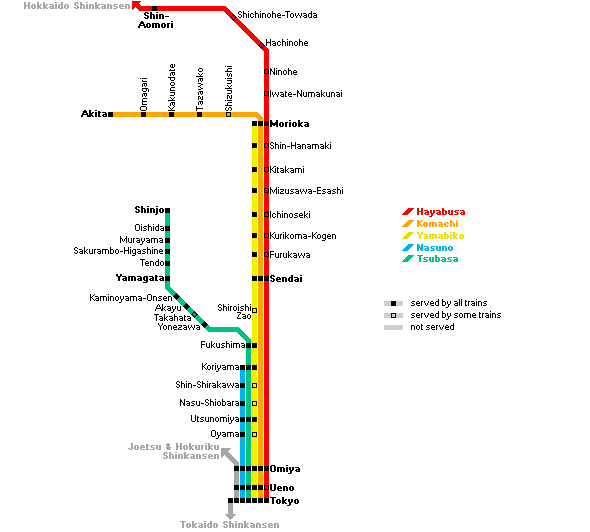
The stations nearest to Tokyo are served by the all-stations Nasuno commuter service, while local services for the segment between Fukushima and Morioka are covered by the Yamabiko semi-express, and the Hayabusa only offers local connectivity north of Morioka into Hokkaido.
Using this more extensively is the JR West Kansai area network2, which utilises a series of section rapid services along its multiple commuter lines in the Keihanshin urban area that reach farther suburban communities without penalising local catchment, within the confines of a largely two-tracked system. JRUrbaneNetwork does a wonderful(ly long-winded) post explaining how the Kansai system works in this post linked here, so feel free to peruse for the curious.
The section rapid system ensures that train frequency gets distributed roughly evenly across the line, but still fails to open the capacity bottleneck from having express and local services sharing the same track. Worse still, connectivity between different sections can be suspect, with mandatory transfers required to travel between sections. The section rapid system defines a central point of primacy along the line and assumes every commuter is only headed there. This structure does not fit systems and cities that aren’t planned in the highly monocentric manner as Japanese urban areas are. Limited outer fringe services like the Hayate on the Tohoku Shinkansen (Morioka – Shin-Hakodate-Hokuto local-stops service) are but imperfect attempts to paper over these connectivity gaps, on the same line.
The Kansai commuter network was planned in the context of a less-densely built up urban area with heavy competition from private railways (Hankyu, Meitetsu etc) providing alternative capacity, combined with the pressure to fit in local and various express services on the same two tracks that also carry long-haul limited-express and JR freight trains, all on meagre budget scraps left over after the Kanto area took the bulk of it. None of these conditions fit the Singapore MRT network, particularly where local trips are dispersed more evenly across long-haul lines like the EWL with the CBD being less of the center of gravity than it is in Japanese cities.
Branching, in disguise
Both the Tokyo Monorail and Tokaido Shinkansen examples above reflect an uncomfortable truth about introducing express services to existing lines — that express services are an implicit form of branching the line, except without ever physically splitting the line into two branches. Non-express stations are effectively imposed with a ceiling to the maximum level of service they can possibly get. Because track capacity is fixed given the same signalling, this is a geometric zero-sum game: a more frequent express service pattern means worse frequency for people living at local stations. When the Nozomi was launched in 1992, there were 8 Hikari and 3 Kodama services per hour. This shrank to 5 Hikari and 3 Kodama services in 1999, and two of each from 2007, remaining to the present day.3
Physical line branching comes with the option of running shuttle train services (think Guangzhou’s Line 3, home to the internationally infamous Tiyu Xilu hellscape meme) to make up for underutilised track capacity. “Virtual” branching cases, such as running express and local services on the same set of tracks, do not give the same respite to stations skipped by express services. Even with passing loops in place, express trains require more buffer to overtake local trains too, so overall train frequency falls even further.
Who are we leaving behind?
There is a deeper question behind the number crunching of adding more trains on the track however: who’s left behind, when the express train denies service to the local station?
So far, most proposals for EWL express trains out there go roughly along the lines of having the express trains call at the termini (Pasir Ris, Tuas Link or Joo Koon depending on year), then interchange stations (e.g. Tampines, Raffles Place, Buona Vista) and lastly major town centers (eg Bedok, Clementi) if they aren’t already interchange stations. In general, the immediate vicinity of the proposed express stations are already quite well-served by existing bus and rail options. Residents in these areas are also the most likely to fall in the 90% adequately covered by LTMP 2040’s 45-minute city vision. The 10% left behind with no safety net in transport planning policy are found outside these usual express station candidates: smaller offshoots of larger residential estates caught between town boundaries and especially neglected by bus planning. Express proposals for EWL typically pass them over in the belief that their smaller population makes them less deserving of express train service, but they are precisely the demographic who stand to see the greatest improvements to their commute from express transit options. To also include them in the express service pattern would mean too few stations skipped to make the benefit of implementing an express service worth it.
This irony in planning express trains in Singapore works against its feasibility from this angle, particularly in whole-of-population approaches towards abundant mobility goals. If executed improperly, the fiercest opponents to express train services here will also be those who need it the most — but live in areas that express train planning overlooks. But the approach of express services on the same infrastructure as existing local services runs this very real risk of pushing the neglected 10% past the point of no return. A Simei resident who spends 90 minutes commuting to work today might add even more minutes to his commute time because the express train skips Simei, and he has to wait longer for a local train that might even have to run slower to give way to express trains to pass!
Smarter people took a look at this approach and decided that the constraints of existing infrastructure was not worth the minimal savings in attempting to force-fit express services in them. Rather than forcing express and local commuters to fight for the same limited track space and burn some, it would simply be more intelligent to build an entirely separate set of tracks for express services faster than existing lines, with much wider stop spacings, and built for higher top speeds. Dedicated high-speed rapid transit lines in Asia represent a departure from the long-held philosophy of believing express variant services were sufficient to meet long-haul commuting demand, contributed by high population density overcrowding existing limited rail corridors.
Even in high-speed rail, the smarter solution to meet high traffic volumes is to build one more line. The Tokaido Shinkansen is expected to get relief from the maglev Chuo Shinkansen from 2035, which travels twice as fast as the current Nozomi services and stops at even fewer stations. In China, multiple HSR lines which began as 200-250km/h “express railways”4 or “passenger-dedicated lines” (PDLs) are now being supplemented by second-generation, true “high-speed lines” that operate in excess of 350km/h. This enables the first-generation HSR line to operate more local-stop intercity and suburban services, leaving long-haul HSR services to operate on newer, dedicated express routes. On a side note, this also reflects CR’s intent to emphasise the former’s development more, and this too is shown in the new train prefixes taking effect in December 2026.5
Thinking outside the box
The population growth of Singapore will not slow so soon. Demand for public transport specifically, measured in passenger-km, would rise further, as decentralisation plans by URA take shape, and workplaces are increasingly scattered nationwide. Express rail service must not come at the cost of passenger capacity on our rail lines, regardless of any comparative advantage against the local service it outruns. With this important context, the conclusion for the direction of developing express rail options in Singapore is clear: There is only one correct path to take, and that is the formation of dedicated express lines purpose-designed and built for high-speed, cross-country travel. The purposefully-named Cross Island Line is a good first step, but even that gets held back by limitations in planning goals, and existing technical doctrine.
All in all, it’s not pretty if the EWL gets an express service shoehorned in, even assuming the feasibility of doing so. Look out for the future post on this, because this one is getting a bit too long.
It’s tempting to look at Japan, praise their urban express trains, and call for that to be implemented in Singapore. But in the zeal that comes with glazing Nihon, be reminded to look at the Tokaido Shinkansen, or Tokyo Monorail, and ask if that’s what you really want to see in Singapore.
Do you really want to see express services curtailed when they’re needed by most, or worsened train services for those not beside express stations?
Interested in building a better future for Singapore’s transport? Join the STC community on Discord today!
- Atami station is infamously known for being the bottleneck on the Tokaido Shinkansen, due to it not having any passing tracks and being located on a curve that limits train speeds to 200km/h. This was the speed of the line when it first opened in 1964! ↩︎
- Kinki Area Urban Map — JR West https://www.westjr.co.jp/global/en/timetable/pdf/ubn_en.pdf ↩︎
- Bullet at 60 — Trains to Beyond https://trainstobeyond.com/tokaido-shinkansen-timetable/ ↩︎
- Is China’s HSR Overbuilt? — JR Urbane Network https://jrurbanenetwork.substack.com/p/is-chinas-high-speed-railway-system. <– Author’s note: good read for clarifying why new lines are now preferable when faster service is demanded ↩︎
- 国铁新编号是什么?2026版车次编排规则变化与查询指南 — Baidu https://kuku.baidu.com/app#/workbench/new-task?md5=cb1fd665b2d814ad07403109e95b74ea ↩︎


Leave a Reply