

Cannot board your bus? Well, if it isn’t already running a majority double-decker (or bendy bus) fleet, it’s ineligible for service enhancements in LTA’s eyes, no matter how many emails you attempt to flood them with. Here’s why.
Feel free to substitute “double-decker” for “bendy” if your service is eligible for it. The underlying logic behind faulty bus planning justifications remains the same anyway, since this is all a numbers game, just like with farebox recovery.
About a week or so ago, Sengkang GRC MP Jamus Lim queried the Transport Minister on the utilisation of City Direct bus services in his constituency, and asked for the possibility of adding additional trips to those services serving his area. Slightly important bit of context: his specific ward is Anchorvale, located in midwestern part of Sengkang town. Not so far-flung as Fernvale, but far enough from the NEL for CDS services to become a considerable alternative to being a daily sardine underground.
If you’ve checked our peak express ridership report from earlier this year, you’ll realise that Sengkang and the wider northeast region in general face a severe shortage of rail capacity, and hence the push for many such peak-period express bus services to be introduced. As also mentioned in the follow-up post, these ridership hotspots of CDS services also reflect where future rail lines are urgently needed… today. These CDS services in the northeast, originally introduced to offer a comfort-oriented experience with the better chance of getting a seat into the city, now face the ironic situation of being no less crush-loaded than their regular public bus counterparts, or even the MRT, with them now being favourably seen as a potential alternative to taking the train. (Of course, as LTA will also tell you, credit must go to the enhanced TSJ, which offers monetary incentives for NEL commuters to switch to taking CDS buses, although its effectiveness is suspect for newer routes)
With this in mind, it can be puzzling to open the MOT website and read the official written response to the MP’s question:
If for some reason MOT chooses to delete this from their website, the statistics in question have been reproduced below:
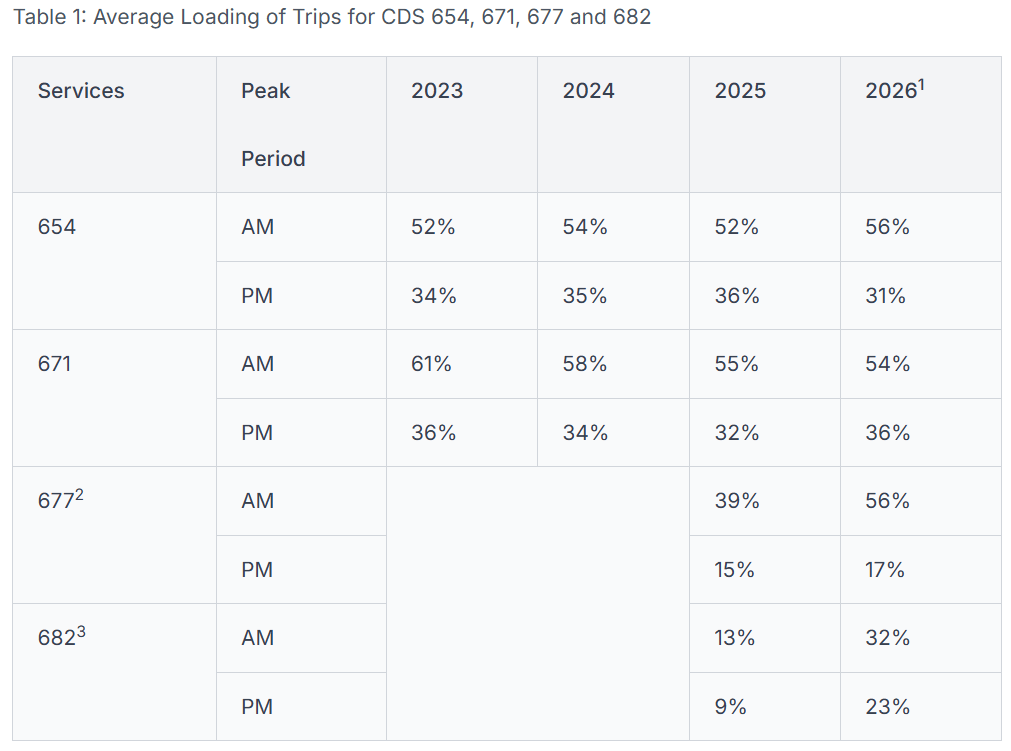
You read that right — according to MOT / LTA statisticians, the 654 and 671 that get crush-loaded to the brim every single trip, every day in the morning, are somehow just barely over half filled. How exactly were these percentage values derived?
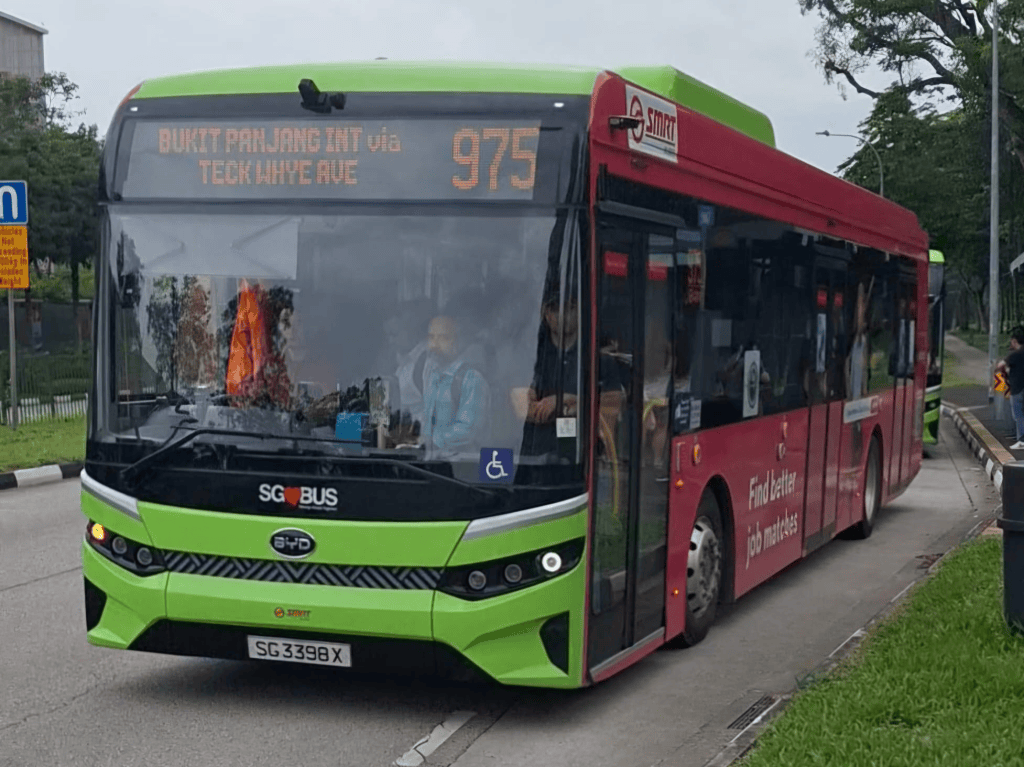
As an aside, some of our Team members have previously attempted to write in to LTA to request for a service enhancement (namely: an express variant) of bus 975 during peak hours, as that’s when the greatest conflict between demand from NSFs, Choa Chu Kang residents and migrant workers living along Old Choa Chu Kang Road arises, frequently leading to overcrowding and missed buses. (An example can be seen in the cover photo of this post)
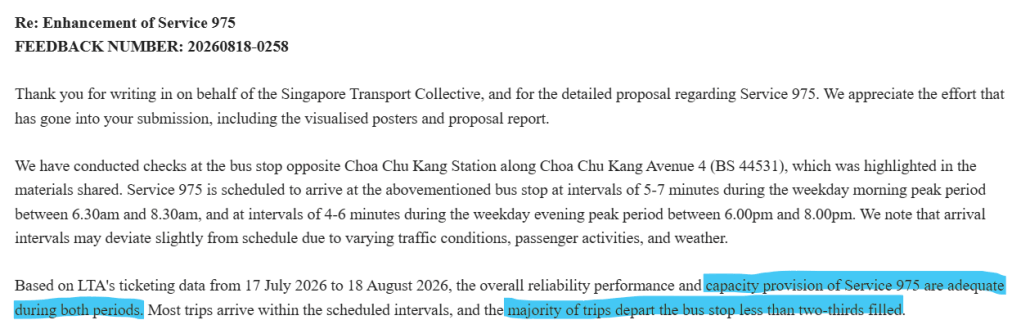
Like with this request from the Sengkang MP, that proposal was also summarily rejected by LTA, with the representative citing a seemingly arbitrary “average 2/3 loading” threshold that had to be reached before service enhancements were permitted for consideration. As questionable as that statement was, this additional piece of information put out by MOT today helps paint a clearer picture of what might be going on. Why are calls to improve bus service being rejected?
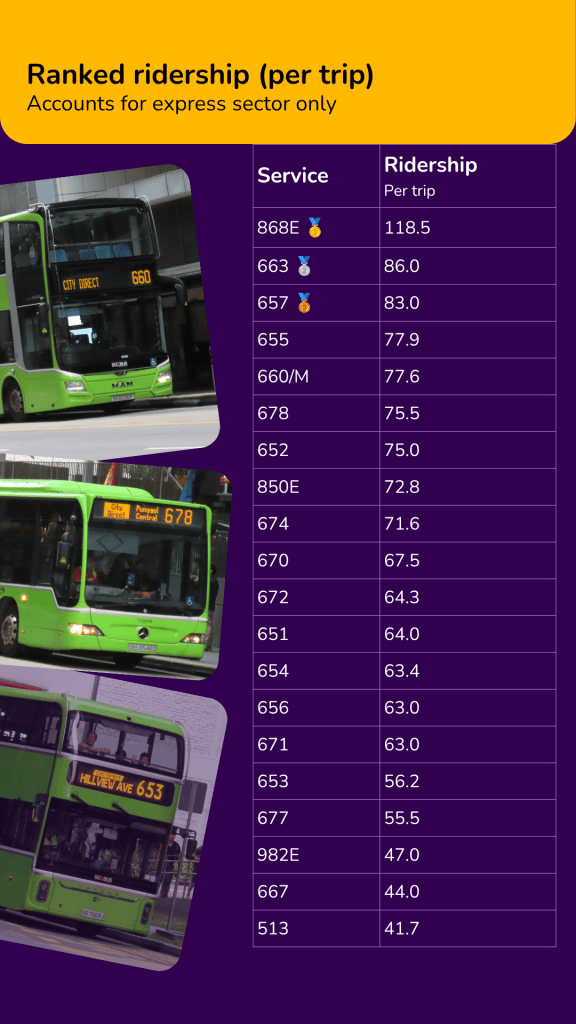
Lucky for us (and unfortunately for whoever compiled those percentage numbers), we here at STC had compiled our own ridership statistics for the peak-express CDS routes back in April. Besides just the total average (per day) ridership of each individual route, we also put out a similar ranking list of all the CDS/adjacent routes per trip, which accounts for routes operating with different trip counts. As you can see, 654 and 671 both manage about 63 passengers per trip on average, which translates to a fully-loaded single-decker if passengers do not move to the rear. That corresponds with the ground observations of these services.
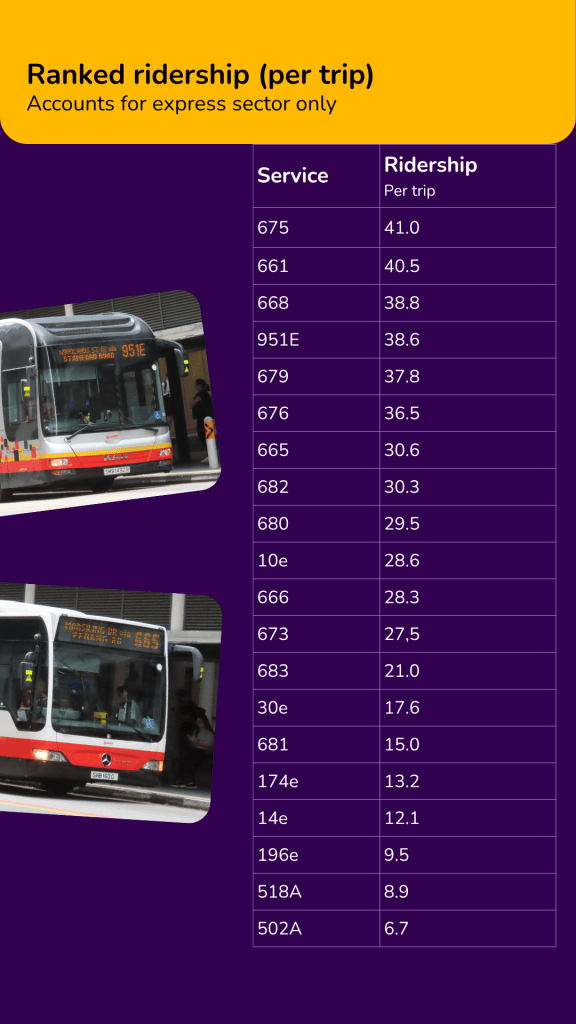
With average per trip ridership available, and the given percentage loading by the Ministry, we can work out a rough estimate of what the “100%” baseline used in LTA’s ridership calculations is:
- Service 654: 113.2 passengers
- Service 671: 116.7 passengers
- Service 677: 99.1 passengers
- Service 682: 94.7 passengers
Two important things should be noted. Firstly, all of the reported “100%” values are greatly in excess of any capacity rating for single-decker buses which are the majority fleets on all four routes. Secondly, the figures are somewhat inaccurate — percentage values were likely based on August (or July?) 2026 data, while the raw per trip loadings were obtained from data sourced in April. In the span of these 3-4 months, there will definitely be an increase in the ridership of these CDS services, not least because of ongoing efforts to promote them as patchwork alternatives to the NEL. For 677 and 682, their very recent nature also means commuters might still be in the stage of getting used to their presence, with larger ridership jumps within expectation. This bit is particularly important.
With the consideration that the 100% per-bus loading baseline for a group of bus services with few double-decker bus deployments exceeds the capacity of most of their assigned fleets, and the greater likelihood of larger ridership increases on newer BCEP-era CDS routes (677, 682), a logical deduction to make based on both observations would be that the benchmark used for measuring bus loading is based on the assumption of a full double-decker fleet, regardless of the actual deployment in place. (A double-decker bus is rated for a capacity of 120 passengers, while a single-decker bus is rated for about 80 passengers)
We can confirm this hypothesis by re-modelling the 100% “average capacity” baseline to match the actual proportion of bus types deployed on each route:
- Service 654: 90 passengers (6/8 x 80 + 2/8 x 120)
- Service 671: 91.4 passengers (5/7 x 80 + 2/7 x 120)
- Service 677: 80 passengers (No double-deckers)
- Service 682: 80 passengers (No double-deckers)
Dividing by the reported 2026 loading percentages, the supposed number of passengers on each bus would therefore be:
- Service 654: 50.4 passengers (Actual: 63.4)
- Service 671: 49.4 passengers (Actual: 63.0)
- Service 677: 44.8 passengers (Actual: 55.5)
- Service 682: 25.6 passengers (Actual: 30.3)
A consistent deficiency in the calculated values compared to actual reported numbers (based on direct Datamall ridership values) confirms that an unnaturally high baseline is being employed to evaluate bus loading within LTA and the Ministry. The most probable figure being employed, as stated above, is the assumption that every single bus is a double-decker. Under this logic, trips operated by single-decker buses can never reach full capacity, as it is next to physically impossible to cram 120 passengers into a single-decker bus in real-world operations.
Let’s go back to the case of the failed Service 975 enhancement proposal above. Were the same logic applied, this would perfectly explain the “two-thirds full” rationale being described, despite the objective reality of repeated, large-scale failboarding of bus 975 at Choa Chu Kang MRT during the peak hours. A fully-loaded single-decker bus carrying around 80 passengers lies exactly on this two-thirds threshold set by LTA, because the modelled assumption was that every trip was operated by a double-decker bus. For 975, which is fully run with single-deck buses save the one or two lone double-deckers during the peak, that also means that the service will never be able to exceed the threshold needed to justify a service improvement, as even a fully loaded 975 bus is considered within the 2/3 capacity range needed to be deemed satisfactory.
975 is not the only bus service in Singapore that runs a mostly single-decker fleet, and it definitely is not the only bus service in need of further enhancement. Many bus services in Singapore cannot deploy high-capacity buses due to various reasons (route restrictions or fleet shortages), but nonetheless are still heavily used, with buses also filling up beyond capacity. A service enhancement would be greatly warranted and welcome in such situations, but chances are that pleas for these services to be enhanced would fall on deaf ears like with the 975 enhancement proposal.
Is this an issue with computing infrastructure, where the actual bus capacity cannot be obtained to provide a more accurate calculation of bus loading to inform bus planning decisions? Or is this yet another case of accounting laziness, tone-deaf in the face of a shortage of high-capacity buses all across Singapore currently? Surely, even if the planners barely touch grass or take the bus, they’d be steeped in knowledge of the predicament of the bus network (and their colleagues handling assets and operations) to know better on how bus loading should be modelled? Perhaps uniquely Singaporean silo culture struck again, where even next-door neighbours in the LTA office feel separated by what appears to be the tallest high-security border walls.
We can do better. Full should mean full, and even LTA’s own APIs can recognise this fact accurately regardless of the bus type (somewhat, with exceptions). Just because a smaller bus is being used doesn’t mean the bus magically becomes less crowded than the bigger bus it replaces. In a country that tops (somewhat) the PISA rankings for math, there’s no need to swing fractions around to flex mathematical knowledge on the average commuter who probably just wants a bit more space to breathe on the bus.
Sorry buddy, this bus service is on average less than two-thirds full, and hence ineligible for enhancement!
Right after the MOT news release got circulated, I got wind of the sequel to customer feedback madness — another friend of mine who had written in to LTA proposing an enhancement to 179 and its express variants (179A/B) was turned down, this time because all buses were on average less than 3/4 full. Shifting the goalpost? Make up your minds on where the threshold lies!
Interested in building a better future for Singapore’s transport? Join the STC community on Discord today!
 Singapore Transport Collective
Leave a comment