

As part of STC’s 6th anniversary throwback, this is the very first STC Commentary (formerly SG Transport Critic) blog post made, now migrated to the new website. Previously archived on the old site as well, it has been restored with full accuracy of the original text for viewing. Original text and contents below the separation line.
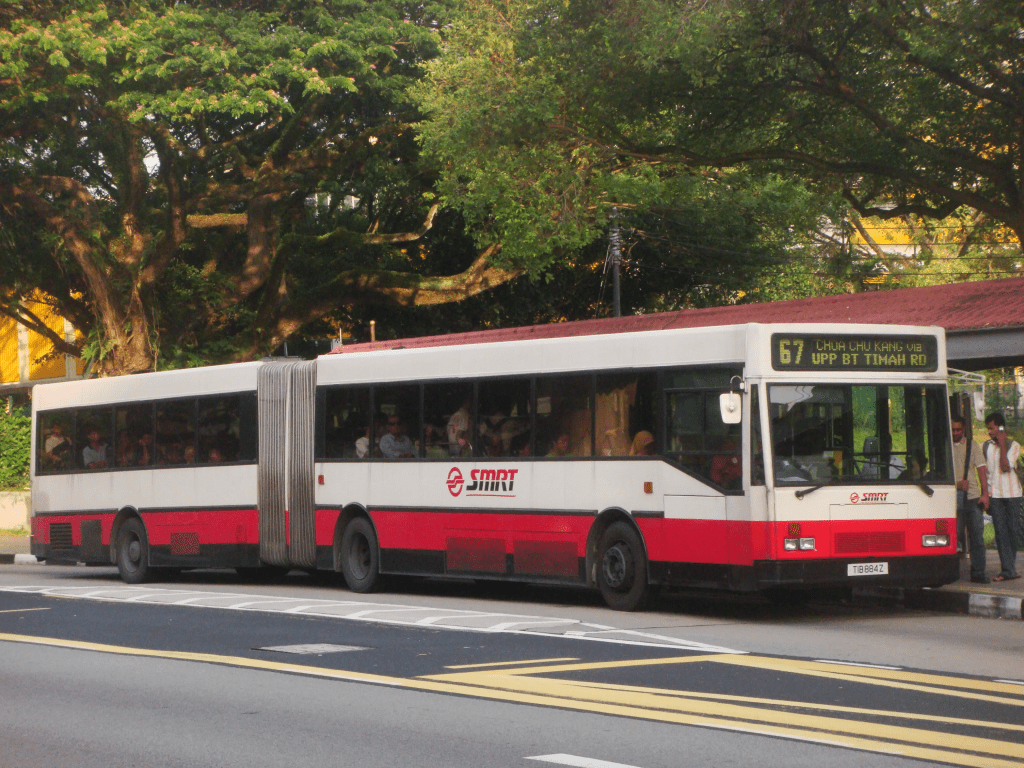
Bendy buses, long vehicle buses (according to that reflective sign they carry at their rear), articulated buses – they are essentially the same thing – buses with 2 sections that carry more passengers than their rigid-body counterparts (and with some number-crunching, their double-decked counterparts too).

Unfortunately, these vehicles don’t exactly leave an excellent impression on Singaporeans.
Clunky, un-maneuverable, old, you name it, each person has a different pet peeve about the two-sected, tri-axle buses.


Elsewhere in the world, they don’t fare that well too.

However, despite all the flak they have drawn, they are still a valuable asset of our bus fleet that should have their potential fully realised! Of course, the main argument in favour of them would be capacity, but there are a few other things that I’ll talk about here that makes bendies superior as high-capacity road transit vehicles.
Benefits and advantages of articulated buses:
- They carry more passengers than double-decker buses
- Their deployment is not constrained by height limitations (e.g. Changi Airport)
- They have faster boarding and alighting times
- They are more stable than double-decks
- If we design them properly, they could potentially be more efficient and faster.
1: They have a higher capacity
Number 1 on the list is, at first glance, counterintuitive. But it is indeed true. While it seems that what is effectively 2x the space of a rigid-body bus would carry more passengers than a vehicle occupying 1.5x the space (all our rigid and double-decker buses are 12m long while our bendy buses are 18m long), the catch to this argument is that according to Singapore regulations (and in fact regulations all over the world), passengers aren’t permitted to stand on the top deck. Now we all know that mass transportation gets its huge capacity not from the seats but from the sheer number of people standing. Add this to the fact that standing space on double-decker buses is painfully minimal, because the lowered floor causes the front left wheel of the bus to stick out like a sore thumb, and on the right side you have the stairs blocking off even more potential standing space.

In the rear, there ain’t many spaces either.
Unless you want to get kneed and kicked by the manspread gang, you probably don’t want to stand here.
According to Land Transport Guru, that brings the overall capacity of a Wright B9TL bus (the most common model of double-deckers) down to anywhere around 131 to 135 passengers. But in practice, the actual figure is around 80-100 passengers.
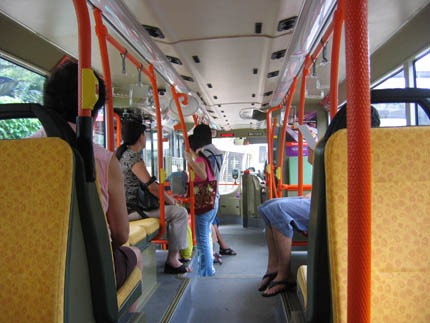
On the other hand, the articulated buses have a decent amount of standing space, especially the new MAN NG363F buses.

Although the listed capacity of the NG363F is slightly lower than the B9TL (130 vs 135), the articulated bus frequently fills up to its full capacity, without any “no-go” spaces! The difference in capacity is 30 passengers, but multiply that by a few hundred buses every day and this easily adds up to tens of thousands more transported!
2: They can be deployed without much worry
Next up on the list, would be the flexibility of deployment of bendy buses on almost any route.
Above is a full list of fleet restrictions, both official and speculative. From the table shown, it appears most of these restrictions exist because of:
- low headroom
- road width (i.e. clearance area)
- inclines (noted example: NUS campus)

Counting the list, and adding in a bit of logic, it appears that double-decker buses are banned (note: the list is unofficial and can be subject to change any time) in nearly all of the instances mentioned: of the 16 restrictions, double-deckers are banned in 15 of them. On the other hand, bendy buses are banned in only 11 instances. The list is somewhat imprecise when they mention “single-deck” buses, requiring me to do some logic work based on my understanding of the areas mentioned. This means that bendy buses can be used on more routes to boost their capacity! They would also not be constrained by low bridges (i.e. those lower than 4.4m) in future bus routes, which makes them more useful for such services.
3: Faster boarding and alighting
Then we have number 3: faster boarding and alighting times. I should have put this one before all the talk of deployment flexibility because this point is indeed very important to creating strong high-capacity routes that are fast, reliable and punctual.
Why?
Because our bendy buses have more doors than our double-decker buses! More doors mean more passenger exchange going on at any specified point in time at the bus stop. This means that a sudden surge in passenger demand wouldn’t hold back a bendy bus for as long as a double-decker bus would. When the time savings are accumulated across the 50+ stops along the average trunk route the high-capacity buses are deployed in, it adds up to a significant amount of time saved on the roads and that means that you won’t be waiting forever only to see 3 buses show up, packed to the brim, or spending eternity sitting in a stopped bus because the school nearby has let out and thousands of students are streaming to board your bus.

Besides, another reason why the passenger exchange on a bendy bus would be faster is due to a severe design flaw in the double-decker buses: they are only equipped with 1 set of stairs! Add that to the horribly-clastrophobic nature of those stairs that can only fit 1 slim person and you get absolute pandemonium when lots of people board and alight at the same time. (see the pic above)

No wonder routes with many double-decker buses always take forever to come.
Feb 2021 Update: Of course, the playing field is getting levelled – this advantage is no longer exclusive to bendy buses, with the introduction of the new 3-door MAN A95. However, to forcefully do so comes at a hefty cost of much, much reduced capacity of those buses, especially once one factors in the amount of seat space the second set of steps would hoard inside the already tiny 32 sqm of space (12.5m length x 2.55m width rounded to nearest whole). Once again, articulated buses are the clear winner.
4: Increased safety and stability
At least to the passengers inside the bus (motorists often use this to argue against articulated buses).
This doesn’t really need much explaining.


On the other hand, have you heard of a bendy bus tipping over?
And this means that bendy buses can travel faster around bends without too much fear. Of course, if it’s a narrow road, that’s a different story.
5: They have the potential to be faster and more efficient
In recent years, LTA has been prioritising the purchase of double-decker buses to boost the fleet capacity. I would consider this ill-advised and beg to differ. Purchasing bendy buses would actually be cheaper in the long run due to the indirect fuel/energy (depending on whether this round of hybrid/electric buses actually pick up steam) efficiency advantage that bendy buses inherently have from having less surface area on the front. Less surface area = less air resistance. Less air resistance = lower energy consumption! When these savings are multiplied across the entire higher capacity fleet of around 1,000 buses across an entire lifetime, LTA stands to save more $$, which means lower fares! Yay! Or if they’re really that profit-oriented, they get more profit and can spend that on more improvements in service. Either way, we win.
We can push the equation further in our favour if we mod the bendy buses slightly. Articulated buses with an aerodynamic front can actually make our rides even faster due to the further reduced drag that our buses face. And before anyone argues that that’s illegal because of the 60 km/h speed limit: the average bus speed in Singapore today is about 15-20 km/h. We have a lot of room to expand our speed.

Alright, that was about it for all the arguments I have in favour of articulated buses. Now I shall anticipate some rebuttals from the pro-double decker camp.
“But bendy buses hog road space! You literally admitted they were 6m longer! Will we need to extend our bus stops to accomodate their entry en masse?”
Nope, we won’t. As I pointed out in points 1 and 3, the combination of the capacity advantage, as well as the shorter dwell times at stops, means that buses will clear a stop in a shorter time. For the super high-demand routes, advantage #1 of bendy buses means that we can actually reduce the number of buses running on the route slightly, reducing the chance of bus bunching which is the main cause of “piling up” at bus stops.
“Yes, but bendy buses are a pain in the ass to operate! SBS Transit did away with them in 1998 for a reason!”
The “pain in the ass” you speak of mainly stems from their main weak point – sharp turns. Admittedly, they do suck at turning. But there are many other advantages of bendy buses that should not be overriden by the laziness and conservatism of LTA and the operators.
“They cost more to maintain though”
Like I mentioned in point 5, these costs should be cancelled out by the energy-efficiency advantage they inherently have over double-deckers.
“Why does it seem that the standing space is much less on the bendy than in the DD?”
Oh. That’s actually an issue of camera perspectives, which distorts the images slightly to make one think that there’s actually more standing space on the lower deck of a double-deck bus. In reality, the aisle width is roughly the same across the entire bus fleet (save the Scania K230UB with a longitudinal front section seating, or the Yutong E12). So at this point really there isn’t much discussion about “how wide” the aisles are, rather the question of “how much standing space” becomes “how long” the aisle is once width is fixed constant.
Here’s a different pic from another angle. It’s taken on the CDGE variant of the B9TL but the specs don’t really differ that much from the widely-spammed WEGII variant (presented in the above pics)
Liked this article? Subscribe to SG Transport Critic to receive all the latest articles!


Leave a Reply