

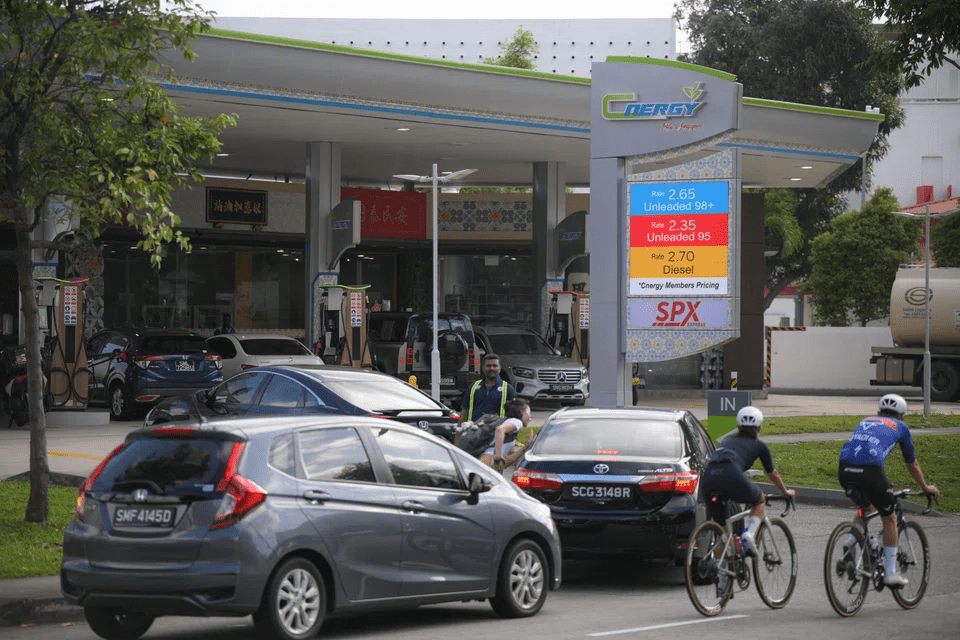
Cover pic: Long queues for fuel at a Cnergy station in Mountbatten, The Business Times
There’s no sugarcoating this, unfortunately.
Now having passed 40 days since the start of escalated conflict in the Middle East and with no end in sight to the senselessness of the US/Israeli-orchestrated mass murder in the region, things are heating up, and it will be quite a while before normalcy as we knew before February returns. After the Pearl Harbour-style decapitation strike launched on top Iranian leadership on Feb 28th, Iran retaliated by shutting the Strait of Hormuz, which is the single exit point of all Middle Eastern oil, and the world is now paying the price. With the supply of crude oil disrupted to all but a select few staunchly anti-American countries on the planet (China, Russia etc, and unfortunately for Singapore, we’re geopolitically aligned with the wrong side to not have to suffer the fallout from the ongoing conflict), it’s not an easy sight to behold, and the final week of March has seen enough of our immediate neighbours, let alone those further-flung, buckle under the stresses of fuel shortage.
- A terrible position to be in
- The delivery timeline bottleneck
- The pain, only beginning
- Higher stakes, less error tolerance
- A test of fortitude and adaptability
- Homework, due decades later
- Tackling the transport question
- From first principles
- Speed is king
- To cut or not to cut
- Rethink the last mile
- De-risking
- When hell freezes over
- tl’dr:
South Korea announced on March 25th a series of restrictions to be imposed on the usage of government vehicles. (These restrictions were further tightened on April 8th) The same day, the Philippines signed into effect an exective order enabling stricter controls on fuel usage domestically. Petrol stations in Australia and India have begun running out of fuel supplies, with long queues forming, eerily reminiscent of scenes of food lines during famines in decades long past.
Back home in Singapore, we haven’t bore witness yet to any of these extreme situations, nor had to sign any drastic legislation into action yet. However, the effect isn’t not felt here — fuel prices are on a sharp rise, particularly since the start of escalated hostilies since 28th Feb. Private motorists note a steady increase in their fuel prices, but the price hikes are more acutely felt among owners of larger vehicles intended for commercial use. Diesel fuel used in trucks and buses, once the cheapest fuel variant available at local petrol stations, has rapidly overtaken all other fuel variants to become the most expensive, and the increase has yet to show any signs of abating in the near future.
To give an idea of just how crazy diesel prices have gone up by, a litre of diesel fuel costed barely $2.60 when 2025 ended. That went up to $3 in the first week of the latest Middle Eastern war, and has been increasing at a pace of about 50 cents per week since then. The CNA article above reports diesel prices surging past $4 as March concluded. One week later as this post is published, all but one major petrol station franchise here are posting a $4.68 rate per litre of diesel, inching dangerously close to a doubling of fuel prices since last year, even as 2026 is barely a quarter complete.
Why the focus on diesel? Because it’s not just the fuel type used by public buses here — goods transport vehicles such as trucks and lorries run on diesel too. There’s a third critical player in this field as well: the military, whose mammoth fleet in the tens of thousands consume diesel faster than almost any other civilian vehicle out there. When shit hits the fan, these three irreconcilably necessary groups of vehicles would be fighting over a limited diesel supply, and here is where the toughest choices will have to be made. It’s likely that public transport would yield first without much of a fight, with the supply of food and essentials prioritised ahead of it, and the military’s central role in maintaining national security.
And all of this gives rise to a very chilling, but increasingly plausible question: What should be done if fuel supplies run out?
Or its sister question, which sounds more optimistic in outlook but isn’t any less depressing: What is to be done to avert its ugly arrival, when it comes, or stave off that day for as long as possible?
Now, it’s true the Government is playing as many cards as possible to alleviate the situation. Reserve oil supplies hidden on Jurong Island are being explicitly mentioned as an additional layer of supply safeguard in the event of a total supply chain breakdown. Additional rebates were just announced earlier this week to help local households and businesses cope with the crazy fuel price increases. Some attempt is also being made to source oil from alternative suppliers, although it remains to be seen how successful that would be in reducing our dependence on oil flowing through the now-embargoed Hormuz Strait.
But as a small country highly dependent on the global supply chain for everything we produce, consume and export, with little natural resources of its own to strategically secure us other crucial resources (ie oil in this case), there is only so much we can do to tilt the supply balance in our favour, especially not when tangible resources are mostly held by the non-Western BRICS camp in the emerging cold war of our era. The not-so-nice reality of a resource shortage, imposed by man or not, is that once the resource in question really becomes scarce, no amount of money would be sufficient to grant one access to enough of it for basic living, let alone the extra niceties of modern society. For all the hype that the free market and commodity production get about their supposed efficiency in economic allocation, it’s been repeatedly proven throughout history to do an incredibly bad job at it, especially in times of crisis where the level-headed rationality of economic planning is needed above the reckless adventurism pursued by the free market to maintain basic human survival.
In retrospect, the current oil crisis may well be the “dry run” for an eventual depletion of crude oil reserves globally. At least in Singapore, it is commonly taught as part of environmental science that the world has about 20-30 years left before crude oil is completely exhausted from the surface of this planet. Even if the US didn’t senselessly attempt bombing Iran into submission and trigger the greatest energy crisis in 50 years, we would have to revisit this uncomfortable reality in future anyway, and we would go in less-prepared, with fewer available offramps by the time that happens. So in a very convoluted way, the ongoing conflict around Iran is a good thing for us, because it forces us to think about strengthening our energy resilience before it’s too late. Nowhere else is this more relevant than in the transport sector, which in Singapore continues to be the predominant user of oil-based fuel to power the many vehicles that make passenger and goods transport possible.
A terrible position to be in
I want to begin this piece with a severe admonition of the extremely laggard pace in which the electrification of our bus fleet is carried out. Yes, we have about 500 electric buses currently in service today, up from 70 barely two years ago. But this immensely pales in comparison to the total public bus fleet size, which stands at around 6000 in 2026. That’s only 9% of the fleet available, should the unlikely day come where we find ourselves out of diesel altogether.
This holds more than 90% of our bus fleet hostage to geopolitical situations elsewhere, a situation that could have been entirely avoided had more serious effort been put towards enabling a larger portion of the bus fleet to complete the electric transition. For crying out loud, Singapore’s very first electric public bus (a BYD K9 under Go-Ahead) debuted in May 2016, and in the span of almost ten entire years, 500 is all we could muster…? Electricity is a versatile energy source, capable of being generated by multiple sources renewable or not, and switching to a different source of electricity generation is much easier than the rebuilding needed in the global oil supply chain after all is over. Diesel fuel… well, it’s entirely reliant on a steady stream of crude oil supply available to obtain it from, which is the entire reason why we’re having these difficult conversations now.
Ten years is more than enough time to have converted most, if not the whole of our public bus fleet to electric buses. The fleet’s size is unfortunately never a valid excuse for Singapore — over in China, Shenzhen debuted their very first electric bus (also a BYD K9) in 2011, and had managed to successfully commission the fleet and infrastructure needed for 100% electrification by 2017. Prior to Covid, their fleet size stood at 16,000, almost thrice that of Singapore’s 5,800 back then. There is simply no valid reason to have only brought in 500 electric buses in total over the span of a whole decade, given our economic prowess and technical expertise in fleet management and upkeep.
For the record, cities in North America (particularly the US) and the developing world (South Asia, Africa, South America etc.) have mustered a more serious effort in driving electrification efforts, despite starting later than us and having fewer financial resources to throw around liberally. In China, most major cities have converted significant portions of their public bus fleets (if not in their entirety) to run on electricity instead of diesel or natural gas fuels. In the face of a global oil crisis, they’re reaping the fruits of their policy decisions made 10-15 years ago. Being on the right side of history helps, but even if oil supplies to China were cut tomorrow, their more acute oil deficits would hurt them less than it would to Singapore. As far as domestic transportation is concerned, the Chinese system is as resilient as it can get, with electric buses and metros serving urban areas, and electric mainline railways supporting the bulk of intercity passenger and goods transport, powered by a healthy mix of nuclear, renewable and traditional energy sources.
This could have been us, if we took bus electrification seriously. I don’t expect the China miracle to happen in Singapore, but a decently serious effort would still land us in the ballpark of about 50% of our bus fleet electrified by now. It’d still be bad news if oil runs out, but losing half your bus fleet or less is a far better position to be in than losing more than 90% overnight. We dug a grave with our tardiness in transitioning to clean energy, and until things in the Middle East cool down, it’s entirely on us to pull ourselves out of this mess.
The delivery timeline bottleneck
Surely, wouldn’t the solution be to accelerate the procurement of electric buses, such that we reduce our reliance on diesel in public bus operations? It’s not as simple as it seems, as much as we all wish it were so. As much as electric buses free our public transport from the shackles of global oil supply issues, the not so neat part about not already owning them is that the very same geopolitical tensions out there are actively disrupting the supply chains necessary to build these energy crisis panaceas. Two major bottlenecks emerge when studied closely.
This is an AI-generated image of an abandoned car in a deserted snowy town. It was generated free of charge by WordPress, by analysing the content of this post and title for generation prompts. On the wider internet out there, many more of such free AI image generation tools exist as well (though the more well-known ones are increasingly rate-limited to squeeze more profits from users), and might even do better in realism or artistic sophistry than a basic WordPress AI extension.

But behind these AI extensions to digital apps lies a vastly hidden cost that isn’t apparent to the end user — that is, until they need to get new electronic devices. In the ferocious arms race to increase the computing power and bandwidth of these AI models growing at breakneck speed, the ultimate price is borne by the market and smaller consumers who share the same upstream sources for computer processors, also known more informally as “chips”, used for memory storage, graphics processing, or basic compute tasks. With the predominant strategy of leading AI firms continuing to be that of “chip-wave” tactics, in which compute power is increased simply by throwing ever so many more GPUs together to hopefully edge out competitors in the race for faster AIs tapping on ever-growing pools of data, the result has been nothing but an acute shortage of processor chips that are required for any digital device to function, including consumer products that come enabled with digital features such as touchscreens, intelligent driving, or even something as basic as performance and condition monitoring. If something contains a screen, it’s likely beholden to the global supply chain of computer processors too, and count yourself lucky if you don’t have to buy more of it within the next two years.
Termed counter-affectionately as the RAMageddon in effect since early 2025, the global chip shortage is expected to last all the way through end 2027, while additional production capacity waits to come online by that time period. That’s if more recent events around the globe haven’t started throwin extra wrenches into the work.
Unfortunately when it comes to procuring new electric buses, the current RAM shortages are an inseparable issue from the struggle to reduce the fleet’s reliance on oil-based fuels. Being modern vehicles, it’s inevitable that they would need a couple of these processor chips somewhere in their assembly for power steering and the intelligent touchscreen dashboard controls. Choking the chip supply with a flood of orders from AI farms holds up the entire production line, driving up costs together with waiting time. At this point, cost isn’t even an issue anymore, if the product cannot be delivered on time. It doesn’t help that new electric buses are mandated to have a myriad of additional screens installed in the name of enhancing bus safety (supposedly to eliminate blindspots, even though these distract more than help with safe driving), each requiring their own chipsets to translate camera sensor input to on-screen graphics in real time. Think of them as little computers, each requiring their own CPU and GPU to fulfil their part in the larger setup. We all know it’s exponentially harder to upgrade or buy a new computer now than in 2024. The same applies for these gizmodo add-ons that LTA mandates for new public buses too.
Earlier this year LTA announced tenders results for a new batch of 660 electric buses (contract PT602), with a targeted delivery date *from* end 2027. With the AI-induced chip shortages expected to last till then or worse, it’s anyone’s guess if the introduction of these new buses would be delayed by it, although hopefully the relevant manufacturers have secured sufficient stocks prior to entering the bid last year. And even with their introduction, that puts the electrification progress of the total bus fleet at around a measly 1150 — hovering just slightly under 20% of the total 6,000 buses plying our roads today. The emerging shortages in processor chips and another critical ingredient (which we will get to soon) might not have affected the 660 new electric buses under PT602, but future electric bus procurements hang precariously by a thread. When these future orders can be fulfilled and delivered in a timely manner, remains heavily to be seen.
On a similar note, the electric bus equivalent of a fuel shortage induced by geopolitical tensions would be a series of restrictions levied on the export of rare earth metals by China, which are considered dual-use materials capable of being used to produce military equipment. With 91% of global rare earths refining capacity located within its borders, the Chinese maintain a strategic dominance in the field ahead of its Western competitors, of which the advantage it grants is only recently being appreciated to the extent it deserves. These rare earth metals include a series of metal elements with strong magnetic properties, and are used to produce industrial-grade magnets. The inconvenient fact about electric vehicles in general, is that their propulsion is mostly reliant on the use of permanent magnets (PMSMs) made out of these rare earth metals (because they simply perform better in terms of torque and efficiency than traditional brush motors), and that includes electric buses as well.
Most readers have probably only heard of PMSMs in the context of the abandoned second refurbishment of first-gen C151 trains, which saw selected units retrofitted with them. Funfact: besides those few trains, all electric buses in Singapore are also fitted with PMSMs!
See the infographic below on the differences PMSMs have from traditional brushless motors, which explains why they’re the industry mainstream for EVs, and why choking rare earths supplies has such a strong ripple effect across the EV industry. Good to know: “BLDC” motors are the ones typically taught in basic science curriculums, vs the more commonly-applied PMSMs in real life.
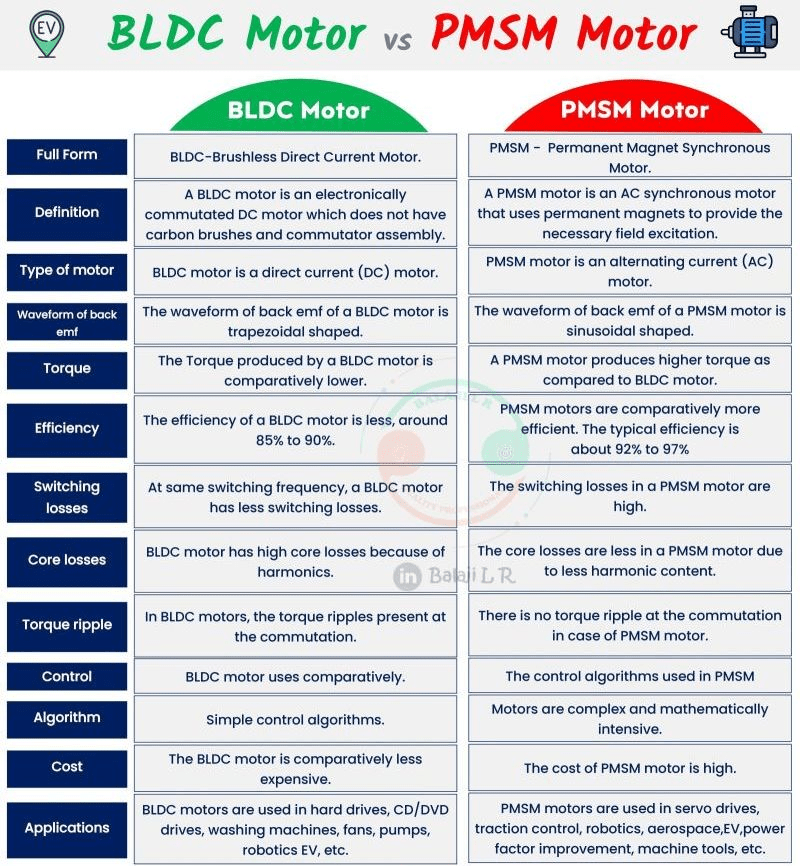
Unfortunately, while raw rare earth minerals can be found across most of the world, China remains the only country capable of processing them to the quality needed for commercial applications like PMSMs in electric vehicle motors, at a reasonable price and quantity. Many pin hopes on a hypothetical market-based “AI bubble burst” restoring chip prices back to normal after end-2027. It’s harder to say whether disruptions to the rare earths supply chain initiated by state actors can be resolved by then, or whether reasonable workarounds can be discovered in that time frame.
But be it AI-driven global chip shortages, or state-led restrictions on rare earth exports, their disruptiveness is all forecasted to persist through the rest of this year and the next. In the context of the current fuel shortage, that’s way too far off in the future, with strategic crude oil reserves lasting no longer than a year for net oil importing countries, Singapore included. In mid-March, energy minister Tan See Leng reassured Singaporeans that the country has sufficient oil reserves to last for “months”. Batches of electric buses hitting our shores from late 2027 at the earliest will not arrive in time if fuel runs out. Sure, our electricity is generated by regionally-sourced CNG, and that could hold out longer than the precarious supply of fresh crude oil. That’s not exactly helpful to local transportation needs if we don’t have the vehicles capable of directly converting electricity into motion before the oil taps run dry.
Our public bus fleet is caught in that awful position where most of it is directly reliant on imported oil to run, but yet we do not have sufficient electric buses (and neither able to obtain more of in time!) to tide the overall network through should the diesel pump go dark.
The pain, only beginning
As of late March when diesel prices surged past $4 for the first time, the impact of rising fuel prices on the local passenger transport industry formally entered the spotlight. While the relevant authorities have remained tight-lipped on the ramifications of pricier diesel for public bus operations (and the dreaded year-end fare review exercise), the CNA article spotlighted the worries of a private bus operator who’s been more forthcoming on their expected operational challenges. It’s not a perfect mirror of what goes on in the public bus industry, but it offers some insight into what’s possibly in store for public transport as the Middle East war continues to drag on.
The situation is less dire for private bus operator Westpoint Transit, though its diesel expenses have risen by about 150 per cent on average, pushing operating costs up 15 to 20 per cent this month.
“Aside from the cost factor impacting our margins, everything else remains status quo, as our customers regard daily staff transportation as vital to their continued operations,” said director Lionel Lee. The company operates 65 buses of various sizes.
Westpoint Transit reached out to customers earlier this month to discuss fuel surcharges, with a proportion agreeing to a 5 to 15 per cent increase, said Mr Lee
With diesel prices having skyrocketed to almost double that of pre-war levels, the notably muted increase in overall operating cost reflects the relatively low proportion of total operating cost spent on fuel — the general rule is that about 70% of operating cost for buses is on paying employees to drive the buses and maintain them. But even by these conservative numbers reflected as of end-March, our public transport fares are in for a serious rollercoaster ride, let alone any further increases expected from now (April 2026) till December.
A tap-on journey costs $1.28 today, and that’s also the flat fare charged for feeder services in the current fare framework. Passing the 20% cost increase in its entirety to passengers (though unlikely) would mean a 26-cent hike to $1.54, far surpassing the 22-cent increase deferred from the Covid-19 pandemic. For reference, a 20% fare increase would mean the maximum fare for a basic bus service (at the 40.2km mark or more) would leap an entire half dollar from $2.57 to $3.08. To give you an idea of how much that is, that’s equivalent to the express bus fare value for the 14.3km band as of the 2025 fare revision.
Going by the optimistic range of just a 5% increase, that works out to a feeder fare of about $1.34, with the maximum basic fare capping out at $2.70, with an increase of roughly 6-10 cents. The scary part isn’t that fares are going up 10 cents again as with the past two years — it’s the fact that even going by the most optimistic estimates, the potential fare increase on public transport over the span of barely a month is quickly coming close to equalling similar (deferred) fare raises annually for past years. The longer the war drags on and the more acute the fuel shortage gets, the more ridiculous one should expect the operating cost of public transport to become, for as long as the status quo is maintained. How far the PTC and the government are able to shield millions of public transport users daily from the fallout will be put through a test of blood and fire, and their next moves remain to be seen.
Just as we thought 10-cent fare increases for two years in a row was unspeakable madness, it turns out the show has only begun. It’ll be a very emotionally-charged December for PTC and the majority of Singaporeans relying on public transport, regardless of the course of action taken then.
Higher stakes, less error tolerance
In light of the disadvantageous position of our bus fleet, it may be tempting to suggest that more passengers currently using buses today be pushed to the rail network to reduce demand for diesel fuel by the public transport system. Some other blogs are already colourfully describing this as “intensifying the war on bus riders” , upon the belief that our MRT network, powered fully by electricity since day one, is wholly able to replace the role of buses in the public transport system in the name of energy resilience.
Even in peacetime, that is a terrible suggestion to make, and its folly has been repeatedly demonstrated in numerous high-profile disruptions in the past half decade alone, let alone the decades before that. From the triple-line blackout in October 2020 to the derailment of September 2024 and subsequently the NEL blackout in August 2025, these incidents have repeatedly proven that our underbuilt MRT system is incapable of handling the stress of current ridership, let alone sustainably carry even more riders beyond its breaking point. To give the rail fanatics a sober reality check: in the face of a looming fuel shortage, it is in fact ever more important that the MRT does not break down, and every endeavour must be undertaken to ensure this does not happen for as long as humanity collectively fails to resolve the underlying conflict elsewhere, or as long as needed before we transition to a future not dependent on oil from the Middle East.
Either way, with the stakes raised, the last thing one would want to do is to engage in risky policy adventurism and gamble with the limits of the rail network. In peacetime when fuel is abundant and cheap, buses (specifically: massing sheer quantities of them at will) are conveniently viewed as the fall-back contingency should the rail network fail. That calculus changes entirely when fuel begins running short. With bus availability becoming uncertain, the MRT has no “plan B” to catch its failures — even something as minor as a track fault can now paralyse the nation, literally. There’s far less room for error (if not none at all) in times of crisis, and demanding all bus riders switch to rail in such times is playing with fire in a room filled with highly explosive flammable gas.
A test of fortitude and adaptability
This part goes out to everyone out there busy advocating for better urban transportation during the LTMP planning season, inclusive the many distinguished individuals working on our alternate Transport Manifesto 2050.
As advocates for better transit, our modus operandi thus far has always been to demand for more, rooted in the belief that when it comes to public transport and active mobility, there is indeed far more that our LTA and MOT can deliver upon than is being done so currently. With a litany of examples from elsewhere in the world that shows us what a better Singapore could be like, most of us began our work in the ideal of abundance, as with quality improvements to many other public services that should be delivered with a rising standard of living and a booming economy. To be forced into austerity isn’t natural for the mind of a transit advocate, which plays into stereotypes of how the establishment functions.
But having recognised the need and importance of a strong functioning public transport system in ensuring the long-term development of a sustainable society in Singapore (within our unique cities-in-city urban structure), we cannot be fair-weather transit advocates, whose planning calculus is solely dependent on good times characterised by exceptional amounts of room to further grow the network. The strongest credibility that advocates can lend themselves is the ability to adapt under imposed austerity with the least compromise on our goals of accessibility, connectivity and and sustainability. Trying times like these are the prime opportunity to establish ourselves not as mere internet yappers (which is far too often the impression formed of us by uninterested parties), but as people who really understand how transport works, and capable of forming a sound contingency plan for the daily journeys of six million people even when times get tough.
Homework, due decades later
What would the answer to anticipated energy woes look like for the transport sector. The keyword here that serious visions of the future must incorporate, be it LTA’s LTMP or STC’s TM50 or any other such masterplan, is energy resilience. In the context of the current situation, energy resilience is a two-part question: to address the long-term transition away from vulnerable non-renewable fuel sources, and meet immediate shortages in energy supply. In terms of the former, officially-announced plans chart a pretty solid path ahead for de-risking our economy from the volatility of fossil fuels, and it’s just a question of implementation at this point forward. Things like committing to a fully electric bus fleet by 2040, whilst made significantly more Herculean by today’s geopolitics, continue to remain a relevant goal to strive towards, so that even if it can’t save us from today’s fuel shortage, it’ll help greatly when similar fuel crises strike again in future.
I’d like to add that given the far greater emphasis on using electricity as a substitute for internal combustion in a variety of applications beyond just transport, serious thought must be put towards bringing nuclear energy to Singapore in some form or another. With all other versatile renewable energy forms (wind, solar) greatly lacking in energy density needed to feasibly replace fuel-fired power generation, and Singapore being geographically unsuited for hydropower or geothermal energy that is somewhat capable of that, that leaves nuclear as the only available alternative heavy-duty energy source appropriate for powering an economy whose electricity consumption continues to rise every year. Dangerous? That risk has to be mitigated some way or another, and recent technology in the field of nuclear energy is highly promising in making nuclear energy palatable to a hungry city-state that lacks the buffer zone otherwise needed for traditional nuclear plant designs.
Overcoming short-term challenges is the trickier question, and in a labyrinth that corners you from all sides, the response isn’t to attempt bashing your head on them and hoping they budge. Metaphorically, the more productive response is to leap over the walls that surround you. In practical terms, that means revamping for process efficiency, such that the rules that otherwise define the industry’s limits are changed altogether. The worst enemies of the public transport system in these challenging times is often not the onslaught of external cost component factors, but existing processes that exacerbate their impacs on operations, which in turn makes commuters suffer.
An easy and tempting answer to all this is to mandate working from home (WFH) again, like we did in 2020 when Covid hit our shores. While it’s a useful tool in the box, particularly when made possible with the aid of teleconference technology, the harsh truth is that as long as the economy isn’t a hollowed fake by years of financialisation (which is a turbulent path Singapore should never go down, small and resource-deprived as we are, as the mistakes of the West deindustrialising has shown us), WFH is really only available to part of the workforce whose job profile and work scope permits remote working. It can take some pressure off public transport for sure, but to mandate it across the board again is a surefire way to damage the livelihoods of countless Singaporeans with no clearly-demonstrated medical rationale. More meaningful perhaps is how businesses employing workers with partially-WFHable jobs can more smartly organise timelines to reduce office days, since this worker profile makes up a broad majority of the Singapore economy, even in fields requiring significant on-site staff presence, such as manufacturing.
Tackling the transport question
With so much said about the current state of energy prospects in Singapore and beyond in the coming weeks and months, as well as the partial and non-solutions to it, the big question that remains is what is to be done for public transport in the near term to react to the increasingly volatile fuel situation overseas. Generous agaration estimates suggest that Singapore has about 6 months of fuel reserves to survive on if imported supplies get cut, although the silence from LTA and MOT on this issue speaks louder than the DPM’s reassurances. The given is that a significant portion of the bus fleet will be taken offline when fuel runs out pending the restoration of a very complex and interwoven supply chain far beyond Singaporean control in the Middle East (of production lines and drilling facilities on oil wells). Even with full effort to accelerate the procurement of electric buses, it remains an unknown as to when sufficient numbers of them can be amassed to maintain the same or even higher (given that new towns are still being progressively built, with more underway) level of service seen today.
The following represents just our view on what could possibly be done to adapt to a potential acute fuel shortage in the immediate term. In these times, nobody has all the answers, and it’d be dishonest for anyone to claim that they do. This post should be the starting point of a much larger conversation in general society (and specifically within circles that cover transport affairs more, with their greater knowledge of operations) about adapting daily living in the face of reduced fuel availability. Even if they don’t take public transport, they most likely drive or use private-hire transport (taxis and Grab etc.), which are arguably even more vulnerable to a fuel shortage than buses running on diesel. And even the hikkikomori types will feel its effects when the price of food and other daily necessities, transported within Singapore predominantly by truck, starts spiking due to the same factors that will drive fare increases this year end. It’s helpful when more are aware and actively engaging on this topic that few can avoid eventually.
From first principles
There’s two possible ways of approaching an impending fuel shortage, particularly for diesel where competing uses cannot simply be curbed (because they play equally, if not more important roles in this country than buses do) the way petrol can for private car users, if things really get sufficiently terrible. The first option, better described as “do nothing”, basically entails keeping everything as it has been for the longest time and being forced to only use up to 20% of the total available bus fleet when diesel supply runs out entirely. Outside the deepest circles of the government, nobody knows for sure when this will happen, or how long the “blackout” period will last. Alternatively, active steps can be taken to operate in a “reduced” state that continues to meet connectivity needs, but prolongs the usage of existing diesel stock, such that it may hopefully ride out the entire crisis altogether when life is back to normal years later. It’s delusion to expect disruptions to supply chains to last for less than years on end, as shown with the very recent example of the Covid-19 pandemic, whose effects on the local economy continue to ripple six years on. Likewise, it’s anyone’s guess how long it takes before things return to the “normal” as known before February 28th, 2026, and the first option is, in our opinion, an excessive gamble to take.
The present is simultaneously an opportunity both for and against major policy interventions to shake up public transport, especially for our public buses. This site has maintained since 2020 that our public buses, despite being continually renewed to look young and modern, continue to operate by and large the same way as they did in the 1980s. With few cosmetic differences, a Singaporean who passed away 40 years ago could navigate the present-day bus system with remarkable ease and confidence. The BCEP launched in 2024 introduced some reforms (eg the new “limited-stop/express feeder” designation for the 45x series routes), but we’re far from making enough major changes to bring the bus system into the 21st century, in terms of structure and operations. A fuel shortage threatening the operationality of more than 4 in 5 buses here is prime time to introduce these reforms.
The following part of this article may contain language that some may consider overly technical or inside jargon; but the gist of it is that all the complicated stuff you’ll read below is aligned to a couple of key principles that define our proposed strategy for dealing with a fuel crisis affecting up to 90% of the bus fleet:
- Make every drop of diesel count. If diesel buses must burn fuel, make sure as much of it goes towards serving passengers, and as many of them as possible.
- Maintain coverage of the overall public transport network (Note word choice: connectivity implies one-seat rides, which are harder to guarantee when fuel is scarce)
- Do not push the MRT past its limits to maintain a capacity baseline in the public transport network. (Important, as much as the MRT could potentially soak up some bus ridership)
Low-hanging fruit
The easiest thing to attack is fuel-wasting practices behind the scenes that were once mild annoyances, but now a tangible threat to the fuel security of the public transport system. Best yet, this barely affects public-facing bus services, unlike what’s being proposed further down this post.
Offender numero uno of this is the needlessly massive amounts of deadheading present in the current bus system, mostly introduced artificially in recent years by the Bus Contracting Model dividing operations across operator boundaries, decreasing operational flexibility. The unit of operations under the BCM is the bus depot, which is expected to maintain sole operations and maintenance responsibility for all buses and routes under its purview. For shorter routes located close to the home base this works fine, but problems arise when much more useful long-haul trunk services enter the picture. With the BCM rolled out across roughly half of the bus network here, 10 years after its introduction, it’s regrettable to note that only two (with a third coming up in the Tampines Package) BCM depots as of April 2026 are permitted to enable versatile joint operations with other depots, instead of running as an isolated entity disjointed from other depots in the system.
Why is this an issue? On long trunk routes spanning halfway across Singapore, one end will be near the depot from which the route is based from, while the other will be significantly far away, meaning buses launching and withdrawing from the far end of the route must deadhead significant distances without passengers. Because of the local-stopping nature of many of such routes creating long cycle times, it also means that this problem affects many buses, multiplying an already undesirable wastage of fuel at least twice a day, every day. Historically, legacy operators SBST and SMRT got around this problem through a practice known as “dual depot”, where long or resource intensive routes are jointly managed and provided for by two depots, one near each end of the long route in question, cutting down significantly on deadhead mileage. Sadly, this practice is banned by default under the BCM, unless the package in question is won on an alternate bid. It makes for simpler administration within discrete package boundaries, but it comes at a hefty cost of rampant fuel wastage in times of high fuel vulnerability.
An easy start to managing a fuel shortage would be to bring back dual depot across the board in disregard of operator and package boundaries, such that deadhead mileage in bus operations can be minimised significantly. If the BCM is to live up to its name of promoting more cost-efficient operations, to chuck out industry standard practices proven with decades of operations experience is the most unbecoming of it, yet is what the BCM has become in a sordid twist of irony. Making every bit of fuel count means reintroducing legacy practices that were aimed at efficiency, rather than lazy bureaucratic simplicity.
Even some current dual-depot pairings could be optimised too, as they were made with the limitation of bygone operator boundaries. We must emphasise shortest overall deadhead, because that’s how you stretch a limited fuel supply for use over longer periods of time.
| Bus service | Current depot/s and longest deadhead* | Suggested depot pairing and longest deadhead* |
| 143 (Jurong East – Toa Payoh) | Bulim (20km) | Ulu Pandan, Hougang (8.1km) |
| 67 (Choa Chu Kang – Tampines) | Gali Batu, Woodlands (28km) | Gali Batu (5.2km), East Coast |
| 852 (Yishun – Bukit Batok) | Seletar (22km) | Seletar (4.8km), Bukit Batok |
| 104 (Punggol Coast – Woodleigh) | Loyang (16km) | Sengkang West (7.6km), Hougang |
| 59 (Bishan – Changi Village) | Hougang (18km) | Hougang (6.6km), Loyang |
It is not difficult to imagine what such an arrangement would look like — as recently as 2023, selected BCM depots leased out part of their parking capacity to “tenant” operators who paid a small sum to park at another bus depot closer to their served routes than what their own depots could offer. SMRT for instance, used to park buses for Bukit Batok and Choa Chu Kang routes at Bulim depot (managed by TTS), located much closer by than their old Kranji depot near the Woodlands Checkpoint. The only difference this time would be that leasing fees should be waived through higher-up intervention, or made symbolic, given the necessity of such practices to cut fuel wastage across the board, and the larger need to incentivise bus operators to take up such practices.
For a common adversary such as a fuel shortage, the competitive model prescribed by frameworks like the BCM are self-sabotaging and counterproductive to the immediate survival of the bus system. It’s sad how the BCM, once touted as the more advanced framework to replace the entrenched duopolies of old, instead proves itself less capable of weathering crisis than the system it was intended to replace. It reinforces an inconvenient truth about the BCM in relation to the history of bus operations in Singapore — the duopoly that BCM sought to replace, in fact represented a more advanced stage of bus operations and management that the era that BCM-like systems were originally designed for. We almost always forget that SBST had its origins as a monopoly mandated against the odds to optimise itself for adequately serving a rapidly-growing Singapore in the late 20th century. Decades of nationwide management experience puts us in a favourable position for centralised planning and operations to deliver efficiency where bus systems elsewhere falter. In times when this efficiency is demanded of us, it’s shameful to forget older wisdom in bus operations just because it doesn’t come packaged in green and sealed with the “SG❤️BUS” logo.
Normalising the collaborative operations model that has historically served us well for more than 40 years doesn’t just stop at opening up greater operations flexibility within our highly-connected bus network. It paves the way for the eventual abolition of the BCM and transition to a publicly-owned monopoly, wholly responsible for all 6000 buses and 400 routes in the Singapore public bus network, and well-equipped with managerial experience and technology to most efficiently coordinate bus services from Tuas to Tampines, and Sembawang to Shenton Way. Asking for greater inter-mixing of buses within depots to save fuel is the first step towards the dissolution of operator and package boundaries, and its logical outcome is an eventual full nationalisation of bus operations across all of Singapore.
Or, just don’t.
Even so, it’s noted that deadhead distances continue to remain significant in certain cases, with some still as high as 10km despite adjustments made to park at the closest depot to the given route termini. We must severely chastise decisions made that resulted in our bus depots located far from where our bus routes start and end, and even more so the distribution of routes between them that further exacerbates deadheading issues in the network. Bus interchanges and terminals are more or less generally located deep in the heart of major population centers, whilst the bus depots that supply the buses operating from them are instead located in far-flung areas. Is it any wonder that buses are racking up insane lengths in dead mileage?
To further drive home the point on why the fuel crisis should accelerate the dissolution of the Bus Contracting Model, it’s worth highlighting the sheer absurdity of the package boundaries being drawn, in terms of how bus routes are assigned to various depots. Setting aside fringe cases of individual routes operating almost standalone from their peers in the same package (Sengkang’s 110 under Woodlands package, or Punggol/Sembawang’s 117 under Sengkang West), what’s more notable in this field is the systemic failure to appropriately draw boundaries such as to reduce required deadhead mileage. Of course, the worst offenders of this are in the west with a galore of examples to behold — Clementi feeder services (96, 282, 284, 285) for instance are based at Bulim depot, located more than 10km away, whose closest bus interchange is either the upcoming Tengah ITH or the current Boon Lay interchange. What makes it even more absurd is that there are three whole other bus depots that are closer to Clementi interchange than Bulim is — namely Ulu Pandan, Bukit Batok and Gali Batu! Granted, two of those didn’t exist in 2016 when the boundaries for the Bulim Package were first drawn, but more sensible minds would pause to consider that maybe Clementi (and Jurong East, which is almost fully under Bulim control!) shouldn’t have become part of the Bulim package in the first place, with more focus on routes further west closer to the depot itself.
Areas further east might be slightly better off, but not to say they’re much ahead in this aspect either. Consider the Loyang package, which covers bus services in most of Pasir Ris and all of Punggol. As the package name implies, the depot is in Loyang, which is located deep in the far east, beyond Pasir Ris town and partway to the far-flung Changi Village. You read that right — every bus serving Punggol town (less 39, 50 and 117) must travel about 15km each way to and fro their bus depot, because of the way the Loyang package’s boundaries were drawn. That’s a shitload of fuel that your buses are wasting, because not only are package boundaries being treated as sacred inviolable gospel, but also because they were never drawn in a rational manner in the first place anyway. Granted, there’s some indication that Loyang isn’t the permanent location of this package’s depot, but plans for this envisioned future are too far off to be relevant to the current discussion on managing an impending fuel shortage anyway.
Or consider where coverage gaps of bus depots force excessively long deadhead routes out of necessity, because the placement of bus depots continues to be an incoherent patchwork of legacy private decisions and what could be described as impulse-building on LTA’s part (based on land use plans released by URA for the long term) for BCM-era new infrastructure. Consider this perennial favourite of mine: Which group of full-day bus services has the longest average deadheading mileage? Those with at least one terminus in the downtown area, or somewhere relatively “central” in the Singapore context. Open a map of bus infrastructure in Singapore and be amazed by the “dead zone” corresponding to the CBD and similar central areas. Where’s the nearest bus depot to the CBD? Ulu Pandan, located all the way in Jurong East. It’s going to be more than a slight operational headache for the upcoming AV trial on 400 at Marina South, but it’s a massive fuel waster for buses operating from the Bukit Merah, Kampong Bahru, Shenton Way and Marina Centre terminals today. The Pasir Panjang depot is coming by 2029, but if electric buses from late 2027 aren’t timely enough to bail us out of a fuel shortage, forget about bringing it up as a relevant point in the immediate term.
Another practice that we could potentially bring back to save more fuel is just simply, to not deadhead buses back to depots unless needed for maintenance and refuelling. Some buses could just park at bus interchanges overnight, akin to ancient SMRT practices from when TIBS decided to skimp on depot construction costs by building fewer depot parking lots than their fleet size. This would be handy for the few buses originating from termini that are just… too far from any bus depot, and could do with some fuel savings by parking at a nearby bus interchange for the night instead, which might also save on the need for employee ferry buses too…?
Speed is king
With fuel supply uncertain, the need to ration diesel usage in public transport might extend beyond culling immediate areas for improvement in dead mileage. The question then arises of what can be done to the main public bus network to further delay a scenario of fuel bankruptcy, whilst least damaging the rides of millions who use the buses daily. In these times, it’s helpful to recall certain basic axioms about how public transport works, and a particularly significant equation discussed on this site recently comes to mind.
Recall that longer cycle times mean more buses required to meet headway. A scarcity in fuel might be the best impetus to push forward a massive campaign to speed up bus services across the board. Counterintuitively, faster buses actually consume much less fuel than the slow image that Singapore’s buses collectively paint today, as a result of various factors in bus priority, designed service speed, and stop spacing. Unlike what some might like to say, this isn’t even about buses being faster to compete with the MRT, even though that’s a side effect. In this case, buses have to become faster to preserve their irreplaceable role in the local public transport ecosystem under pressure from a fuel shortage. To reiterate: It’s not about competition, it’s the bus network’s survival.
Faster buses have a three-fold effect on fuel economy in public transport. The more obvious one, given the “magic triangle” formula earlier discussed, is that faster bus services require fewer buses to operate, meaning fuel savings from having to run fewer buses. Fuel-powered motor vehicles such as buses are designed to operate with the highest fuel efficiency at top gear. That’s 60km/h at 4th or 6th gear (depending on make and model) for our public buses, which despite being their legal speed limit, remains beyond reach for buses plying on routes with largely all-stopping patterns. Perhaps in the context of the current fuel shortage, it wouldn’t be wise to raise the top speed of diesel buses beyond 60km/h (as this site has been advocating in the past) for now over fuel economy concerns, but enabling our buses to maintain 60km/h operations more consistently is already a huge improvement over the status quo.
As if having to stop for passengers every 400m isn’t enough, they have to stop at traffic lights too, which further kills any chance of the status quo at achieving fuel-efficient operations. Funfact: just as motor vehicles are most fuel efficient at top gear, they also burn the most fuel at very low speeds, when they come to a stop and initially move off. Cutting the number of times buses have to stop could be a bigger game-changer for fuel efficiency than just simply enabling them to maintain cruising speed for longer periods of time.
How to make buses travel faster is an open question to all and invariably different people charged with knowledge on the topic will have different suggestions in mind on how faster bus operations can be delivered in the Singapore context. At STC, we have our own set of solutions (itself with many variations among the diverse community) targeted at reducing the fleet sizes of long bus routes if necessary, for situations such as these. Others may have other concepts in mind, and this is prime time to put forth such ideas. But there hopefully should be a consensus that the energy resilient vision for the future of buses, is also one where they travel faster than they do today. It holds true for not just diesel buses, but also the electric buses that will replace them one day — cruising on EVs consume very little power as compared to the initial acceleration too, with smart cruise control technology being mainstream in the industry.
So not only does a faster bus service require fewer buses burning precious diesel fuel, the increased likelihood of them cruising at top speed for longer periods of time, and the probability of using signal priority at junctions to help speed them up in the first place contribute further to the fewer remaining buses burning even less fuel each. The benefits to a bus speed-up campaign in fuel economy, and long-term energy resilience is tremendous. That’s one more reason for further speed enhancements to existing bus services, and introducing new route types that travel even faster than their current counterparts, besides the immediate ones in achieving bus connectivity with fewer resources in manpower and fleet.
To cut or not to cut
Hopefully we never reach the point where we have to start making the even tougher decisions involving sacrificing parts of the bus network. Nonetheless, it’s better to prepare for the day that never comes, than to be caught empty-handed when calamity strikes.
This is the area most likely to cause some jitters, with past service cuts still freshly etched in mind. After all, they have been all about erasing bus connectivity to areas left behind by the rail network in the name of cutting duplication with rail. We must strive not to make this fatal past mistake, and be more smart with resource conservation efforts that do not negatively impact coverage, while still trying to preserve the bus connectivity that residents highly value in our bus network.
Here I’ll make a point perhaps controversial in existing Singaporean transit discourse. Given that the MRT absolutely cannot be pushed past its limit due to the lack of redundancy allowable in a fuel shortage, the consequent policy choice in bus network planning should be to double down on emphasising trunk-line connectivity, and building higher-intensity trunk bus transit through appropriate consolidation of selected routes. The key here is to ensure that any service reduction carried out in the name of fuel economy or otherwise (route cuts, withdrawals, frequency reduction etc) must be accompanied by a corresponding service enhancement along the corridor in an equal or greater than proportionate manner. To maintain the coverage of the overall public transport network, and preserve the integrity of the bus network, priority should be given to trunk (inclusive long feeder) and essential feeder bus services, over other duplicating feeder routes and peak-only express services.
The inconvenient truth for many who are used to the trunk-feeder dichotomy in bus planning is this: trunk routes can accommodate feeder journeys (and regularly do), while feeder routes with almost no exceptions are unable to serve trunk journeys, and yet still extensively duplicate trunk services. “Essential” feeder routes refer to feeder services that serve areas not served, and unable to be served by trunk services due to limitations in road network and town layouts. Feeder service 225G/W in Bedok for instance, serving the portion of the Kaki Bukit HDB neighbourhood pressed into a dead end against the PIE, would count as one such “essential feeder”.
What does culling a non-essential feeder look like? Let’s look at a particularly glaring example from Ang Mo Kio. Feeder service 262 connects the bus interchange to Mayflower MRT…. but via a circuituous route through Ave 8 and Ave 1, instead of the more direct Ave 3 route. It runs at unimpressive headways (10-12 min) too, for what it’s worth.
Notice the fact that most of its route, bar the loop sector, travels along main roads that already have other (trunk) bus services plying along them, and probably carrying more people because of their greater access offered to other destinations beyond Ang Mo Kio. All in all, if we set aside the semi-regular electric bus deployments, that’s quite some fuel being burnt to move not that many people. That’s not the worst, though.
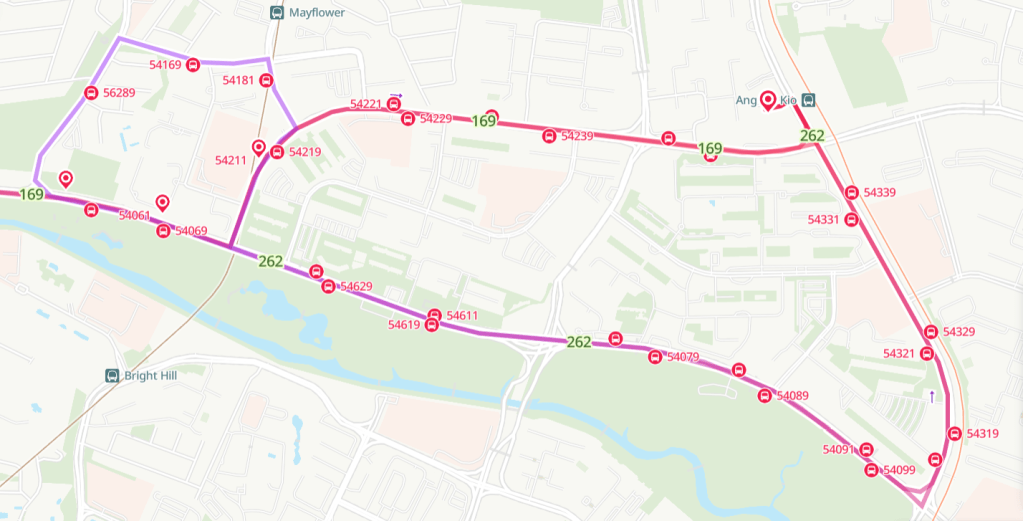
On the other hand, trunk-branded service 169 is a long feeder threading between the Woodlands, Yishun, Springleaf and Ang Mo Kio MRT stations, connecting residential and industrial catchment to MRT more efficiently than traditional feeder services are capable of, due to the bidirectional connectivity it offers. Because it connects the Woodlands industrial area to Yishun directly (somewhat), 169 runs very frequently during the peak hours to meet this demand. There’s one problem however. Within Ang Mo Kio, 169 exits the town by travelling through Ave 3, then turning onto Ave 1 and exiting to Upp Thomson Road northbound. Here’s the thing: every westbound trunk and feeder service in Ang Mo Kio shares the same Ave 3 sector. Buses 132, 165 and 166 also exit to Upp Thomson Rd using the exact same route, while 76, 265, 268, 269 share the same corridor to serve Mayflower station, where 262 loops at. To meet high demand in the Woodlands industrial area, 169 is very frequent in Ang Mo Kio too… but the buses are empty even during peak hours, because of rampant duplication with other trunk and feeder services. Considering 169 deploys a majority fleet of double-decker (and sometimes bendy) buses running at 6-10 minute intervals, that’s burning a shitload of fuel to move barely anyone around.
Instead of an infrequent feeder serving residents in western Ang Mo Kio and a frequent trunk carrying fuck all throughout the day as a result of duplication, a smart way to rebalance resources is to amend the frequent trunk service to ply the feeder’s route, reducing the number of buses needed in total, and enhancing last-mile journeys for residents along the former feeder route. In this case, it entails discontinuing feeder 262, and amending 169 to ply its route in lieu of it.
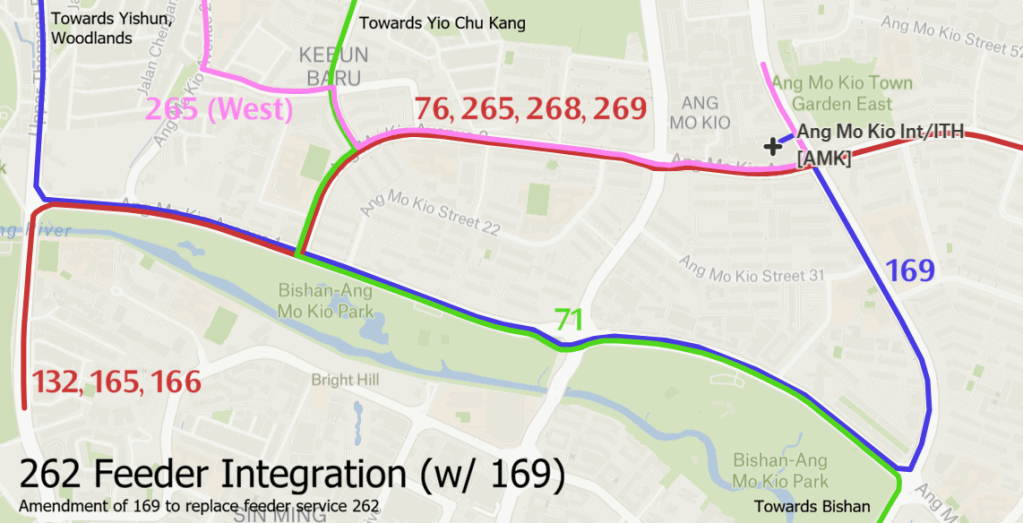
The effect here is two-fold — high-capacity buses on 169 can be better filled with higher feeder ridership instead of competing with several other bus services for the same limited ridership down the same corridor. Residents in turn, enjoy shorter waiting times, and the added side benefit of a direct connection to Springleaf and beyond. And the entire fleet formerly assigned to 262 can be taken out of service, if the fuel shortage gets serious enough to start grounding fleets. Furthermore, by reducing duplication along Ave 3, this enables the other trunk services (132, 165, 166) to be more well-utilised, reducing the overall fuel wastage present. This is in line with the earlier-stated philosophy of emphasising high-quality trunk-line transit, even if to meet short-haul trips that are more last-mile in nature.
There might be some missed connections as a result of the above changes, so let’s address them too. Residents along Ave 1 might bemoan the lost connectivity to Mayflower station on the TEL, which 262 enabled from day one of the former’s opening. If they were headed north, 169 to Springleaf would fulfil this connection too, but for the more time-conscious and southbound riders, a gentle reminder that 71 (which also predates TEL by about five years) is also capable of fulfilling the initial connection from home to TEL. Residents along Ave 2 and St 13, where 262 loops and are rightfully concerned about the loss of one feeder route (out of two). They need not worry, because the west loop of 265 that also serves them, with its unique catchment along Ave 2, makes it an essential feeder where it should be striven to maintain service upon even when fuel is short.
Is there room to encourage some modal shift to rail to further reduce the demand for diesel fuel in the public bus industry? Yes, but there’s less headway to be made conserving fuel here than through other avenues described above. Forcing further increases to ridership on the 6-car compass lines (NSEWL, NEL) is a no-go, given sufficient painful experiences from the past half decade alone. Neither should further strain be applied on the CCL, or at least in the northern half where the upcoming CCL6’s opening doesn’t help alleviate. There might be space to encourage ridership on DTL and TEL (where frequency isn’t yet maxxed out), but it has to be balanced against excessive loss of connectivity along the highly linear road corridors upon which these rail lines are aligned upon. Much of the slack up for cutting has already been cut in bygone (ir)rationalisation exercises for the DTL and TEL, I’m afraid.
Rethink the last mile
Traditionally, the role of providing last mile connectivity in our transport system has fallen largely upon feeder buses, and even the most recent policy direction from LTA is still inclined towards maintaining this arrangement, as has been the case for the past 50 years. Other forms of last-mile connectivity, such as encouraging cycling and utilisation of bike-sharing, have been on (a very slow!) rise in Singapore, but continue to remain a significant minority in the transport mix, largely due to reasons related to the way our streets and housing estates are not designed with active mobility modes in mind. This is probably a topic to explore another time, but the when it comes to maintaining viable operations that still ensures timely journeys for commuters, the math is stacked against the entire idea of specialised feeder bus services, and that’s even more so the case now that additional limitations are imposed on fuel consumption across the board. Earlier parts of this article mention a distinction between essential and non-essential feeder routes; resource commitment towards even essential feeders could be minimised further if alternate modes in last-mile connectivity can be effectively promoted.
It goes without saying that with road-based (and in Singapore: still largely oil-fuelled) transportation being severely impacted by the fallout of the new Middle Eastern oil crisis, it’s the prime opportunity to redesign our roads for a more balanced transport diet. For years LTA has been unilaterally promoting “Walk, Cycle, Ride” as a substitute to driving, but due to the way our built environment is designed, most meaningful progress has only materialised in the last pointer. To push forward the viability of walking and cycling within our communities would require some significant reforms to road design, and potentially even the layout of our urban communities. The Government is encouraging Singaporeans to reduce car usage to reduce stresses on existing and stockpiled oil reserves. This should come accompanied with re-allocating road space to more accurately reflect the far greater proportion of people (over 70%) who are on public transport and active mobility compared to driving private vehicles, and the opportunity for it has just presented itself.
Here’s an inspirational anecdote from history: the last oil crisis of similar scale and nature in 1973 spurred the development of France’s TGV high-speed rail system to reduce the reliance on oil-based intercity transport, which opened in 1981. The oil crisis of 2026 could well be Singapore’s “TGV moment” — not for high-speed rail, as much as I wished the Malaysians got their shit together over that, but for revamping our streets and communities to better accommodate active mobility options in addition to a public transport system enjoying a stronger central position in our transportation diet.
De-risking
With rare earths supplies being strangled, is it game over for the quest of our bus system to fully electrify by 2040? At least for PT602, not so — with an entirely Chinese consortium (BYD, Yutong, CRRC, Zhongtong) winning the contract, the worst of the EV production line crunches has been avoided for now. As much as we promote high-quality Chinese products as cost-sensible alternatives that can be procured in more abundant quantity, Singapore’s firm alignment within the Western camp in the emerging Cold War means that the entirely Chinese-dominated first and second batch orders of electric buses are likely to be an aberration, rather than a new procurement trend moving forward. It’s already politically incorrect in Singaporean society to favour anything to do with mainland China, and having Chinese-made MRT trains and buses dominate recent orders has certainly drawn their share of backlash. But the economics is clear with Chinese export sanctions on rare earths which EVs rely on: accept the Chinese century in EV production or wither amidst skyrocketing production costs.
Of course, this isn’t something the Singaporean government likes, and I’m sure there’s a camp within highly resistant to a Chinese-dominated public transport fleet. The good news for those who stubbornly insist on clinging to the delusion of American dominance is that alternative propulsion technologies are in the works to break the rare earths hurdle in creating high-efficiency EV motors. One recent breakthrough is the translation of SiC-MOSFET VVVF technology used in railway trains, to smaller-scale applications such as electric cars and buses as an alternative to PMSMs requiring the use of controlled rare earths. (These achieve 99% efficiency, compared to 95% in PMSMs!) With rare earth shortages affecting the rest of the world significantly, there is some possibility of viable non-PMSM alternatives to EV propulsion being made available on the market in the near future, which should make those fearful of Chinese market dominance sleep a little more soundly at night.
When hell freezes over
When the worst of the fuel crisis hits us, what can we expect of our public transport system if it is to still serve us adequately? Assuming the rest of the economy (less sectors directly affected by fuel) remains relatively unscathed and employment levels are maintained, and the normal operation of the MRT system, the biggest difference from today’s idle peace would be a complete reorganisation of bus services for the express purpose of conserving highly limited fuel supply available. Perhaps the routes might remain recognisable to someone from the present, but its unlikely they would remain exactly the way they are today.
Disclaimer: things stated below is exclusively intended for use only in emergency situations. Unless mentioned elsewhere also, these would never be advocated for peacetime otherwise, unlike other “dual-use” proposals listed above that have merit even when fuel is aplenty.
The basics of an emergency bus network would be the same as stated above: the de facto abolition of the Bus Contracting Model as we know it through dismantling the rigid boundaries that have defined the system for a decade. By that point it might even be necessary to mandate all the four existing public bus operators to merge under a single unified command structure for maximum operational efficiency, such that dead mileage is cut to an absolute minimum. Some overnight parking in bus interchanges might even be necessary where dead mileage is simply too great due to non-administrative reasons.
“Rapid” routes, with consistently wide stop spacing and fewer stops in general, would be introduced, either as new routes or as replacements for existing long-haul local trunk services to maintain long-haul bus connectivity where the MRT falls short. With guaranteed signal priority through traffic junctions and stopping infrequently, these rapids conserve the most fuel by reducing fuel consumption throughout the journey, and reducing the number of buses needed to run them in the first place.
By this point, many non-essential feeder routes would have been eliminated, leaving essential feeders for coverage purposes and high-intensity trunk services covering the bus network as we know it today. Besides the rapids, many other trunk services might need further adjustments in a severely advanced phase of the fuel crisis. At this point, a further fuel optimisation of trunk services could be achieved by having local trunks “skip” alternate bus stops, such that they too can operate at fuel-efficient higher gears for longer periods. This caters to the supermajority of the public bus fleet that continues to be powered by diesel today, a position lasting well past 2030. With bus stops wider apart, walking further to the bus (standard or rapid) is encouraged, or the use of bicycles to access trunk buses of different service types that may be slightly further away from homes in this contingency situation.
We understand that hyperlocal connectivity might be necessary because not all demographics of people can walk the longer distances that an emergency system like this would require, and whilst most of the post appears to operate on the assumption of an all-diesel bus fleet, this is where the 500 (or 1160, come 2028) electric buses in our fleet shine. As electric buses whose energy supply is better insulated from the shock of external geopolitics than diesel buses are, they can be reassigned to operate on all-stopper “local” services (aka the stopping pattern seen today) that are more energy intensive, providing coverage to bus stops skipped by the standard and rapid routes described above. This ensures that limited diesel fuel is truly used in a highly efficient manner to serve the most number of passengers.
Frankly speaking, that’s still a terrible position to be in, and while the contingency network described above has been designed to minimise the pain while maintaining service, converting the vast majority of trunk bus services to skip alternate bus stops is going to be highly unpopular, even among those physically capable of waling the extra distances such a network would require. Hopefully, the oil crisis doesn’t last long enough for us to be forced into such contingency measures to begin with, but it’s anybody’s guess as to when the war will end (or subside), and when the global crude oil supply chain can return to normal.
tl’dr:
Everyone who has to rely on an oil-fuelled vehicle to get around will get shafted to varying extents, public transportation inclusive. But amidst what is tempting to view as a doomsday event, lies great opportunity to transform our transportation system to be more resilient against similar episodes in the future. Make this a good wake up call for ourselves to actively pursue policy decisions in public transport and active mobility to be more energy-efficient, and potentially nudge us towards a more thorough realisation of what being a car-lite Singapore truly means. Long-term visions calling for an electrified bus fleet, more MRT lines (*taps sign furiously*) and greater active mobility uptake are all pointed in the right direction already. What’s needed is the sensibility to make the right decisions to tide us through in the short term, such that when all of this is over, we aren’t left licking our wounds all over instead of focusing on the next step.
At this point, the fuel shortage isn’t even an administrative issue for Singapore to tackle. it’s a geopolitical one, but one whose complexity and scope of discussion exceeds that of a transit blog here. At the very least, our government should refrain from engaging in unsolicited, pretentious moral posturing that only serves to further jeopardise our fuel supply lines, and inflict unnecessary pain on the livelihoods of Singaporeans. Unless everyone is wrong and we somehow do have years and years of undisclosed crude oil reserves somewhere that gives them the audacity to gamble with our supply lines, but what’s the probability of that?
It’ll make for a very eventful December definitely. Any guesses how much the PTC plans to raise public transport fares by, even if deferred?
You may continue to monitor prices for petrol (92, 95 and 98-octane) and diesel in Singapore through the Motorist.sg website. Data in this post accurate as of publication on 11th April, 2026.
Interested in building a better future for Singapore’s transport? Join the STC community on Discord today!
 Singapore Transport Collective
Leave a comment