

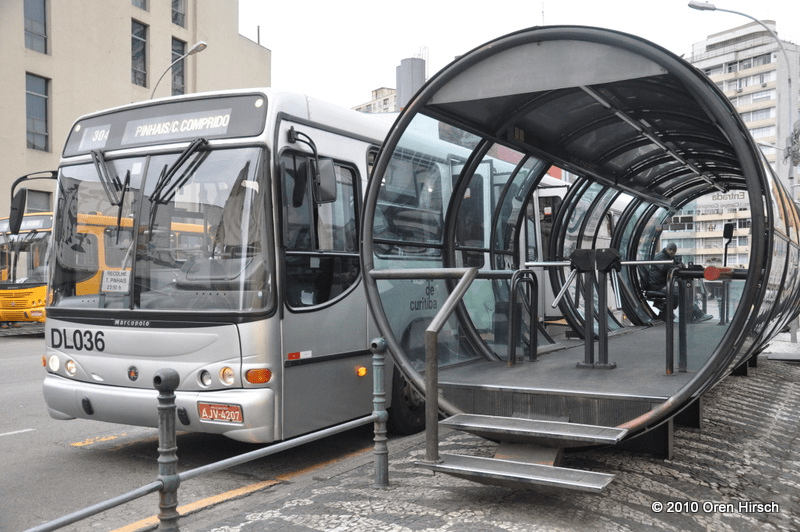
Well technically, the city in question should have more than just two bus maps — two refers to the number of maps used on its BRT system only, with other maps likely out there for conventional bus services beyond it.
Shoutout to @transportecoletivobr on IG for bombarding my feed enough to inspire me to jump into yet another rabbit hole again after a very long while. Despite the name similarity, they’re not affiliated with the Singapore Transport Collective!
If you’ve stuck around in the field of bus priority solutions long enough, chances are that you’d have most likely heard of the pioneer Bus Rapid Transit (BRT) system that started it all — the Rede Integrada de Transporte (RIT), or known more plainly as Curitiba BRT. Its development since 1974 has brought about most of the characteristics we associate with BRT today: higher-capacity buses, top-notch bus priority, all-door boarding (and off-board fare collection), as well as the idea that bus stops need not be a simple shack and pole by the roadside. These ideas would inspire the first generation of BRT systems, implemented in Bogota, Istanbul and next door in Jakarta.
Older readers may also remember the Curitiba BRT mentioned in (older; now discontinued) local geography textbooks as an example of a low-cost alternative to building rail rapid transit for main trunk public transport corridors, which also prominently feature the iconic red bi-articulated buses to highlight the system’s high capacity. Those are buses with three sections instead of the usual two (which are the bendy buses found in Singapore and the rest of the world).
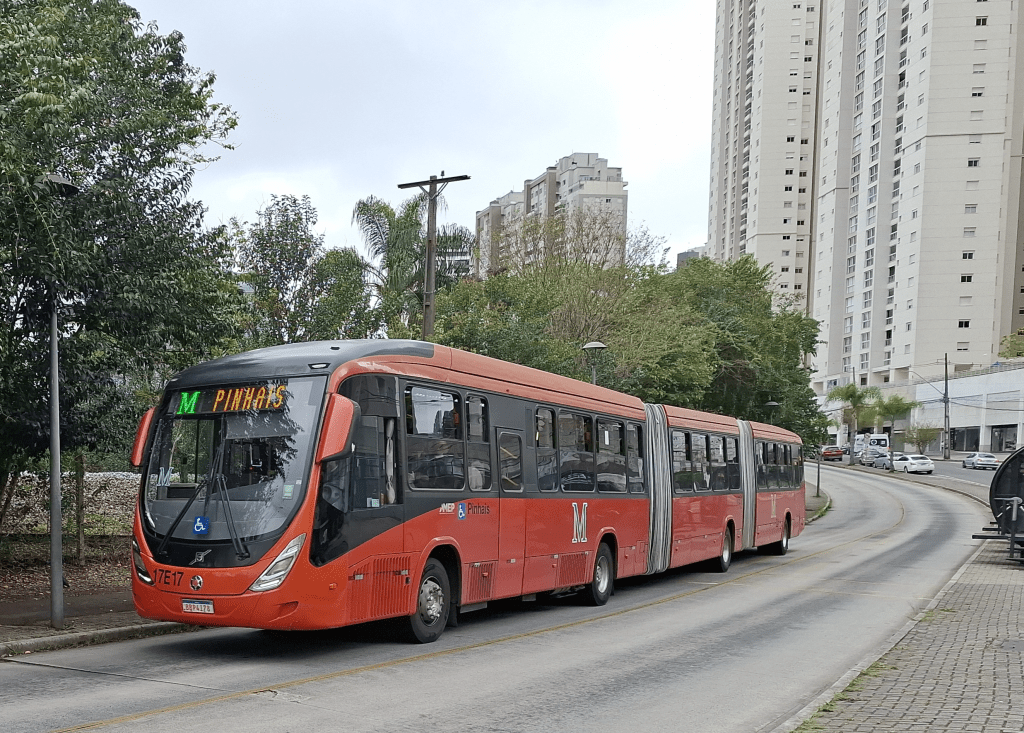
As a system in continuous development since 1974, it would however be remiss to paint an image of it containing only the big, bi-articulated buses, operating in a highly “metro”-like manner. (That’s more similar to Bogota’s TransMilenio, which only uses bendy or bi-articuated buses in the busways) They’re front and center of the city’s brand image, but don’t tell the full story of how the Curitiba BRT works.
It’s in the map
Public transportation systems (at the same scale; ie regional, urban, or local) tend to produce just one single map containing all lines and services operated at that scale. A metro/BRT map, for instance, would attempt to show all its lines on the same map to inform passengers of the coverage and connections offered by the system. Some cities, like Xiamen and Los Angeles, even combine their metro and BRT systems onto the same map, either as part of a unified rapid transit branding or because the routes of each mode complement each other too.
Things get different in Curitiba, where despite the concerted effort to present the BRT system as a unified entity, two distinct maps of the (core busway) system emerge:
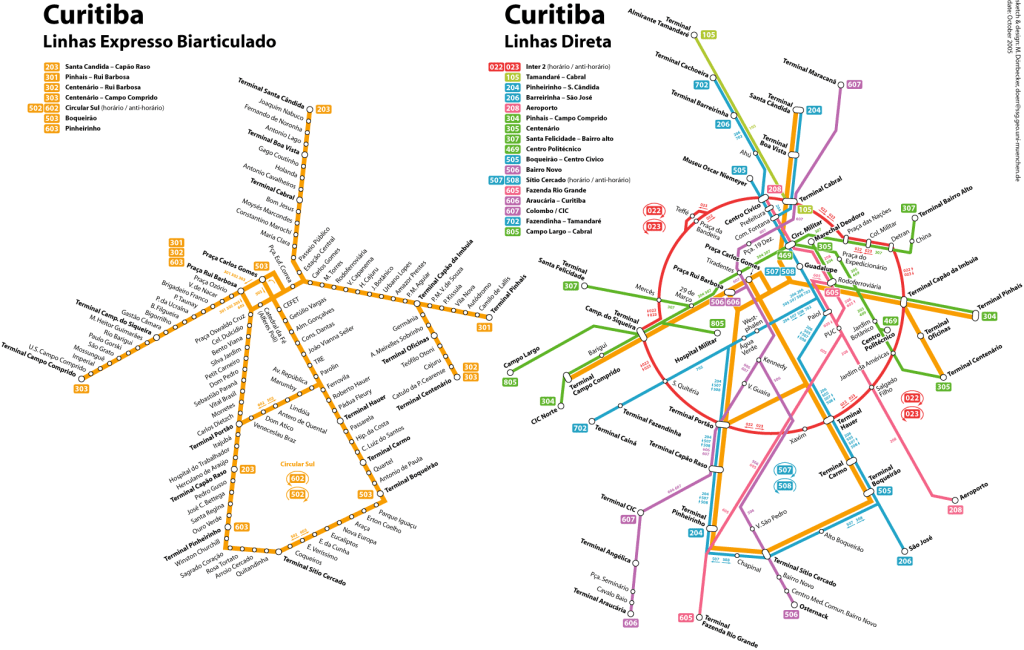
It should be noted that despite being engineered in every way possible to become a “closed BRT” system (services limited strictly to infrastructure) like many of its successors (Bogota, Istanbul) became, the Curitiba BRT is increasingly evolving towards an “open BRT” system (services flow beyond infrastructure into general traffic), particularly at the periphery where the system interacts with suburbs and other cities, with the help of specially-designed buses that can serve both roadside stops and purpose-built high-floor stations on the legacy system. This is an inevitability brought about by the system’s network design, which the system’s dual-map setup makes most obvious.
Services that ply mostly on the dedicated bus-only roads making up the core BRT system are divided into two categories: Linhas Expresso Biarticulado operated by a full fleet of bi-articulated buses (as the name suggests), and Linhas Direta, which cross multiple core corridors and extend the BRT’s coverage beyond their immediate reach. The latter is overlaid on an oversimplified map of the former to guide navigation in the more complicated network
Linhas expresso biarticulado (biarticulated express lines) is what comes to mind for most when the Curitiba BRT is mentioned. They form a simplified, lean network confined to the core BRT corridors, and due to the way the buses are built, are dependent on the purpose-built, iconic “tube” stations to operate. Unlike the systems they inspired, these services operate very similarly to rail rapid transit, with only one or two distinct routes operating along a given corridor segment. These were the product of consolidating the old first-generation routes when higher-capacity bi-articulated buses were introduced in 1992. All services are operated fully with red (all-stopping local) or blue (express) high-floor bi-articulated buses.
Linhas direta (direct buses) are another type of service utilising the Curitiba BRT infrastructure. As their name suggests, they offer direct connections across different linha expresso biarticulado corridors, sometimes even by operating outside the BRT system for part of their route to avoid detouring through the largely-radial busway network. Unlike their main trunk counterparts, “direct” services typically operate using lower-capacity single-articulated (= typical bendy bus seen outside Latin America) or rigid buses, and are painted silver or white. Because of their ability to bypass a detour through the downtown core, buses operating on linhas direta are also christened ligeirinho (quick) by locals.
These BRT buses are also supplemented by green interbairros (local trunk / long feeder) and orange alimentador (feeder) buses outside the dedicated infrastructure, operating in mixed traffic to connect the rest of the city to the BRT network.
| Service type | Translation / Route profile | Livery colour | Typical fleet |
| Linhas expresso biarticulado / Ligeirao* | Biarticulated express line Fully within core BRT corridors, operates local-stop* pattern. Simpler, consolidated route network | Red / Blue* | Bi-articulated bus (High floor only) |
| Linhas direta / Ligeirinho | Direct line / quick bus Partially within core BRT corridors, rest of the route in general bus lanes across the city. Dispersed; point-to-point connective network | Silver White (spares) | Articulated bus Rigid bus (Mixed: high floor and street level on the same bus) |
| Interbairros | Neighbourhood bus (lit.) Local-stop trunk or long feeder operating entirely outside BRT infrastructure | Green | Articulated bus Rigid bus (Street level boarding) |
| Alimentador | Feeder Feeder services specifically designed to connect to BRT | Orange White (spares) | Articulated bus Rigid bus (Mixed) |
| Convencional | Conventional Full operational separation from BRT system | Yellow | Rigid bus (Street level boarding) |
White buses appear to be interchangeable between alimentador and ligeirinho, as both interface with the legacy BRT infrastructure
Convencional buses differ from interbairros in terms of integration with the BRT network at node stations.
The linhas direta system serves two key functions in the Curitiba BRT network. One, they provide a faster and more direct route between points on different main busway corridors that would otherwise require multiple transfers, a significantly more long-winded route by trunk busway corridor, or a mix of both. Some of these form important, complementary orbital connections that connect the outer edges of the core BRT corridors (the red orbital 022 / 023 routes in the map above is the most obvious example, but similar cases exist that are not reflected on the simplified map above) with standards of service not any inferior to that on the linhas expresso biarticulado. Crucially, this takes advantage of the ability for buses to be flexibly routed based on the available road network, rather than be confined to the direction set by permanent infrastructure as seen in rail.
Two, the ligeirinhos expand the benefits of the BRT system beyond the core busways indicated by the extent of the linhas expresso biarticulado. Linha direta services may use the core bus-only corridors (served by the bi-articulated red expresses) for parts of their route to connect to the main arterial corridors of the BRT system, but diverge off into a general road, with bus priority still in place. This expands the BRT’s coverage without the high capital costs or disruptiveness of reconfiguring less major road corridors around strict land use and road management standards set in Curitiba. (As the system was first conceived in 19741, the core BRT corridors that later received the bi-articulated expresses had a strict density management plan around the periphery of the bus corridor, as well as a total reconfiguration of streets and blocks to put the BRT front and center of the city’s radial axes)
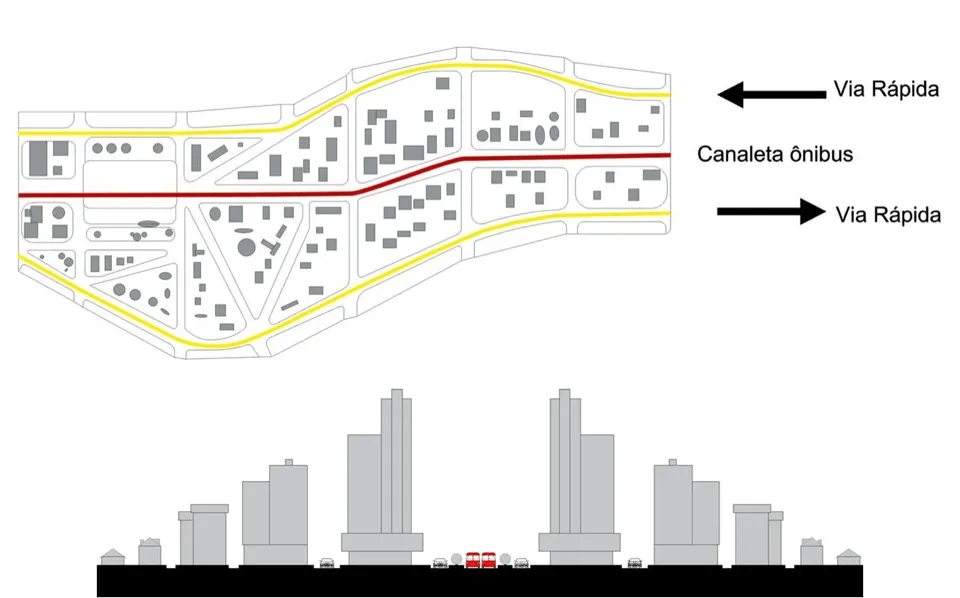
Why do ligeirinhos operate with smaller buses than their linhas expresso biarticulado counterparts? Fundamentally, both service types are built with different goals in mind. The red express buses are designed for raw capacity, meant to move huge volumes of people down highly dense main urban corridors, with throughput being the key focus. Hence, the linhas expresso biarticulado tend towards all-stopping patterns, consolidated routes and stop patterns, and raw emphasis on extremely high frequency service during peak hours. In other words, these operate very similarly to trains, specifically metro lines found in other cities that also feature similar service patterns.
The silver ligeirinhos on the other hand, while also intended to move lots of people, (and formally intended to enhance the capacity of the busways2) are instead designed for distributive connectivity across the entire city. Their strength lies not in using the biggest buses the world sees, but in the large quantity of routes that offer many fast connections between multiple main BRT corridors and beyond. Because there’s many more linhas direta that offer cross-corridor coverage and connectivity, a similarly large volume of passengers can be moved across Curitiba without the need for too many additional bi-articulated buses, which don’t fit down every corner of the city also. The ability of the ligeirinhos to disperse crowds across the wider Curitiba BRT system ensures crowding on the core linhas expresso biarticulado corridors, especially through the central downtown segment where all of them converge upon, doesn’t get out of hand. In contrast to the red express lines, ligeirinhos are designed with access being the main focus, instead of solely throughput.
Riders new to Curitiba would be more inclined towards using the linhas expresso biarticulado, whose simpler network and stronger legibility offer predictability and consistency to the trip. I suspect this is why far too much coverage of Curitiba’s BRT only extends as far as the big red bi-articulated buses, because they’re the easiest part of the system to understand, compared to the more complex weave of services offered by the silver ligeirinhos, green interbairros and orange alimentadors that cover much more of the city than the red buses do. On the other hand, local residents more adept with the intricacies of the bus network would consider potential ligeirinho options for a faster ride instead, especially when taking into account the fact that despite following the same corridors as the bi-articulated expresses, the ligeirinhos call at even fewer stops, effectively serving as an express variant to the already-fast core BRT system.
If that’s too much information to process, here’s an (over)simplified overview of how the Curitiba BRT system is organised:3
| Service type and colour | Network role in RIT |
| Linhas expresso biarticulado Red / Blue | Arterial rapid transit |
| Linhas direta / Ligeirinho Silver | Secondary rapid transit |
| Interbairros Green | Local corridor transit |
| Alimentador Orange | Last-mile connectivity |
| Convencional Yellow | Miscellaneous |
Singapore’s “Missing Middle”
Probably you’re wondering the relevance of introducing this quirk of Curitiba’s BRT system to us, living on the polar opposite of the earth from some small random Brazilian city only known for being the birthplace of BRT. Certainly, this post isn’t asking to make bi-articulated buses mainstream in Singapore, not least because of the different scales of population density we’re working with here.
The Singapore public transport network is made up of the MRT, LRT, trunk, feeder and express buses. It goes without saying that even without the explicitly hub-and-spoke oriented planning policy of LTA in place, the MRT is still intended to play the role of arterial trunk transport in the overall public transit system. Like with the linhas expresso biarticulado in Curitiba, the MRT is designed to move shitloads of people quickly and efficiently, at the cost of immediate convenience and sometimes even travel time, due to the largely radial nature of the system currently. In Singapore, that’s achieved with big trains (whether they’re big enough, or run frequent enough, or should be increased further in quantity and size, is an entirely different topic altogether), high frequency, and because of its design as a rapid transit line, the operation of only a single service pattern (excl. regular short turning) along any given sector of MRT line.
Our bus services, particularly “trunk” branded routes, as a result of many decades of past planning legacy, largely take on the role of either last-mile connectivity within residential and industrial towns, or as local transit along corridors located away from MRT lines. In three selected towns, the former role is also played by the respective LRT systems. Because Singapore once ran an all-bus public transport system, we inherit a complex weave of hundreds of routes that crisscrosses most inhabited areas, providing direct connectivity between different MRT lines and expanding public transport’s coverage beyond the immediate reach of the MRT system. That sounds like the role played by the ligeirinhos in Curitiba, but there’s an important catch: with mostly all-stopping service patterns and slow travel times, it is hard to equivalate existing bus services in Singapore to the ligeirinhos of Curitiba.
While the ligeirinhos of Curitiba are an extension of the core express (biarticulated) corridors, one would be hard pressed to state the same relationship between our public bus services and the MRT. Even bus services with express sectors here can only, at best, be described as a slightly enhanced version of their local-stopping counterparts, and might fare worse in other aspects such as waiting time and capacity too!
In form and function, local bus services in Singapore instead resemble the interbairros and alimentadors more closely — without bus priority protections, and operating fully local-stop services connecting transfer nodes in the network. And on a semantics level, the interbairros use green buses too, just like the BCM-era standard livery 🙂
| Network role | Curitiba BRT | Singapore |
| Arterial rapid transit | Linhas expresso biarticulado | MRT |
| Supplementary rapid transit | Linhas direta / Ligeirinhos | Does not exist* |
| Local transit | Interbairros | Trunk bus |
| Last mile connectivity | Alimentador | Trunk/feeder bus, LRT |
| Point-to-point connectivity | Convencional | Trunk/express bus |
Express bus services (inclusive trunk-branded expressway buses) in Singapore tend also to be designed based on a point-to-point philosophy, as it was the prevailing planning doctrine in the 1980s and 1990s when many of these higher-speed bus services were introduced. This meant passing over major transfer nodes with other bus services (and the MRT!), as well as a strong focus on providing one-seat rides, rather than overall travel time, accessibility and growing ridership. Sensible strategies for implementing faster buses (regardless whether part of an all-bus BRT or intermodal transport system) place more emphasis on these latter aspects, particularly if the intent is to open up alternative pathways in the network to alleviate congestion on arterial lines. (Failing at these aspects would also mean failing to reduce overcrowding on the arterial lines, which severely impacts riders’ quality of life. Just ask Bogota’s TransMilenio next door, or any resident in northeastern Singapore.)
Why is it frequently said that public transport riders in Singapore don’t have much alternatives to the MRT, even if trunk bus alternatives may be available in their region (say, in the west or east)? A large part of it boils down to the fact that, as a result of rail leading the transport planning process but failing to deliver timely growth in sufficient quantity, Singapore lacks the “missing middle” in the public transport hierarchy: a “secondary rapid transit system” that also operate at fast speeds, but designed as a complex, dispersive network that effectively distributes excess passenger crowds from arterial trunk routes. A commuter in Curitiba who is unable to board an overcrowded expresso or ligeirao service can resort to riding the ligeirinhos with no additional penalty (or less!) to his travel time. This is a luxury that the average Singapore public transport commuter cannot enjoy, and is a key part of why despite having thrown everything to repress car ownership rates here, the desire to own a car is only getting stronger. For travel time to come at the cost of comfort or service availability is a trade-off that world-leading public transport systems should not be forcing their users to make.
As mentioned above, an entirely local, all-stopping bus system does not meet this description. That’s why they can feel empty at times (especially during offpeak), because despite them technically meeting the criteria of being an “alternative to the MRT” which is in demand, riders who value travel time more in their decision-making matrix choose the MRT instead anyway, despite the number of local buses available.
More complex than “MRT 2”
In past articles and online commentary introducing the concept of rapid buses to Singapore, I’ve often described them as “a cost-effective means of expanding the benefits of MRT to areas without MRT”, or something along those lines. While it’s a simple way to visualise how rapid buses work and what they could potentially do, I never found that explanation particularly effective or satisfactory, as that ignored the many nuances in potential applications for rapid buses here in Singapore, be it upgrading existing long-haul trunks to rapid or introducing entirely new rapid routes.
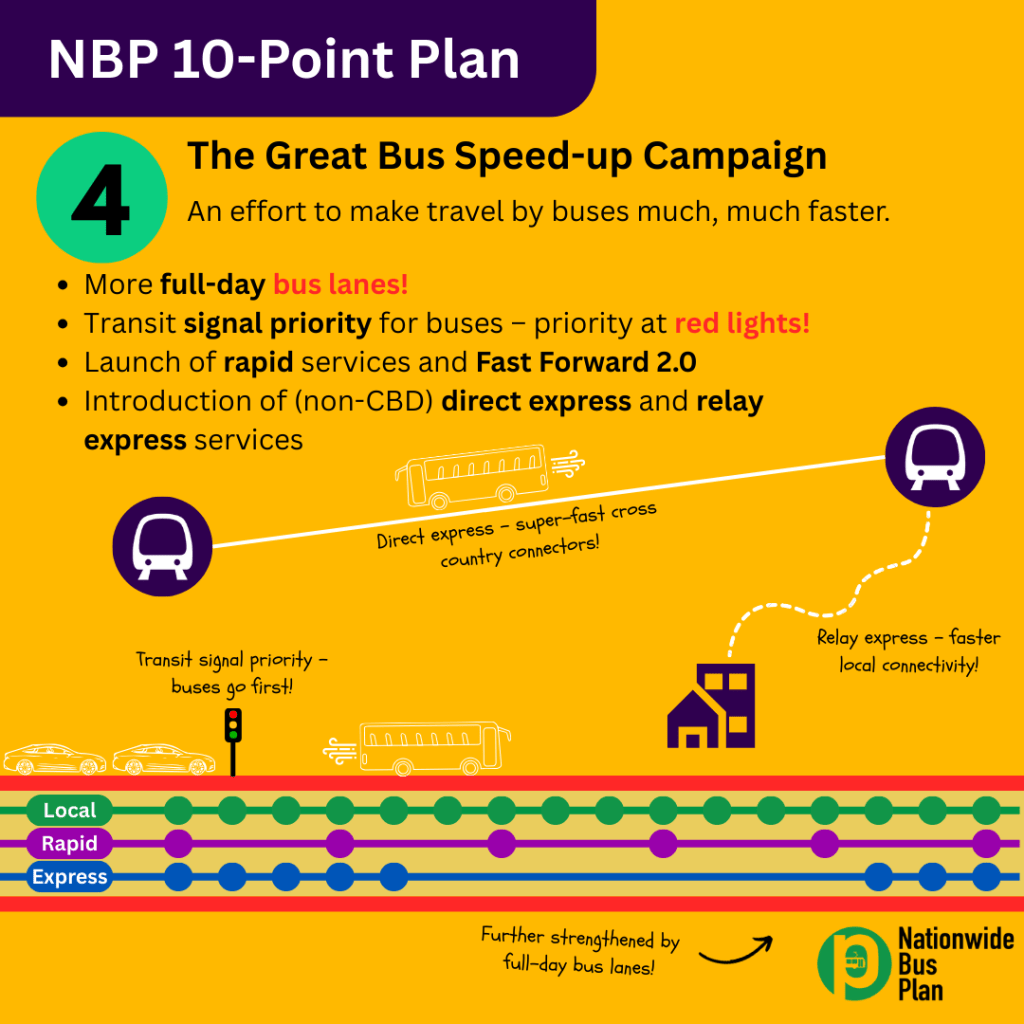
Yes, the MRT is also a rapid-stopping service relative to local buses seen in Singapore, and so are rapid buses, but ultimately the difference in capacity between MRT trains and rapid buses means vastly different ways of organising the network, even with similar stopping patterns in place.
Some (but very few) rapid bus services would probably still take on arterial trunk roles, due to the genuine lack of public transport connectivity, or because of the layout of our road network here. In certain areas, it might even coincide with existing and upcoming MRT lines in part due to the same aforementioned reasons, or because the MRT corridors in question are currently oversaturated.
The vision for most rapid bus implementations in Singapore however, lies closer to a distributed network that forms connections between different arterial transport corridors, linking MRT lines and bus-oriented medium-capacity corridors alike. Like with the ligeirinhos of Curitiba, it wouldn’t be far-fetched to think of them running alongside an MRT line for 2-3 stations, before diverging off via other routes to connect to other major corridors, and then on to points beyond that reachable by the main arterial transport network.
Filling the missing middle between capacity-oriented arterial trunk transit and slower, last-mile focused local transit is the sweet spot that rapid buses fill in the Singapore public transport diet. As a secondary rapid transit system to the MRT, the rapids which can be more nimbly routed, weave between the gaps left by the MRT network (that won’t be filled anytime soon) and jointly form a comprehensive network that is time-competitive against driving, even for journeys that the rail network alone does not immediately favour. With existing resources and infrastructure, we can easily replicate the function of Curitiba’s ligeirinhos in our own public transport system to deliver better travel time outcomes for riders.
The advantage of having a closed rail rapid transit system (rather than a semi-open busway, like Curitiba) for arterial trunk transit means that it takes even less to establish the equivalent of the ligeirinhos islandwide — no need for specialised stations, or specially-engineered buses that are compatible with both street-level and high-floor boarding. In our case, short of minor performance modifications to our buses and implementing strong signal priority at intersections, we are good to implement rapid bus services with what we have today.
Here’s an example of a potential rapid bus service that could be applied with significant travel time benefits for travellers between northeast and western Singapore. (Also, they say Tengah lacks good connectivity, right…)
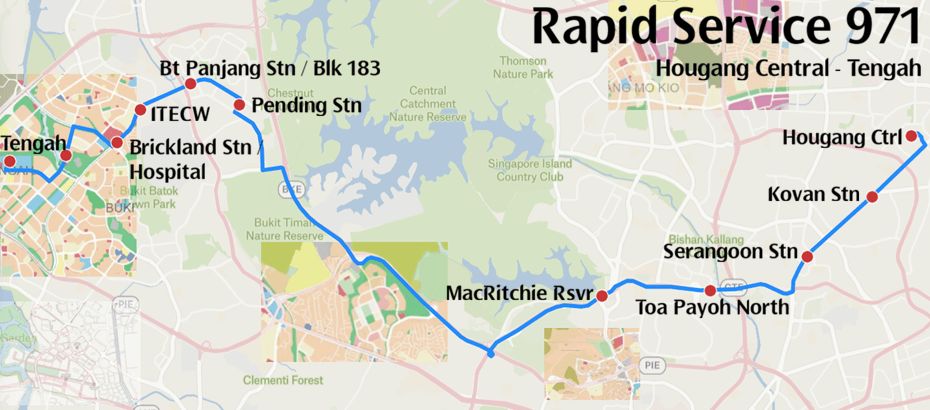
With only 10 stops made between Tengah and Hougang, this is unlike your typical local bus in Singapore — a journey that otherwise takes upwards of 1h30 or more can be completed within 50 minutes, end-to-end! Supercharged by an express sector along the PIE and BKE, that gives an average speed of 31km/h throughout, which puts it above many BRT systems out there (that are built to resemble Curitiba’s red expresses — capacity-oriented design, coverage-minded services), which manage average speeds of about 25km/h. For reference, the last known figure for average bus speed in Singapore’s unprotected bus system is 16-19km/h from 2008.
971 begins in Tengah, where it strings together landmark institutions such as the planned Brickland hospital and ITE College West, linking them to the JRL, NSL and DTL at Bukit Panjang. These are areas beyond the MRT’s immediate reach, and thus its role is to serve as an equivalently quick connection that expands the coverage of rapid transit quality service there. Past that, the Bukit Panjang and Pending stops are positioned to enable maximum access with one transfer to any (existing today!) local bus from any part of Choa Chu Kang and Bukit Panjang. The same can also be said of the MacRitchie and Toa Payoh North stops, which expands 971’s effective catchment to Sin Ming, Bishan and Toa Payoh, whilst also doubling up as key connection points along the ORRS and Upp Thomson Rd MCCs where plenty of local buses play connecting trunk and feeder roles. Lastly, 971 duplicates the NEL for 3 stops between Serangoon and Hougang, bringing the service to where it’s needed in the northeast — where a transfer to the NEL is not needed just for residents deep in the northeast to access this fast orbital service.
Overall, that makes for an effective cross-island ligeirinho service adapted to the needs of Singapore’s intra-heartland travel patterns. But some would already be jumping to bring up the CRL, not least when seeing the general alignment of routes like 971 that bridge the west to the northeast, terminating at Hougang nonetheless. Isn’t this duplication? Shouldn’t we not waste bus resources on MRT duplicating services?
Not if the CRL doesn’t serve areas such as Tengah, Brickland or Bukit Panjang. A gentle reminder too that by the official LTA timeline, a continuous rail link between Tengah and the CRL will only be completed by the late 2030s4 as part of the JRL West Coast Extension (and will be slower, if not taking the same time as 971!). The effective catchment of 971 in Toa Payoh, Bishan and Sin Ming also set it distinctly apart from the CRL’s alignment through Serangoon North and Ang Mo Kio. As a rapid bus completing the overall Singapore rapid transit network, 971’s route might not require the immense capacity of a MRT or (true) LRT, but commuters will continue to value it for delivering shorter travel times than multi-transfer trips through the rail network, and its service of areas beyond the reach of possibility for rail expansion in the foreseeable future. That’s the value that rapid buses bring to the table, even as the rail network continues to expand. It also goes without saying that the CRL is coming earliest in 2032, while rapids like 971 can be implemented today, once the infrastructure for transit signal priority is sorted out.
A strength rooted in history
Earlier I did mention how Singapore’s complex weave of bus routes created by yesteryear might lend some to falsely assume equivalence with the ligeirinhos, despite the former’s local-stop patterns putting it on par instead with the slower interbairros. The unspoken second half to that statement thus, is that the basis for our faster bus services can already be mostly found within the current bus network, with relatively little need to handwave additional resources into existence to support rapid bus operations. With some adjustments, selected existing long trunk services suffering from reliability issues, excessively long runtimes or resource bloat can easily become the shining stars of a future bus system that makes whole the overall Singapore rapid transit network in tandem with the MRT. The distributive nature of the linhas direta system already exists in our bus network, and it’s up to us to maximise its potential in providing speedy journeys across the rail network’s gaps.
Now to be clear, there is no dispute that when existing trunk services get converted to take on mainline rapid duties, those living in between shouldn’t be left behind too. While the same distributive nature of our bus network is largely able to cover for some of these lost connections, the need to carefully re-adjust other bus routes to maintain local connectivity cannot be denied, and to state that this is a challenge for bus planning doesn’t require sugarcoating.
Neither is it the case, as suggested by some, that the upgrade of certain trunk services to a rapid-stopping profile would entail widespread loss of local connectivity in the bus network here. That’s some pretty crazy fearmongering at work right there, mixed in with already deep-seated misunderstanding of rapid bus proposals. As even the creators of BRT in Curitiba would tell you, they keep around a vast and vibrant network of local-stopping interbairros and alimentador to fulfil local connectivity needs beyond the BRT system, and in between. They contribute to the colourful diversity of the Curitiba public transport system, and make it whole for all 3.8 million Curitibanos living and working in its service areas. To hyperfixate on just the fast buses only — the linhas expresso biarticulado and ligeirinhos — is to lose the plot completely, even when the subject at hand is the world’s pioneering BRT system designed to make bus travel faster and more convenient for its riders.
And the people making such fallacious analyses about adapting rapid buses to Singapore would be no better than the many laymen commentors who harp exclusively upon Curitiba’s red bi-articulated buses! If only they discovered that even the city’s BRT maps invite exploration of a much more complex, and nuanced world within.
Interested in building a better future for Singapore’s transport? Join the STC community on Discord today!
- https://medium.com/vision-zero-cities-journal/curitiba-50-years-of-lessons-from-the-worlds-first-brt-1601696259c1 ↩︎
- https://www.c40.org/news/curitiba-a-leader-in-transport-innovation/ ↩︎
- https://transicity.wordpress.com/curitiba-2/ ↩︎
- https://en.wikipedia.org/wiki/Jurong_Region_Line#West_Coast_extension ↩︎
Extra content: a cameo shot of an orange alimentador bus plying an interbairros service, courtesy @transportecoletivobr
 Singapore Transport Collective
Leave a comment