

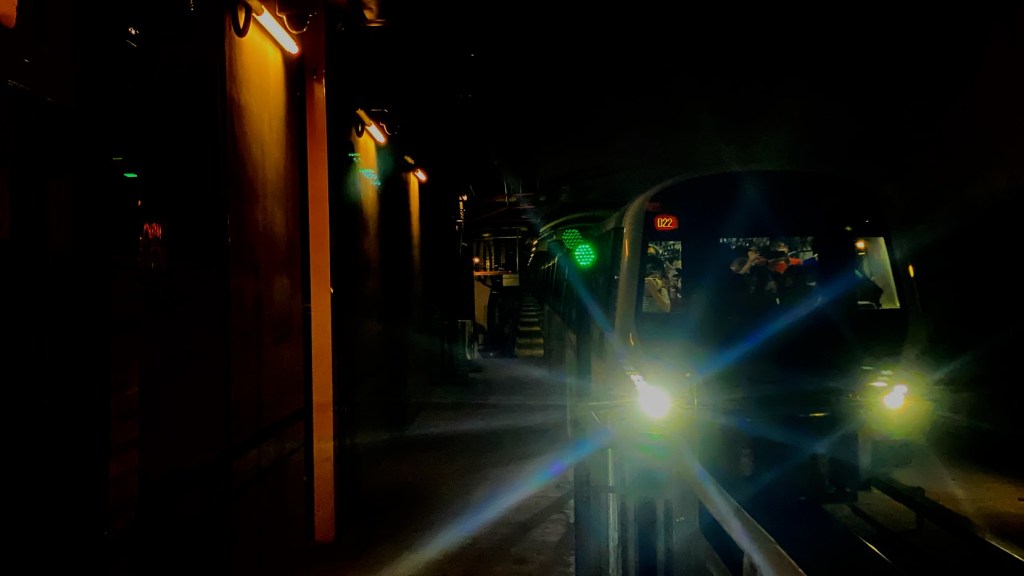
TEL: 31 Jan 2020 – ???
It’s 2025, and the TEL is still incomplete, like it will be until 2026??? What have we learnt about the TEL so far, and what can we do going forward? This post has two main sections: first talking about TEL4, and what we can learn from the TEL altogether.
TEL4: What can we learn from it?
It has been around a year since TEL4 was opened to the public, stretching the East Coast, between Tanjong Rhu and Bayshore. It’s a very simple yet significant extension, mainly just a straight path, but more importantly being the first and only line serving the East Coast.
In this portion (the review), I’ll be using the same benchmarks as AMC did on his TEL post back in 2024, barely before TEL4 opened.
Firstly, on frequency.
Waiting time – 1.5/5
Waiting time stayed the same, and now that there are more towns being served, it would be the perfect time to increase frequency.
Next up, getting a seat.
It’s actually similar demand, as TEL demand is either a node-to-node connection, or a one-way seat to the CBD. It would not have changed much, as not many people would travel the full route from Woodlands North to anywhere past Gardens by the Bay. Due to this, getting a seat would still stay the same at 1/5.
Next up, comfort.
This is one of the parts where the TEL actually got better, as TEL4 (to my knowledge from the open house) does not have as significant a noise issue compared to TEL1–3.
Comfort: 2/5.
As I can’t really compare the speed of TEL4 to other lines, seeing as TEL4 has no interchanges, speed will remain at 3/5.
In TEL3, we mentioned Maxwell, and how its bicycle parking exposed to the elements is not really good for cyclists. Enter: TEL4.
Station design: 4/5. The potential is here.
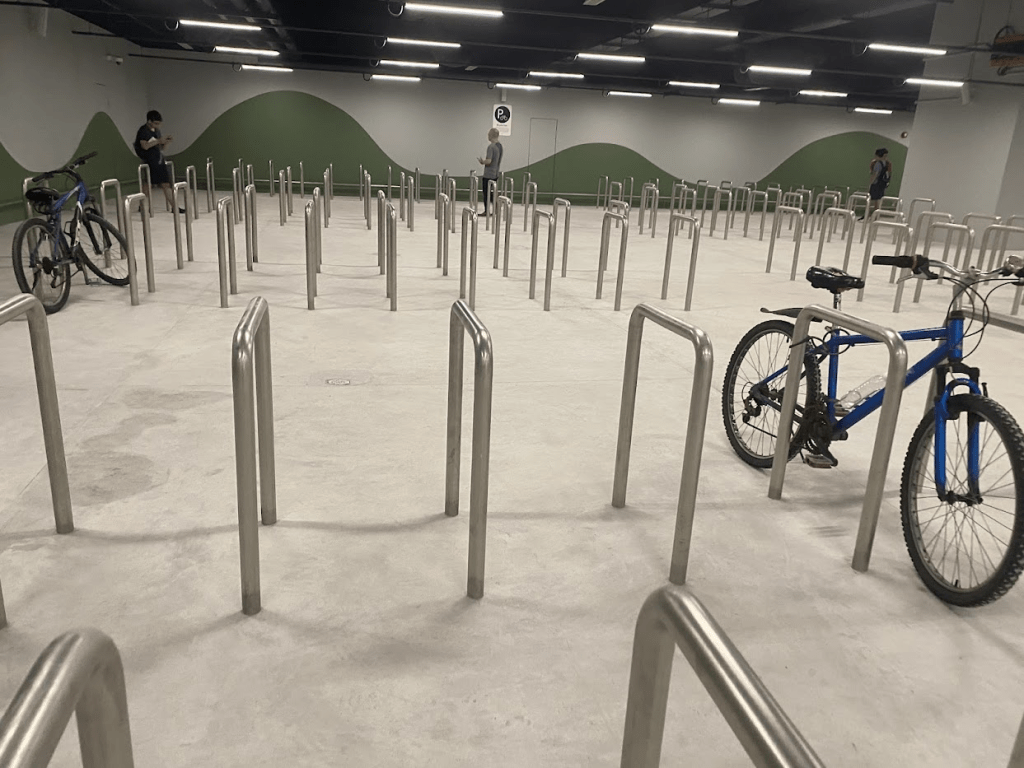
Underground, sheltered bicycle parking is available at Marine Parade, among other TEL4 stations. It’s a really good way of using up extra space! There is also access by bicycles from ground level, which is a really nice initiative!

Frequency
While the TEL does not need extremely high frequency, it is the only train connection for commuters of… let’s see… certain parts of Woodlands, Ang Mo Kio, Toa Payoh, and the entirety of the East Coast.
So being the main connection to these towns means there must be at least a decent frequency, right.
Wrong, as SMRT has proved again, well at least I first saw…

When I originally published this post, I was talking about the photo above, with 8 minute frequencies. However, I recently went to look at TEL frequencies more in different timings, and saw that SMRT has actually been maintaining actually good frequencies on the line. It could be a niche issue on that time. Hopefully it keeps up, and improves, seeing as 2026 has TEL5 as well as the RTS link being opened.
Our information displays

In this picture, you can see two generations of signs — the ones in the stations are the latest ones, while the ones in the train are from 2001–2012.
This can be easily fixed by doing a DMRD-style display now seen on C951s, refurbished C751As, and R151s.
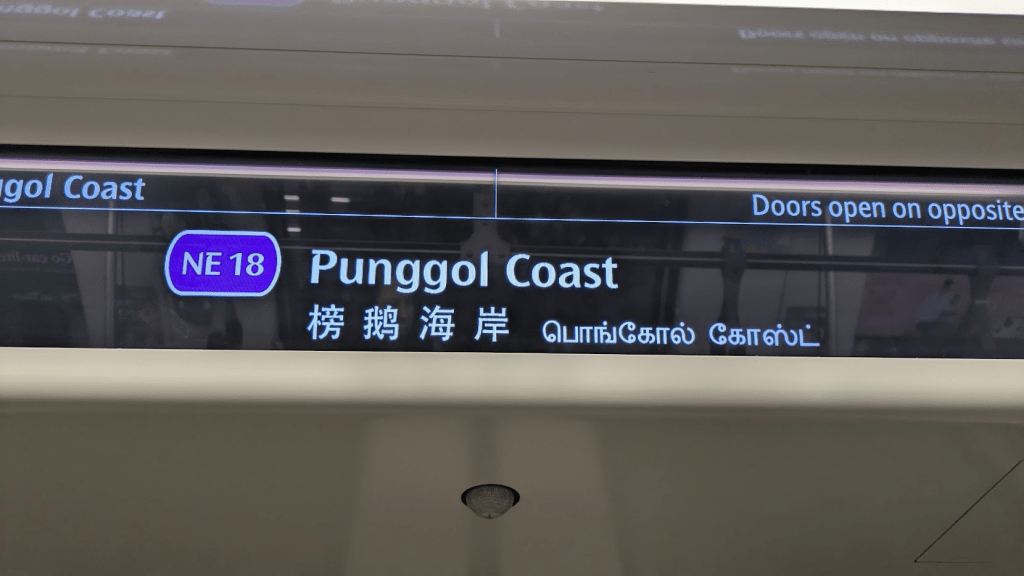
As you can see, the DMRD for this C751A is much cleaner and more polished compared to the TEL one, as well as being up to date. Though, how can we improve this further?
Well, it’s really simple.

Above is a rather poor attempt at recreating a DMRD. Some features of a DMRD I personally feel should be added are:
- Where to go for exits
- A simple route map
- Disruption notices if there are disruptions
And no, the whole map does not need to be shown. In my personal opinion, it’s much more readable if the map uses only major stations (i.e. Marina Bay, Outram Park, Caldecott) if there are many major stations, and has the minor stations only shown between certain stations on the map (i.e. if you are boarding at Marine Terrace towards Woodlands North, the PIDS would show Marine Terrace to Marina Bay, then only major stations afterwards). However, if this does happen, it would be good to have a static map to see the whole network.
This would actually be similar to the STAiRS 2, found in the C151B and C units on the NSEWL, but instead not using PowerPoint. This could be useful for senior citizens to increase visibility. If people would get confused if they are taking longer trips (e.g. Siglap to Springleaf), then we can add a static map beside it.
Another thing is to have disruption notices.
Currently, disruption notices are usually heard, but not seen — unless you are at the disrupted station itself — because people use noise-cancelling earpods. Because of this, many people may not realise that a disruption is happening. That’s where this can work:
- People look at the PIDS.
- People see the disruption notice.
- People realise that there is a disruption happening.
- People will not go to the affected station, knowing to take alternative travel options.
- People will not overcrowd the free bridging buses as badly.
TEL has come a long way since 2020, slowly but eventually fully expanding across the east coast. TEL4, while a straightforward extension, has shown great potential, especially in accessibility, station design, and providing long-overdue MRT access to the East Coast. Despite its strengths, there are still critical issues that are easily fixable: frequency remains poor, getting a seat is still a challenge, and the Passenger Information Displays (PIDs) need serious modernisation.
What can we take away from all this? Infrastructure alone isn’t enough. If the TEL is meant to be a backbone of Singapore’s future transport network, it needs to function like one: reliable, frequent, and informative. We don’t just need more lines — we need better operations.
A last TL;DR
TEL4 has finally connected the East Coast to the network, but does not improve train frequency or capacity.
Frequency has significantly improved compared to TEL from the past.
Comfort has slightly improved, but getting a seat is still hard.
Station design is excellent, especially bike facilities at some TEL4 stations.
PIDs are outdated and inconsistent. We should implement disruption alerts, cleaner design, and better visibility.
Key takeaway: We need better frequency, smarter info systems, and more user-focused improvements for the TEL to live up to its potential.
Thanks for reading this post! Consider joining our Discord server!

 Singapore Transport Collective
Leave a comment