

I last wrote about this some years ago, with it being a fading memory of unsuccessful trials at the time. Buried in all the political gimmicks since then, this particular topic hasn’t been at the forefront of consciousness until quite recently…
After the basket case of autonomous vehicle trials (spanning driverless shuttles in tourist attractions to full-size self-driving buses in university campuses) from the late 2010s, one last frontier remained unconquered — full-scale autonomous public bus operation. Deemed too high-risk for general public ridership, these AV trials were never extended to revenue-collecting public transport in previous iterations.
Finally, that’s set to change, with autonomous buses being planned for public bus services announced in January 2025. Slated to begin operations in late 2026, two relatively lighter-used routes were selected for trialling slightly smaller autonomous buses. 191, which serves as a feeder linking one-north to Buona Vista MRT and Holland Drive, as well as 400, a one-way infrequent circulator connecting empty plots in Marina South to Gardens by the Bay and Shenton Way.
Good news for those who’d hoped for AV trials to eventually expand to public buses. Now that the if for that has been settled, the question then becomes, how exactly do we transition from a fully manned bus fleet, to an eventual fully unmanned system in some far-flung future without the need for human drivers. As they always say, the first step is the most difficult of them all. That’s where we are, on the road to automation of public buses.
过五关,斩六将
Before we proceed with the challenges of even getting ourselves “there”, it’s helpful to know what exactly we’re aiming for, with the line between manual and auto drawn differently by different from one person to the next. The current globally recognised framework for levels of automation for land-based vehicles comprises six levels, numbered from 0 to 5. (A similar, but not entirely equivalent system of classifying automation levels also exists for mainline rail vehicles, more well known as ATO Grades of Automation)

At the highest end, Level 5 automation is defined by the vehicle’s ability to drive and navigate by itself, almost as if it’s a sentient being capable of being an independent agent on the roads. While more recent approaches to automation (particularly MaaS-based solutions which rely on a more “taxi-based” model of autonomous vehicle operation rather than “car-based”) might put the definition of Level 5 into dispute, it ultimately remains the ideal of self-driving vehicles that all players in the field aspire towards. That’s a rabbit hole that’s probably best left for another time, and for us discussing largely public transport matters, it might not matter much to us, for reasons described below.
More concretely defined are the interim levels of automation, beginning with Level 4 and proceeding downwards. From here on, the Grades of Automation system used on railway serve as a good, but not entirely perfect reference for the functionality of each level of automation used in road vehicles. At Level 4, all self-driving functionality from Level 5, including the ability to remedy faults within its own control (ie excluding power outages/physical damage etc) are present, except that it is confined within specific use cases, such as within specific corridors, areas, or fixed routes. This reduces the need for extremely high computational power to constantly process and re-orient the vehicle’s bearings based on its whereabouts, making it an easier step to achieve than Level 5. In extreme cases, it’s even possible to attain Level 4 automation by brute force coding!
This explains why ATO for rail is only defined up to GoA4 — with motion constrained by the physical position of the rails, the number of possible use cases are finite (particularly with rapid transit systems that don’t usually branch or through-operate with other lines), potentially making the entire line a single “use case” relied upon to autonomously operate trains without the need for a human attendant on board! For urban transit buses which ply fixed routes, their evolutionary outcome in the automation game will also lie here — each individual bus route could be its own “use case”, a set of instructions for the bus to drive itself to the destination. While this has been rolled out to a limited extent with driverless shuttles that we have trialled in the past, it’s a different ball game to apply the same logic to automating full-sized, 12-meter buses. More on that later.
Going further down, more self-driving functionalities are stripped until you hit level 0, which compels the driver to take charge of everything about the vehicle, which is probably how people born in the 1980s or earlier learned how to drive. In between, minimal driver assistance features define levels 1 and 2, with technology on-board serving mainly as driving aids, rather than actively attempting to take over the wheel. Outside the very few instances of self-driving shuttles, buses in Singapore today are largely only at Level 1 automation, which is an industry standard for safety among (manually-driven) commercial vehicles today anyway. In a weird twist of logic one could perhaps argue that we’re making baby steps towards Level 2 with further enhancements like questionable digital mirrors, though that’s still a long way off from any prospect of witnessing our buses move without a driver stepping on the pedals.
These improvements, while transformational to making the act of driving buses a lot smoother, have barely scratched the surface of what’s to be done to remove the bus captain from the equation entirely, with the real boss standing ahead of us. Crossing to Level 3 automation and beyond, where the driver’s role as the vehicle’s controller is first usurped, is the real challenge, and where all uncomfortable questions around automating road vehicles are first asked, seriously.
Half a job?
Apologies for the side-tracking again, but there’s a point to be made here. If you’ve taken a ride on our fully driverless MRT lines (as of writing, NEL, CCL, DTL, TEL) and stood at the front of the train, you might see a staff from the train operator posted there, rotated every once in a while. Known as hostlers or “rovers”, their job requires them to monitor the train’s operations as it passes through the underground tunnels, ready to respond in the event of contingencies. They’re also trained to take over control of the driverless trains, should the need arise.
Of course, while that’s their formal job description, what they’re often spotted doing on trains is… let’s just say, wildly the opposite of what’s intended of them.
[No images shown to protect the identities of these rovers, because we believe they shouldn’t be pwned over this understandably boring job]
From sleeping on the job to texting while “driving” and flat out playing mobile games while the train is in motion, MRT riders have certainly seen their fair share of workplace skiving from MRT rovers, as a result of the boredom that comes with partial automation, where they still have something to do sometimes, but not full automation where they can be entirely done away with. (Technically they could, but this appears to be more of an operational matter that SMRT and SBST decided upon) More crazy would be the numerous sightings of train captains on the NSEWL being spotted gaming on their phones while the train is in motion, or doing other things that would spell certain disaster if done at the steering wheel of a road vehicle.
These are all examples of what’s known as the “ravine of distraction”, present in automated vehicles at Level 3 and above still staffed with an attendant on board. Where the vehicle is capable of replacing most of the human operator’s duties, but where the human must remain onboard with very little to do, the consequence is high costs required, be it to train human operators to remain attentive with little mental simulation, or the generally high cost of maintaining them on board relative to their largely diminished pool of responsibilities. On street-running vehicles, it’s also a matter of safety — with attention being intermittent on all but the most-focused individuals, reaction times critical to preventing accidents also increase.
Given that LTA’s “driverless buses” are intended to continue operating partially with human drivers on board, it’s safe to reason that Level 4 coverage has yet to adequately account for all situations these buses will encounter in their operation. While rovers and train captains playing Mobile Legends at work will not constitute a significant safety hazard, the same cannot be said for these “driverless buses”. At the end of the day, while rail operators might be somewhat able to shoulder the cost of keeping these bored rovers around, the same cannot be said for more financially-constrained bus operators, who also have to contend with the risks of inattentive staff at the wheel.
There’s yet another complicating factor when it comes to discussing automated road vehicles. While nothing along the lines of techbro-fantasy automated car-trains has popped up in Singapore (thankfully), a reality to be reckoned with for AV proponents and basically anyone pushing us towards “smart city” goals is the partial evolution question. Of course, it’s always nice to imagine the end vision of a fully smart, connected road system where all vehicles are capable of communicating with each other to ensure safe operations on the roads (if they aren’t already all centrally controlled or something). What then, about situations where only some vehicles are equipped with autonomous driving technology that comes with such IoT-enabled smart communication? You’ll still need humans at the wheels, even for these “smart” vehicles, because ultimately the machines we build have yet to be sufficiently all-reaching to form the final failsafe by themselves. Failing everything, a human who’s hopefully still alert is still what separates an “autonomous” bus full of passengers from catastrophe, under existing infrastructure.
Why automate?
But of course, requiring a failsafe driver on board would not be bringing us closer to what can be achieved with a driverless bus system. Ultimately, having technology supplant, and eventually replace various roles of bus captains on buses is all for the purpose of first reducing the workload of a tiring, thankless job, before rendering it redundant, enabling more abundant bus service to be provided at much lower cost. Retaining an untasked staff member on board each bus (who cannot be removed, for safety reasons) is counterproductive towards achieving this goal, not least while the transition period to a fully “intelligent” road system continues to remain beyond the horizon.
Of walled gardens and gated communities
A typical experimental approach towards autonomous vehicle development is often to trial them in isolated, or low-traffic environments where immature self-driving technology is given the necessary room to develop (without the risks associated with bringing them out on busy streets). Simply put, an isolated environment is a safe space for self-driving software to be debugged and incubated to a level fit for mainline use on arterial roads with more complicated conditions. This has held true for past AV trials in Singapore (within areas closed to general traffic, or less-trafficked perimeters), and the introduction of them on 191 and 400 can be considered a daring step up towards allowing them on public roads, albeit more minor.
In the case of the most recently-announced trial, 191 and 400 are indeed within relatively sheltered environments — 191 plies minor roads within the one-north and Portsdown area, linking it to Buona Vista MRT, while 400 is a one-way loop around the Marina Bay area, presently very low-trafficked due to lack of development. However, as part of running public bus service, these driverless buses cannot expect to stay in their insulated bubble forever — their depot is located far beyond the demarcated comfort zones where Level 4 coverage is guaranteed. Particularly in the case of 400, where an expressway featuring fast-flowing traffic from (clearly not driverless or IoT-enabled) cars separates the route from its operating base, complicates matters at the start and end of the day, and maybe midday if peak launches and withdrawals are exercised. While not a concern now, deadhead routes for quite a few services (the ones in Bedok, I’m looking at you) also involve plying on stroads, which are large roads intersecting overfrequently with minor streets, creating significant traffic crossflow. A headache for human drivers even, autonomous software not adequately equipped will falter when faced with complex traffic congestion here.
While we can reasonably expect Level 4 coverage, and hence the discontinued need for an on-board driver, when the buses are plying their respective routes, the logistics of moving them to and fro the depot becomes iffy. Should we maintain a staff member on each bus just for the purpose of manually driving it between the route and depot? Should we expect the staff member charged with such a task to be expected to travel down to Shenton Way in the dead of night to send it back to Ulu Pandan depot after service has finished for the day? Sure, 191 stops operating much earlier, making the latter proposition still reasonable. 400, which maintains conventional operating hours (last bus 11.40pm), will make it a pain for whoever is tasked to travel to the city at such late hours just for the sake of escorting a partially-automated bus back to depot. And what more if these autonomous bus trials are expanded to include feeder services, whose last bus timings can run as late as 1.30am and beyond, and begin operating as early as 5am? Where will we find an army of willing staff members to send entire fleets of buses back and forth at such unholy hours?
A Gradual, Scalable Approach
The root of the above problems arises from attempting to leap to Level 4 automation across the board, and then having to make unhappy compromises later when faced with the limits of present technology and infrastructure. Much of what’s described above shows what’s effectively a bus system equipped with Level 3 automation requiring constant driver supervision, with enhanced Level 4 capabilities in very limited situations. Ultimately, the shortest plank in the barrel decides its capacity, and little improvement results from this proposed automation program. Designed along the same ethos as many last-generation AV trials, the unspoken assumption in this trial is that of the bus never leaving the defined Level 4-enabled geofence. Of course, given the complexity of public bus operations in Singapore, it’s obvious this mentality in automating our public buses is bound to encounter serious hiccups, if not flopping entirely.
What could more meaningfully nudge us closer to the goal of a driverless future for buses is to instead consider what I call situational automation, where the buses’ automation level varies depending on the task at hand. This would enable automation technology to better ease into existing operation routines of public buses, and better yet, provide sufficient operating expertise at scale to quickly create momentum for driverless conversion. Like with electrification, small-scale trials that cannot have their success broadly replicated do not matter in the grand scheme of things.
Rather than wait years to slowly expand autonomous bus trials by individual routes, a quicker way to gain the necessary expertise needed to incubate self-driving technology would be to pursue a modular approach towards automating common tasks in bus operation across all routes, then being able to mass-deploy these partially-automated buses broadly, expanding the scale and scope of automation technology’s application in our bus system, while actually contributing positively towards realising the intended goals of driverless conversion.
A low-hanging fruit exists here which can easily ease off significant stress on bus captains is the automation of deadheading procedures. Referred to in layman terms as the “off service” segment between the depot and nearby bus interchanges, deadheading at the start and end of shifts to move buses where they’re needed counts toward working hours (which come with prescribed legal limits in Singapore) of bus captains, and in the case of early-morning and late-night trips, occur beyond our already-expansive bus service hours.
While you may get home by 1.30am on the last feeder bus, the bus uncle ferrying you on that trip will most likely only be able to rest at 3am or later, after factoring in required deadhead to the depot, and travel back to his place of residence. At such late hours, especially after long shifts (lasting about 8-10 hours for standard half-day duties, up to 15 hours for overtime), the risk of fatigue-induced traffic accidents increase significantly. In October 2022, one such deadheading bus (between Hougang interchange and the nearby Hougang Depot) lost control and crashed after service hours, killing the driver on board.
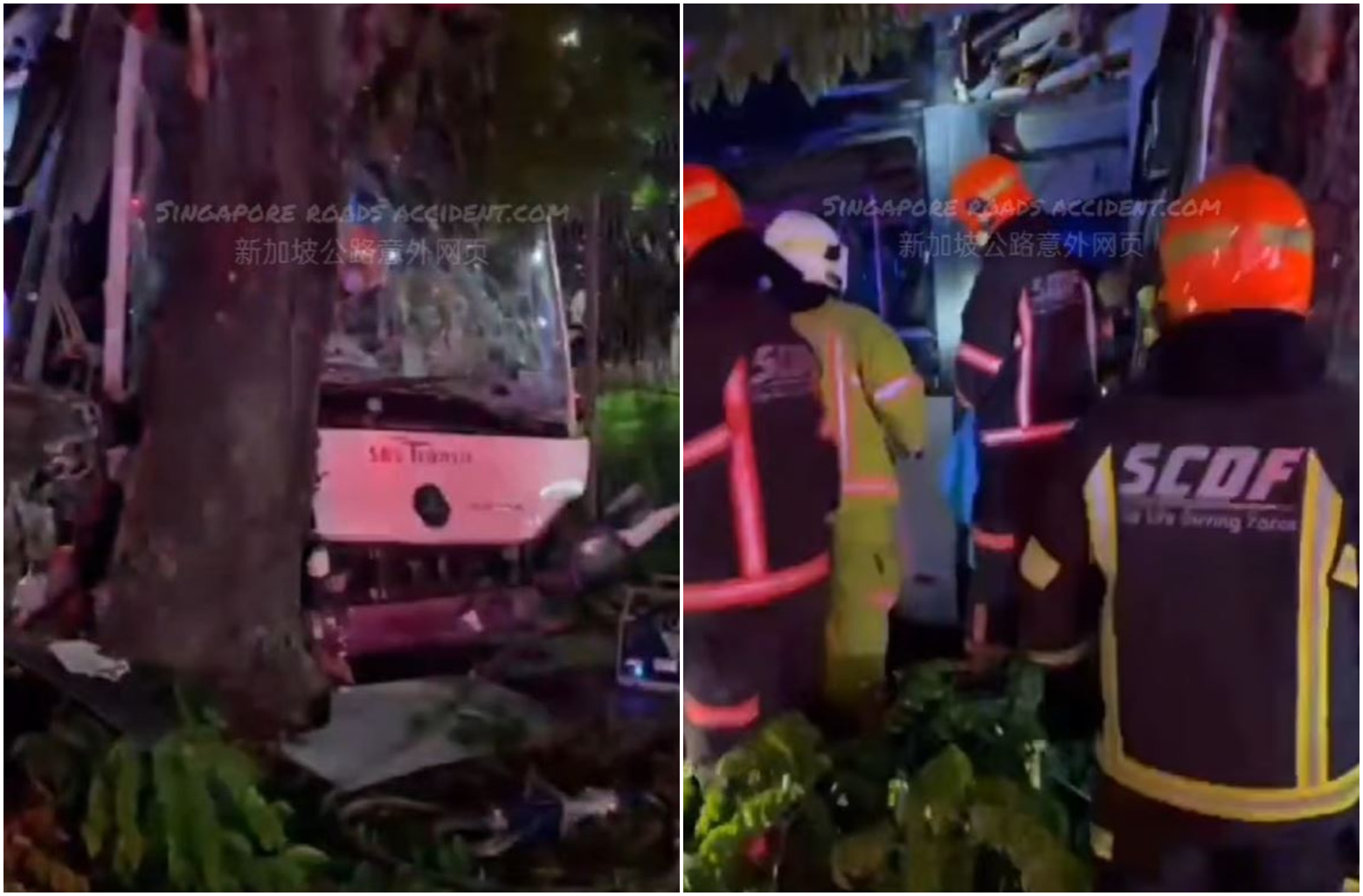
The greatly unfortunate part was that this particular deadhead route was not even significantly lengthy, or passed through particularly challenging environments. Buses withdrawing from Hougang interchange would simply have to pass through Hougang Ave 5, Ave 7, Defu Ave 1 (where the accident happened) in sequence to return to Hougang Depot. Much of this route sees little traffic, and is a largely safe and shielded environment for self-driving technology to prove itself on a much larger scale and advance beyond strict petri-dish applications.
Happily, Yutong has developed an advanced assistive driving technology that takes over the role of deadheading from the bus captain, while continuing to leave the operation of revenue routes in the hands of human drivers. This seems less ambitious than a semi-fully autonomous bus package, but is the step in the right direction, taking into account the intended goals of bus automation, even if only partial in the early stages.
As far back as 2020, some bus depots in Zhengzhou introduced a smart self-parking system where the process of maneuvering buses within the depot and recharging would be entirely automated, with the driver only needing to take over before the bus departs for revenue service. Subsequent products from Yutong (including those involving autonomous shuttles, which are a different basket from driverless conventional fixed-route buses) have also strongly emphasised the ability of these vehicles to handle deadheading operations on their own, even if actual revenue operations may still require a driver:
Update 12/07/25: Embeddable video of the situational automation on Zhengzhou BRT here:
Granted, this is based on an operations model where the function of bus depots and interchanges are combined, but a similar system in place could also massively benefit Singapore, especially where we face a far more acute shortage of willing manpower to drive buses (so much so it’s been a favourite pastime for bus haters to tell those demanding better bus service to “go drive a bus”), and where welfare for bus captains is an increasing concern. The real kicker? Rather than requiring purpose-built autonomous vehicles (which are overwhelmingly minibus or midibus shuttles), this situational self-driving system is intended for implementation on standard, 12-meter buses. Immediately, the scale advantage of this approach is obvious.
Think of situational automation as a “Level 2+” automation grade, where despite maintaining Level 2 for most tasks, Level 3 or Level 4 capability is enabled for common tasks across a large fleet. Inferior to ready-made Level 3 solutions, but unlocks more benefit (justifying the further development of AVs) in the short term, while building up the scale to leapfrog the former in future development too. In fact, situational automation is not entirely unheard of in Singapore — “remote controlling” of vehicles not fully automated used to be common practice on the North-South and East-West MRT lines prior to resignalling. At terminus stations, “remote control” mode may be activated to enable trains to depart even before the train captain has walked to the other driving cab, reducing turnaround downtime and reducing fleet requirements.
Imagine that instead of requiring the bus captain to start and end his shift at the depot (inclusive of deadhead mileage), he only needs to be present to drive the revenue service portion of the bus’ incurred mileage, with self-driving software on board guiding the bus to and fro the depot without a driver. A situation where the bus driver enters the bus together with you at the interchange’s boarding berth. This is transformative, for more than one reason.
First, it enables the same limited manpower hours (limited by number of bus captains, and legal limits per bus captain) to provide additional bus service. Rather than having to allocate a portion of a driver’s shift hours to deadheading, allowing the bus driver’s shift to start and end with revenue service enables all non-rest hours to be dedicated towards providing additional service for passengers. This means buses can run more frequently, without hiring more drivers (up to a certain point)! In a place where we demand frequent bus service, and yet is unable to quickly shore up manpower for it, situational automation of our buses to eliminate manual deadheading provides a small, but significant first step towards the eventual liberation of bus operations from manpower constraints.
Though mentioned earlier in this article, it’s worth hammering home the point: situational automation is the superior option in enabling mass adoption across fleets and networks. Besides just being an applicable technology to existing vehicles (without the need to completely break bus networks apart to redesign them around minibuses), situationally automating deadhead runs enables a limited initial application of self-driving technology to simultaneously benefit a disproportionately large part of the bus network. Many bus interchanges in Singapore are located within close distance to a corresponding bus depot, with a relatively simple route linking them that best fits less mature self-driving technology. Besides the above example of Hougang interchange near Hougang depot, there’s also Yio Chu Kang interchange near Seletar depot, Pasir Ris interchange near Loyang depot, Woodlands interchange near Woodlands depot, and Sengkang interchange near Sengkang West depot. With hundreds of buses plying these deadhead routes every day, limited self-driving “use cases” (seen in Level 4 applications) can be used to massively improve bus service in a relatively short timeframe. And at the scale at which this technology is deployed, the concept of situational automation can be similarly expanded to include main corridors served by multiple bus routes, further maximising what limited manpower can offer in service hours.
Here’s a demonstration of situational automation at work on the Zhengzhou BRT. Scroll all the way down for the smart U12, on which it is showcased.
The better trial program.
With all that said, what could a better autonomous bus roll-out program look like? Rather than fragmented self-driving minibuses that would require LTA to return to the drawing board to bring the technology to full-sized buses, it would be a wiser gambit to tackle full-sized bus automation from the start, not least due to the scalability of such a program. For as long as most Singaporeans can remember, 12m single deck buses have formed the base model of our bus fleet, and self-driving bus development must take this operational reality into account.
Where a better autonomous bus program would begin rolling out would not be on public-facing revenue bus services, contrary to the current LTA practice. Instead, situational automation would continue to leave revenue service with manned operation (for the time being), whilst automating deadhead sectors to and fro bus depots. Rather than waiting for mature Level 4 technology to emerge while existing systems are stuck in the quagmire of Level 3’s distraction ravine, the situation-based approach slowly introduces Level 4 coverage to increasing portions of the network, skipping the undesirable Level 3 stage altogether.
It would gel well with recently-launched fleet additions — the BYD B12 and Zhongtong N12 buses, both of which originate from OEMs with some record of attempting to engineer autonomous buses. BYD has been developing a driverless variant of the older K9 for use in airport shuttles in Japan, whilst Zhongtong showcased a Level 3-enabled variant of the N12 at last year’s SITCE.

With the overwhelming majority of these new buses being deployed in northeastern Singapore (based at Sengkang West depot, based out of Sengkang and Hougang interchanges), a logical extension of the initial mass electric bus rollout would be to first implement self-driving deadhead functionality here, where it has also been established that proximity to their corresponding bus depot provides for a relatively insulated operating environment. Barring the potential challenge of having to install temporary chargers at Hougang depot en masse, this would mark the first large-scale rollout of autonomous bus operations in Singapore, to the tune of hundreds of buses instead of the paltry six proposed for the 191 / 400 trial in 2026. It coincides with the need for increased bus service in the northeast — a benefit that situational automation can readily provide, far before CRL stage 2 opens in 2032. This, despite a struggle to cough up manpower for key trunk routes in the northeast.
Similar trials on a smaller scale can also be attempted elsewhere, for more challenging deadhead routes (eg Jurong East / Clementi – Ulu Pandan depot, Boon Lay – Soon Lee depot) which may require a more cautious approach. There was some talk of an alleged autonomous bus conversion trial involving the oldest Scania K230UBs (including the demonstrator) which never went to fruition, but these scenarios would have been a good testbed to experiment with self-driving technology while retaining them in the service fleet, awaiting their replacements.
With sufficient confidence, this program can be easily rolled out (alongside the procurement of our electric bus fleets in the years to come) to all depot – interchange pairs, which should sufficiently relief bus captains of a significant portion of their duty. (Cut the talk of Murali’s bus safety committee report released earlier this year — being able to get home sooner, without the stresses of also having to handle buses inside the depot, can and should be sufficient impetus to adopt the phased, situational approach to automating buses!) Concurrently, the next phase of the project should aim for something bolder — to bring situational automation to revenue service operations. How? Similar to its original application in Zhengzhou, common segments of bus routes plied by multiple services can be automated first, creating a situation where the bus driver is only needed on part of the entire bus route. Medium-capacity corridors which are hotspots of bus duplication are prime candidates for this, where they serve as further amplifiers of scale for driverless bus technology across the network.
I don’t need to mention the final stage, where every bus service is fully automated, enabled with Level 4+ technology that enables them to operate with the same flexibility and scale as human-operated buses are today. More accurately, at a scale unprecedented in our bus history, where decoupling service from available manpower enables abundant provision of bus service beyond the limits of present-day imagination. It’s doable in about two decades with a phased approach, which is about how long it takes for us to completely retire every bus currently in sight on our roads today. A long time, but definitely much faster than pinning our hopes upon minibuses that will not scale to the realities of big-city mass transport on the roads.
Interested in building a better future for Singapore’s transport? Join the STC community on Discord today!
 Singapore Transport Collective
Leave a comment