

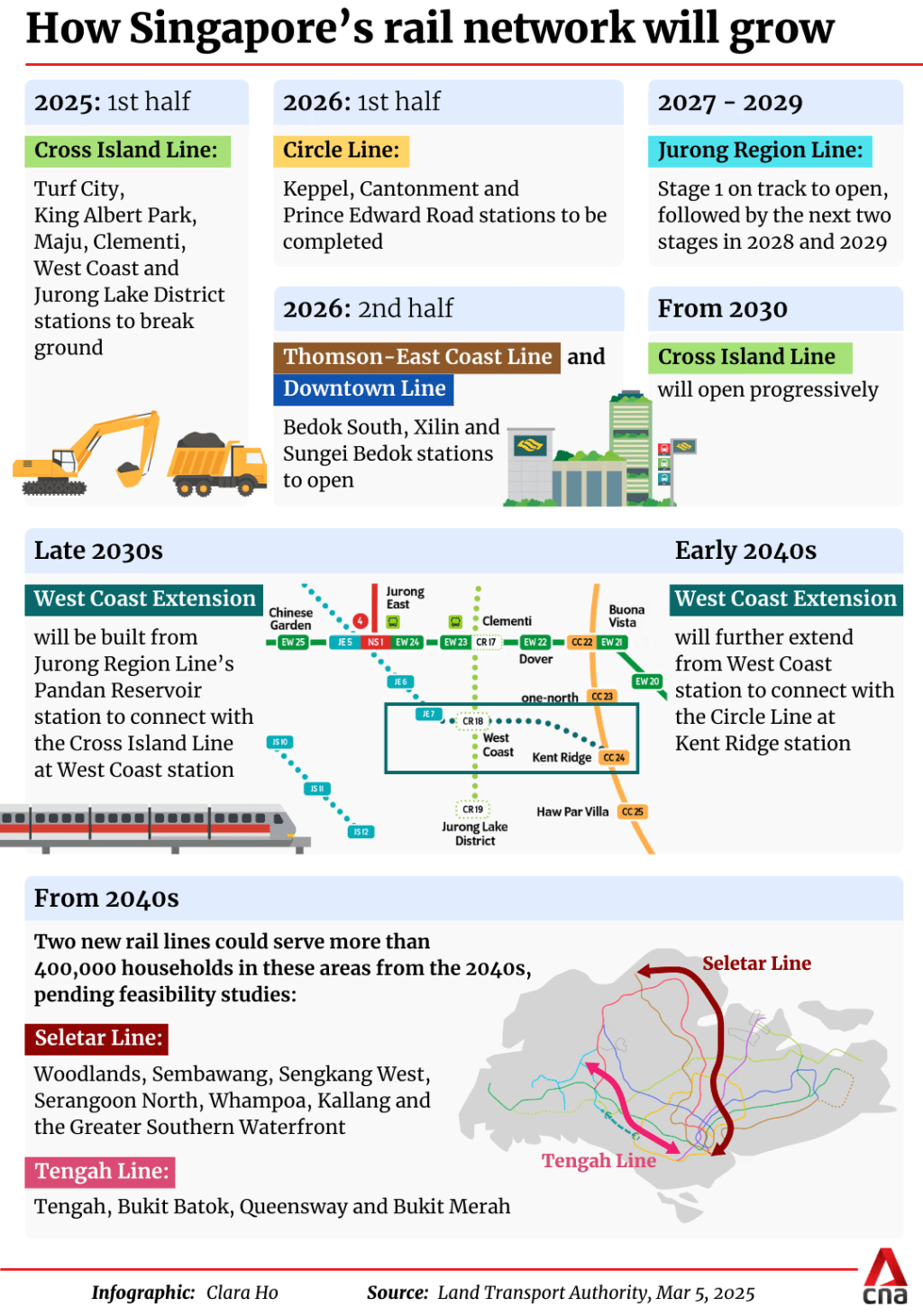
Six years after the release of the last LTMP in 2019, the rail network finally gets an official update again. On 5 March 2025, as part of the Committee of Supply debates in Parliament, two more rail lines (both suggested, subject to feasibility study) and an extension were unveiled to the public, perhaps ahead of an impending LTMP to be issued later this year. As a side note, it really takes the announcement of these new lines for one to realise the relatively slower pace of rail development in Singapore compared to elsewhere, so much so that up till earlier this month, one really could hold things largely constant when examining issues of public transport planning for years on end. This particular revelation, at least in the official perspective, would change the calculus completely. Or will it?
Beyond 2040: teasers for LTMP 2050?

The more confirmed, and sooner of the three is the JRL West Coast extension (JRL WCe). Unlike numerous previous renditions, the 2025 official release of the JRL WCe would involve the line terminating at Kent Ridge, instead of the previously-suggested Haw Par Villa, while incorporating an additional connection to the CRL at West Coast station. This arrangement is surprisingly reminiscent of a proposal on this site from 2022, where we called for a NSL extension to Kent Ridge and beyond via West Coast, taking over the current JRL east branch past Jurong East station, in order to give the NSL a connection to the CRL, otherwise missed in existing plans released then. Relocating the terminus of the planned JRL WCe to Kent Ridge, in line with our NSL WCe proposal, is a surprise, given how the likely attitude towards the former would have been one of reluctance, given complex geography in the NUS campus. Split into two phases, the JRL will first extend to West Coast in the late 2030s, followed by the full extension into Kent Ridge the decade after.
Two new lines (“new” in the sense of it being lines by themselves, rather than just extensions of earlier lines) are also being considered for feasibility studies. Tentatively named the Seletar (SLL) and Tengah (TGL) lines, they would fill in gaps left in the current rail network, with estates nearly half a century over but still unserved by rail (Bukit Merah, Whampoa, Kim Keat) receiving their first connections from the late 2040s.
The SLL remains the SLL that everyone knows (not much) about – a line from Woodlands North, through Simpang, Seletar, supposedly Serangoon North, Whampoa and down to the city, somehow. It’s the same stuff that’s been the subject of endless speculation since the SLL was first hinted in Concept Plan 2001, and this announcement is frankly, nothing new. And that’s problematic, though we will get to that in a bit.
Meanwhile, the TGL is an entirely new invention (which catches the speculators by surprise) — instead of the oft-assumed Holland Line alignment which would see a MRT line running under Holland Road towards Orchard, the choice was made to instead send the line down to the Bukit Merah area, via a connection through some part of near-western Singapore.
Positives first: the TGL and JRL WCe are strong contenders for a rail alternative to the EWL, which the September 2024 derailment exposed as the weakest part of the rail network — points west of Jurong East and east of Buona Vista hang upon a singular thread, which once broken, leaves much of the country largely stranded. (April 2025 update: a less-disruptive train fault at the exact same location as the September derailment continues to serve as a stark reminder of the need for better rail redundancy in western Singapore). The SLL, in a similar vein, would play a similar role vis-a-vis the NEL’s northeastern segment, easily one of the most congested rail corridors in the country serving close to a million people across the span of a few short stations today. Put slightly more cynically, these are rail extensions long overdue, either to bridge missing connections in the rail network, or provide added relief for existing lines pushed beyond their limit. Better late than never, or at least, the hope that this cycle of rail expansion would be the answer to the shortcomings that befall our existing rail network. About two decades late to the party, that is.
However, looking at what was officially announced, it is hard to shake the feeling that something is still not there for these rail plans to authoritatively map out the road towards a more comprehensive rail network. I’m not even talking about the missing connections that the next LTMP rail plan should be addressing — they definitely should, and have the room to build a lot more. The lack of concrete alignments confirmed for especially the SLL and TGL, the two supposed centerpieces of rail construction for the 2030s and beyond, effectively means last month’s announcement is more or less what a certain orange-haired politician would term “concepts of a plan”. Frankly, that’s probably the most likely state of both rail lines in the planning offices at Hampshire Road currently.
In particular, the SLL is a much more egregious offender — concepts of the SLL have been floating around for a good 24 years, having first been mooted in Concept Plan 2001 and staying largely dormant until a passing mention in LTMP 2040, released in 2019. Older and more experienced readers may recall that the SLL was only released in an indicative form then, showing a general direction of the line without divulging any specifics regarding connection points to other rail lines being intersected. (For what it’s worth — speculators still cannot agree if the SLL would intersect the CRL at Tavistock or Serangoon North. That’s how vague public-facing information regarding the SLL is)
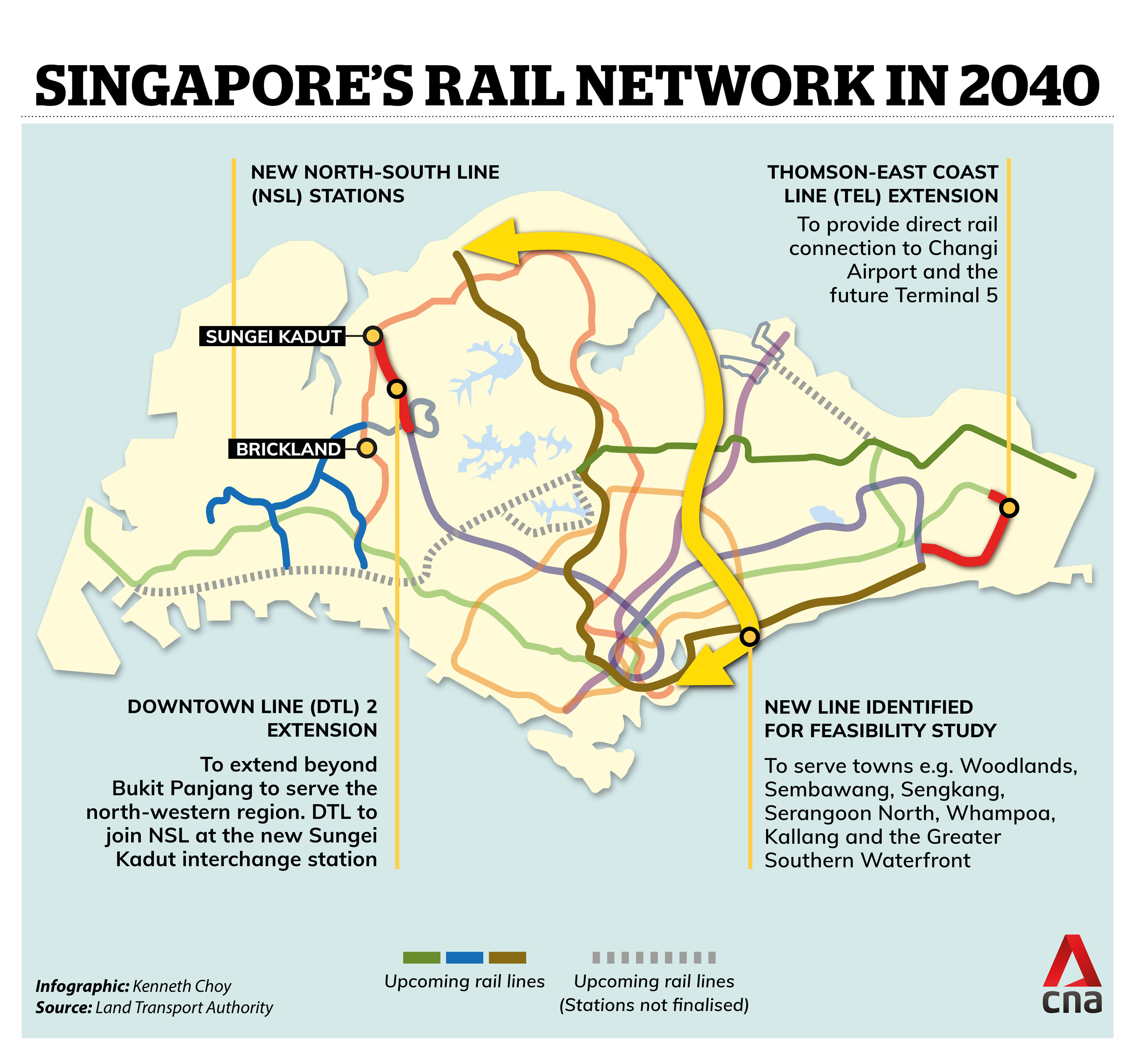
With six years having passed since LTMP 2040’s release, the expectation would be that something of the sort had materialised regarding the SLL’s alignment, at least regarding the specific connection points to existing lines. Heck, even announcing the SLL stage by stage as LTA slowly attempts to work their way through the complexities of legacy areas the SLL would wind through (Balestier, Whampoa, Kallang among others) would have been an acceptable compromise to many! (After all, this is what’s currently being done for the CRL, right?)
What I didn’t expect to have to see again, was that same broad-sized arrow from 2019 infographics being replicated identically in media published in 2025. And this speaks volumes of what’s in store (or not) for us regarding upcoming rail lines being planned. Reusing old material for public consumption implies basically two things.
The first, is that LTA likely did nothing about the SLL in the six years that separate us from the day LTMP 2040 was announced. No further feasibility studies to finalise exact alignments, or choices made that need not have been popular (see: CRL CCNR controversy) to bring the SLL a step closer towards eventual fruition. While our beloved agency charged with land transport planning isn’t exactly known for making good decisions in recent years, the impression (at least, until now) is that they’re at least capable of making decisions quickly, and working efficiently to uphold the central role of rail in the expected public transport diet of the future. Bad planning decisions fail to surprise me anymore, but indecision on LTA’s part, especially over something as significant as the next major heavy rail line after the CRL, is quite the shocker that further shakes their reputation as a credible and competent planning agency.
The second implication is much darker than the first, and is only inferred through the hasty (likely overly early) revelation of the SLL last month. Faith in LTA’s ability to work quickly on plans wouldn’t have been shaken had they chose to omit the SLL from the announcement together with the TGL and JRL WCe, but it was nonetheless decided to expose their inaction in this regard. Why? As much as I wished this wasn’t so, the clues point certainly towards the politicisation of rail planning, an aspect of transport planning which should be even less influenced by the fickle winds blown by political manipulation. A likely interpretation of the intriguing lack of perceived progress around SLL could probably be that political pressures from higher powers arising from the upcoming election forced a mention of the SLL, to court voters in northeastern Singapore with promises for an added rail line to relieve the situation on the NEL. Sure, it’s an empty promise without anything concrete shown, but a promise nonetheless that is believed to be effective at clawing the northeast back from opposition hands.
It’s disturbing that even rail, a much more capital-intensive undertaking with far more severe consequences if executed improperly (the DTL and BPAPM being two glaring examples from our past), can fall victim to the same politicisation virus that’s sweeping bus planning in Singapore with the BCEP’s advent. With Simpang New Town being largely shelved by URA and the CRL Punggol branch extension’s fate remaining unknown, it’s unlikely that the SLL is very high on LTA’s priorities currently. Of course, to admit that would heavily embarrass someone above them, and hence, we’ve got ourselves an announcement of inaction.
Despite all the hype drummed up for the SLL (and the TGL too), fundamentally it’s all noise, with little of meaning to be discerned from within. Which is about as good as saying, little to none has been said about what the future holds in store for rail in Singapore, beyond 2040.
The homework scares
Remember a time in school, when you completed a piece of work, but doubted yourself so much you hastily redid a large part of it right before the deadline, only for your initial instincts to be proven right, with the redone portion turning out completely trash? That’s exactly the Tengah Line for you. It’s obvious where much thought has been put towards its planning, and where isn’t. Where a “Holland Line” had already been speculated by many, the TGL’s corresponding alignment is where it’s most sensibly planned out, and where it isn’t, it’s glaringly obvious that the “indicative alignment” there is but a haphazard crayon scrawl, done hastily with a blatant disregard for connecting to existing rail lines in the area.
It’s pretty much common sense that any expanded form of the “Holland Line” to include Tengah would invariably cross the JRL at Tengah, and the NSL at Bukit Batok. Those were correctly identified in the official release. From there, the proposed alignment is sketchy at best, and outright illogical at worst.

The other two cited locations, beyond the range of the oft-speculated Holland Line, are rather interesting: “Queensway” and “Bukit Merah”. While Bukit Merah’s location is generally well-understood as where the town center is located (along either Jalan Bukit Merah or Bukit Merah Central), “Queensway” is about as vague as one can possibly get without invoking troll expressions like “somewhere in Singapore” or the sort. Of course, we could reasonably narrow it down to the span of Queensway between Margaret Dr and the Jln Bukit Merah flyover, but that’s still a really wide span that opens up way too many possibilities to give us a clear idea of what the TGL is expected to serve.
Two big problems arise from such an alignment for the TGL. More obviously, being a semi-expressway filled with flyovers and underpasses to bypass junctions, Queensway does not have the space to fit critical infrastructure for the TGL’s construction, such as launch shafts and station boxes. This particularly applies for the Margaret Road sector, which is sandwiched between numerous buildings and overly narrow roads for the TGL to tunnel under. (For the matter: Margaret Road is too narrow to even fit double-decker buses!) Unless large-diameter TBMs are applied for the TGL, it’s pretty much impossible to construct an underground line across “Queensway”, let alone an elevated one. (LTA and the local construction industry however, appear to be relatively skeptical of LDTBMs as a form of tunnel construction though, believing it’s not worth the added cost.)
For what it’s worth, the large variation in the TGL’s alignment itself translates to an even larger range of possible interchange points with the CRL, EWL and CCL. To the south, the TGL’s most southerly alignment would require the construction of an infill station between Maju and Clementi on the CRL (somewhere near Sunset Way), then some significant land acquisition from Singapore Polytechnic for a Dover EWL interchange, before potentially passing one-north or Kent Ridge along the CCL towards Bukit Merah. With no known plans for such a CRL infill and the involvement of a key stakeholder, how well this would go can be left to the reader’s imagination. Up north, the northernmost possible TGL alignment would involve crossing the CRL at Maju, then the CCL at Holland Village, before touching “Queensway” along the EWL. Obvious problem here — it’s definitely unrealistic to stuff in a new EWL infill station across the ORRS for the sake of the TGL there, given how close the Commonwealth and Queenstown stations are together. Should LTA proceed with serving “Queensway” with the TGL, it could well mean a missed connection with the EWL altogether, considering neither Queenstown nor Commonwealth stations have much space to shoehorn in an additional station box.

The logical conclusion we arrive at regarding the state of the TGL’s planning is that the section beyond Bukit Batok was haphazardly planned, and most likely changed on extremely short notice, thus the obviously rushed and lopsided planning process.
Obviously, I have nothing substantial to back this up, but I have a hunch that LTA had been planning for what’s essentially the Holland Line that’s common knowledge to everyone old enough to remember ancient Concept Plans, at least up until last year’s derailment. That would explain the well-planned portion between Tengah and Bukit Batok. For some odd reason I fail to understand, a likely explanation for the ill-thought-out connections of the TGL (coupled with the extreme vagueness of its alignment) was that the derailment somehow made LTA planners think that the Holland Line had to swing down to meet the EWL, to make it effective EWL redundancy, as if the original HLL plan somehow didn’t constitute EWL redundancy for the west. At the eleventh hour, the entire HLL plan east of Bukit Batok probably got trashed, with the questionable “Tengah Line” alignment taking its place on maps released for public viewing.
If that’s true, it reflects really poorly on the spatial awareness of the rail planners behind the TGL, whose incredible failure to understand redundancy bring us this monstrosity which ironically, is a much poorer facsimile of EWL redundancy than the original HLL-aligned plan could have been! A little vocabulary lesson here — parallel is also a synonym for redundancy, besides duplication. Had LTA gone through with just approving the age-old HLL instead of a haphazardly-planned TGL, it would achieve effective EWL redundancy by enabling passengers from Tengah, Bukit Batok and points further north to avoid the EWL, instead using the HLL to access the central shopping belt, with the main white-collar office clusters one transfer away by TEL at Napier. On the other hand, the TGL would be funnelling them back to the EWL, except that without a proper connection to EWL being defined, the line is as good as useless, considering it’d end in a stub at Bukit Merah for the foreseeable future! Promises of sending the TGL and SLL to the Greater Southern Waterfront exist, that’s for sure, but if the main intent of the TGL was really to ‘succeed’ the HLL as the EWL’s redundancy in the west, at the very least couldn’t the line have been extended to somewhere people actually want to go, connected at least to another line to enable them to continue their journeys?
Only one logical alignment exists for the TGL, for which there can be a satisfactory resolution to the problems of connectivity to other rail lines, and a somewhat coherent terminus in the city. That is, for the rationally-planned portion of the TGL between Tengah and Maju to be combined with a segment of rail line aligned exactly upon the Rail Corridor between Mount Sinai and Cantonment. In this alignment, the TGL would form the next three-line interchange with the EWL and CCL at Buona Vista, and link up to the CCL at Cantonment, where the old railway ended too. It doesn’t touch Queensway at all, save the Alexandra flyover to the far south, but it’s pretty much the only reasonable option for a line to link Tengah to Bukit Merah and on to the city, thus earning itself some value in the overall rail network that actually improves connectivity.
Like with the SLL, the TGL’s initial announcement, once some semblance of scrutiny is applied, is really just fluff that’s intended to sway voters this election season (which… should be coming anytime now, with the candidates beginning to appear left and right). If you ask me, there’s nothing substantial to be had coming out of it, although the SLL and TGL are useful indications of where LTA intends to study potential rail alignments, and in the case of the SLL, a reassurance that it’s not entirely slipped their mind, or rejected outright.
On smashing bowls
Right after the TGL and SLL were announced, some speculation was abound that the TGL and SLL could potentially be merged into one line, given how both lines are expected to come into close proximity to each other, if not cross in the GSW. Upon the official statement that both the TGL and SLL are expected to serve, and probably meet in the GSW, the new toy of speculation in town has been a supposed “Tengah-Seletar Line”, an amalgamation of the TGL and SLL to form a nearly circular loop line, about a quarter the way to becoming a full “Outer Circle Line”.
I offer a word of caution to the many who believe fervently in an eventual merger to form TSL. A potential merger in this direction would not be of much benefit, and this was perhaps on LTA’s calculus when deciding to brand the SLL and TGL as separate lines. (The option always exists, like was done with Beijing’s Line 8 for instance, to brand the line as two separate segments of the same line, to be connected at a much later date) It is also unlikely that the reason for keeping SLL and TGL planned as discrete lines currently has a strong correlation with “technical complexity” at Keppel, or the unknown vagaries of the GSW’s blueprints. Two strong cases can be made against a TGL-SLL merger, from the network structure of the expected rail network with their presence, sometime by 2050.
This hypothesised “STL” has been compared by many to the TEL, which has a similar line profile incorporating a north-south segment with an east-west segment to the south, and while the TEL has strongly benefitted from north-southeast demand, it would be much harder to anticipate a similar pattern on the STL. Principally, the CCL serves as a shortcut from Buona Vista to Lorong Chuan, effectively nullifying most potential crosstown demand on this STL. What this effectively means is that the STL, similar to the DTL, is simply two radial lines placed together, with little additional crosstown demand to justify the merger between the two lines. On the other hand, without an orbital line straddling a similar shortcut route between the TEL’s two segments, it remains useful and necessary as a connection to the Marine Parade and East Coast areas for many.
Furthermore, attempting to detour into the GSW to meet officially-stated coverage needs while keeping to the goal of merging the TGL and SLL would incur another significant penalty upon potential passengers travelling through the central sector, making the line’s most likely users those that only travel into the central sector, not beyond. The fantasy map linked above gives a good idea of an expected alignment should the STL merger option be exercised. Notice the “bowl” formed around the CBD and GSW.
More problematic than a large detour is how the same “bowl” alignment in the STL’s central sector limits potential for effective rail expansion to other areas in the GSW. You see, the highly nebulous nature of the GSW’s plans (besides a smattering of BTO plots to be released soon) means that outside the URA headquarters in Maxwell, practically no one, including most in LTA, has even a rough idea of what’s going where in the GSW. For what it’s worth, recent developments complicate this further — a new set of coastal protection studies for western Singapore are set to begin in 2026. We cannot rule out the possibility of a “western Long Island” being the result of these studies, and if that happens, the calculus around our rail planning will change once more. The STL’s “bowl” is crayoned out of a complacency that the STL represents the southernmost point of our rail network that will ever be. What if a western Long Island shatters this illusion, requiring us to provide a rail connection to it similar to the eastern Long Island in the works today? Merging the TGL and SLL prematurely would make it inordinately difficult to separate if the planning need for it arises, which has a probability so significant it’s incredibly foolhardy to ignore.
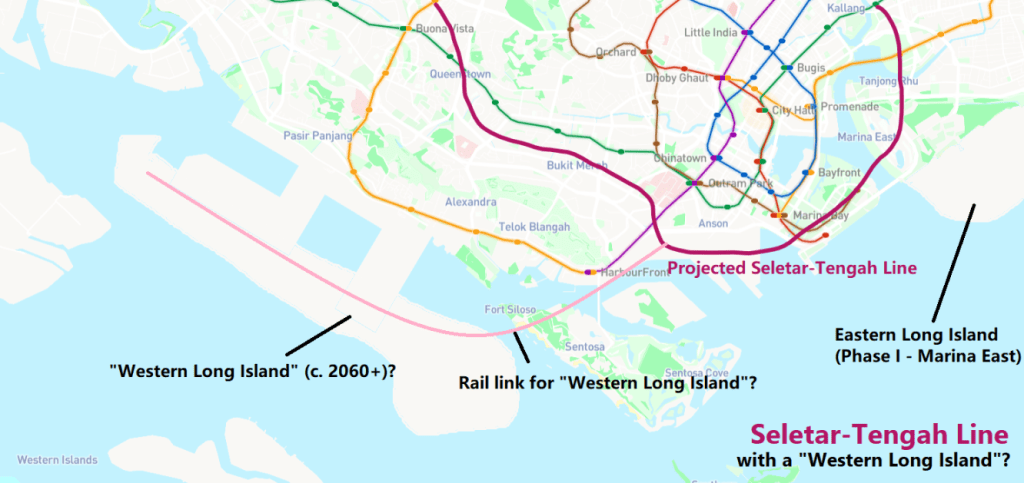
Need a real-world example of Singapore in 2050 when we realise we have to send an MRT line into a western Long Island? Ask Beijing today, who’s spent forever agonising over their bowl-shaped Line 13, the butt of all abuse hurled at “overcrowded” Chinese transport infrastructure last decade. Despite having long resolved to split the line into two discrete radial lines (the reverse process of us merging the TGL and SLL together in our fantasy crayons) as far back as 2018, it’s still as WIP as ever, so much so the split line extensions are set to open as their separate line for the time being. Bear in mind also that Beijing’s Line 13 is entirely overground (the product of converting ancient railway lines in the suburbs to rapid transit), whilst if we attempt to decouple a TGL-SLL merger to expand catchment, good luck to future us doing the same thing underground. Rather than prematurely close the door to rail expansion beyond the immediate TGL and SLL within the GSW, the many unknowns beyond our knowledge is a humbling call to keep our minds open, even as far as our fantasies are concerned.
Why miss it?
A word about the JRL WCe, even though I haven’t covered much about it. The potential challenges of sending a rail line deep into the NUS campus aside, it’s also intriguing to notice the comparatively short gap between its final terminus at Kent Ridge, and what would be the TGL’s right of way near Bukit Merah just a stone’s throw away. With the mistakes of the DTL’s missed connections fresh in memory from just a decade ago, it’s astounding how such an opportunity for the JRL to form yet another through-running rail corridor in the west was missed. Maybe they’re leaving this for a time even farther in the future, but if rail redundancy in the west is really the driving force behind the JRL WCe and TGL, it would make sense to open up a connecting pathway between the JRL (which offers direct links to the JLD and Jurong East) and the TGL bound for the city sooner, right…?
near the end?
So what has been said, after much hype and discussion around the three new lines slated beyond 2040?
In practical terms, very little concrete plans have been mapped out beyond the previous LTMP’s scope, excepting perhaps the JRL WCe, which itself invites debate on how it may be realised. With materials around the SLL being the exact same shit as readers were fed many years ago, and the TGL being a cloudy mess of vagueness, it’s best to treat the official announcements around them as mere fluff to hype up the populace with generic promises for a far-flung future. Once that hype’s settled, the bad news is that LTA probably still doesn’t have much of an idea what to do with those new lines they’ve conceptualised. The good news is that where their confusion lies, sits a golden opportunity for all fellow transport advocates to push for better connectivity in the west and northeast, upon the basic premises of EWL and NEL redundancy that the TGL and SLL embody respectively. Maybe the rail planners at LTA, in the heat of political pressure being applied, tripped over themselves and let loose a mediocre plan.
Given how long more the SLL, and especially TGL need to be properly thought out, it’s fair game for anyone to come forth with more robust plans for the future of our rail network. I’m confident, even if LTA planners are unable to deliver a satisfactory solution themselves, there will be someone, among the many passionate souls out there wishing for a better rail network, who’d come up with something that would aid them in finding that answer, even if they wouldn’t be officially acknowledged as such.
For now, when asked what’s in store beyond 2040 for the rail network, the correct answer is “I have a concept of a plan”. When will we eventually see these two highly overdue rail lines, which should be up and running today?
Interested in building a better future for Singapore’s transport? Join the STC community on Discord today!
 Singapore Transport Collective
Leave a comment