

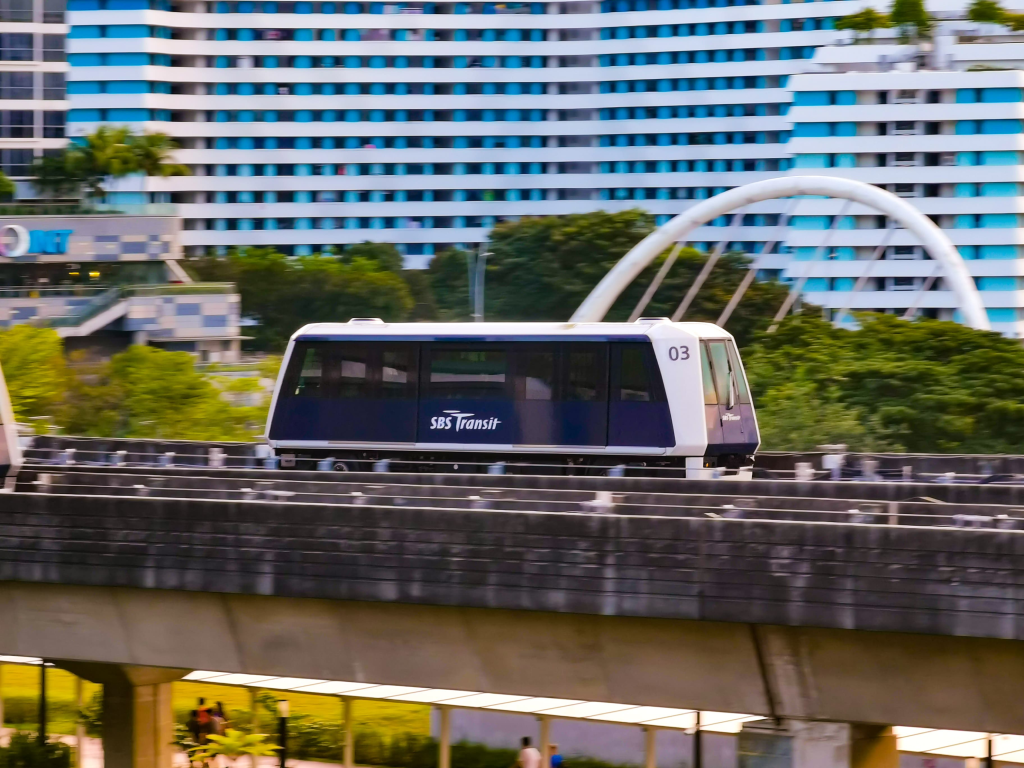
The LRT trilogy, one of the running series on this blog comprising a post explaining its failures in today’s Singapore and two more to fix each system, was slated to conclude once I published the fix for the Bukit Panjang APM system, which I did last June. Over the years however, I’ve changed my mind regarding certain… things on the Sengkang-Punggol APM system, the post for which I wrote all the way back in 2020 when I was raw and new to the field of urban transport commentary. Since then, I’ve learned quite a bit and… it’s time to relook the proposal to improve APM services for the two major towns in northeastern Singapore, with a new twist upon the original premise of guaranteeing frequency.
As you may remember, the original proposal from 2020 was very heavily centered around the town center stations, where both APM lines branched out into two bidirectional loops. The idea was to separate the flows of train traffic on the line such that the branching effect would be removed, increasing the frequency of the Sengkang and Punggol APM lines even along each respective loop.
One small problem, that may not have been apparent in 2020 and the years preceding it — the North-East Line’s capacity crunch, being the sole rail line in the northeast. Obscured by the massive fall in demand brought about by the pandemic (which hit that year), this capacity shortage, had the original proposal to vastly increase SPAPM frequencies went through, would have made whatever the political gimmicks of new City Direct spam were attempting to solve, far worse a beast to tackle. With APM trains arriving more than twice as often as they are now, it’s very likely the NEL would be overwhelmed, despite the 6-car trains and running the most frequently of all MRT lines during the peak!
From where does this demand originate? With the eastern halves of both Sengkang and Punggol towns having matured first, and now hitting saturation point, what’s worthy of greater attention should be the western half of both northeastern towns, with plenty of greenfield housing projects still in the works. In Sengkang West alone, more than 10,000 BTO flats (that’s about a 40,000-strong increase in population) is expected, up and coming in the years to come. In terms of existing BTO projects recently completed, many of the spanking new HDB flats there did not exist back in 2020, and neither were many similar flats along the west loop of the Sengkang APM.

Less than a decade or so ago, practically all the HDB estates west of the Sungei Punggol river were either under construction, or did not exist at all! Some of the “Anchorvale” estates were also recent additions too. Of the upcoming 10,000 flats in Sengkang West, the bulk of them are concentrated around the Thanggam and Kupang APM stations, strung in a chain along the currently-incomplete Fernvale Dr. That same Kupang station, by the way, is also one of the four stations on the entire MRT / LRT network without any bus connection (the other 3 being Teck Lee, Segar and Bayshore). Dozens of thousands of would-be residents here are left largely reliant on the APM for now, pending the introduction of any bus service under the BCEP. In any case, the Sengkang West and Fernvale areas suffer from lacklustre bus connectivity anyway, with many of these newly-complete BTOs still being served by only a single, meandering feeder bus service (374) or relatively inadequate trunk buses (50, 102, 163). Far more can be done to improve any form of public transport connectivity here, and it’s just so deadly ironic how the residential estates beside a train depot suffer from inadequate service, barely any of which gets residents to areas beyond the northeast reasonably quickly.
Beyond the immediate connectivity concerns of Sengkang West residents, the core issue of overcrowding on the NEL is not resolved, either. City Directs in the eastern portions of Sengkang and Punggol make sense due to their proximity to the TPE and KPE, and on paper, even the most illogical routes should be able to garner sufficient ridership to keep a CDS afloat because of the sheer density there that characterises Sengkang and Punggol. On the western side of the NEL however, another strategy is more desirable, one which the APMs can be an integral part of.
Recall an earlier post detailing the scientific approach in resolving northeast connectivity problems. In it, I explained why the recently-launched spam of City Directs is counterproductive to the overall aim of improving connectivity or relieving the NEL’s crowding. The direction that bus reinforcements should be taking, instead of paralleling the NEL (where bus reinforcements already exist to some degree), should instead be perpendicular, guiding away from the NEL those who are merely using the short segment from Serangoon to transfer to a perpendicular line segment.

The main suggestion mooted in that post was the advocacy of numerous crosstown express services that were capable of bridging the northeast-southwest gap quickly. Some may have wondered how big a role the Cross Island Line, slated to first open in 2030 (and become useful for relieving the northeast in 2032), will play in this “perpendicular diversion” greatly needed on the NEL. (Others might wonder what that image of a LRT line running down the western portions of Sengkang and Punggol had to do with NEL relief. That’s what this post is about!)
Enter the Fernvale LRT line.
Getting it right, on the second try
Another detail that would be missed if one were not acutely familiar with the APMs of the northeast — despite covering a larger area with a much higher projected future population, the west loops of both the Sengkang and Punggol lines actually operate even less frequently than their corresponding east loop! Instead of the assumed alternating departures between east and west loops, the actual operating patterns (for both Sengkang and Punggol) is to have two in three trains head to the east loop, leaving only 1/3 of town center track capacity available for the respective west loops! To put it in more concrete terms, if a train was arriving at the central stations every two minutes, it means that trains on the east loop arrive every 3 minutes (on average), while one has to wait six minutes for a train on the west loop! Not exactly helping the image of Sengkang West (and Punggol West too, while we’re at it) being a place with lackluster public transport connections.
This excess track capacity, rather than being used to further amplify feeder demand to the NEL (which practical experience has demonstrated a folly), could well be used to play a pivotal role in diverting the crowds in Sengkang (and Punggol) West away to alternative travel options! The basic premise of a “Fernvale LRT” is this: imagine the west loops of both the Sengkang and Punggol APM lines linked together, with a further extension southward to meet the CRL at Serangoon North.

Since there’s going to be a 6-minute gap between trains anyway, it would make sense to slot in trains that bring westbound demand in between, to enable at least part of the APM system in the northeast to efficiently handle growing population needs, without overwhelming the NEL. A connection to the CRL at Serangoon North would allow residents in parts of Sengkang and Punggol to access the CRL for commutes to the JLD and one-north, without ever touching the NEL. Hence, the Fernvale LRT plays a role in providing some redundancy between the CRL and the northeast, in parallel to the existing NEL.
With some refinement, the concept of the Fernvale APM line can be expanded to have it play a role somewhat akin to that of the JRL in Tengah — a local connecting line that acts as a really overbuffed long feeder service to major rail lines nearby.

A further extension on the other end to Punggol Coast would further enhance this role, and more importantly improve access to the PDD the former serves. The neat part with having the Fernvale Line shuttle between Punggol Coast and Serangoon North via the many residential estates in between lies in the bidirectional demand patterns created — in the morning, southbound trains will be filled by residents heading to the CRL to travel west, while those headed for the PDD occupy northbound trains, and vice versa in the evening. The PDD as the northeast’s new regional hub, deserves more than just a forlorn station along the NEL, which would still demand passengers to make an additional transfer to access it in the first place. The Fernvale Line is best positioned to improve direct access to the PDD from within the northeast itself, besides all the bus connections that should be there, but aren’t (so much for BCEP amirite).
While we’re at it, let’s throw in an extra station at Matilda (Sumang Walk), where limitations in the road network make it challenging to efficiently route bus services through the area and serve residents well. They too, should get quick connections to go places, beyond just Punggol MRT and the immediate NEL. Of course, much else has to change for the Fernvale APM line to be the game-changer in the northeast it’s meant to be. It goes without saying, of course, that the basic capacity problems that my original 2020 post set out to solve, must be resolved, especially with the larger task of bridging two key rail lines that the Fernvale line takes upon. The low-hanging fruit here, which I believe many before me have definitely attempted to highlight too, is the wide berth provided to allow for APM trains to be expanded to four cars, up from the current two.

Anyone who’s ridden the northeast APMs beyond the central station would have noticed the shockingly large empty space located on one end of the platform, used for not much except air-con housing and maybe materials storage. The question then is not if, but how much train configurations can be expanded to make the most use of track space in a branched service. Above, I believe, is sufficient ironclad evidence to demonstrate that the “end station amenities” (used to refer to non-public blank space beyond platform limits in stations) along SPAPM stations are capable of accommodating another two APM cars, on top of the current two along existing platform space.
Principally, this 4-car expansion of the northeast APMs will most meaningfully benefit the Fernvale service itself, serving as a medium-capacity line akin to Taipei’s Wenhu line and Macau’s LRT (which is provisioned for 4-car operations in the future). Two sad driverless pods with a combined capacity less than a single MRT car is simply not going to cut it for the high-density development plans envisioned for the northeast. This also somewhat helps the west loops in Sengkang and Punggol, which the Fernvale service shares track with: at the reduced frequency they operate to the respective town centers, a bigger train is the response to calls for more comfortable rides when track space is still limited. Allowing a slightly lower frequency on the west loop (due to the branching with the Fernvale line) opens up very interesting possibilities, particularly at Punggol station. We’ll get to that in a bit.
Ideally, this Fernvale line should receive new 4-car sets, and preferably with the open gangway, walk-through design that original AGT designs in Japan feature. Though of course, we could equally well achieve that with two 2-car trains coupled to each other, a feature of the Crystal Mover demonstrated possible in Macau, although that would probably require quite a fair bit of modifications to signalling. About time anyway, since the SPAPM is the last rail line in all of Singapore that does not feature basic things like arrival timing estimates, or moving-block signalling that enable high-frequency operations.
The legacy rework
With the Fernvale line in place as a relief line for the NEL, it’s worth examining how the rest of the northeast can stand to benefit from other tweaks to the twin APM systems. To make it clear: branching is still not desirable, but where other concerns with mainline rail capacity are here to stay, creative solutions to the core issues of access and capacity are necessary to ensure things don’t implode. We still want Sengkang and Punggol residents to enjoy shorter waits and less crowded LRT rides, after all.
Punggol’s central station, as a planning relic from an era that envisioned a third APM branch to the present-day PDD, has an unused third track running through the middle of the unusually wide APM platforms. Now covered up by floorboards, this track connects to the mainline on the west loop near Sam Kee station in both directions. An interesting opportunity unfolds here — on the premise of trying to minimise branching across the APM system, a unique method of operationally separating the east and west loops in Punggol can be adopted to increase throughput on the east loop, which the Fernvale line doesn’t benefit, but would appreciate the extra trains anyway. Here, the relatively lower frequency of the west loop (caused by it sharing tracks with the Fernvale line between Punggol Point and Soo Teck) offers the opportunity to perform an uneven distribution of the three tracks available at Punggol. While we’re at it, the way the station is built also perfectly enables these design choices to be made when considering an operational separation of both loops.
Today, both loops’ trains pass through the same set of platforms along the outer edge of the station, and potentially holding each other up when more trains are deployed. Instead of the gridlock that characterises the town center stations of the Sengkang-Punggol APM, the two loops can be cleanly split, such that the east loop calls at both platforms used today. The west loop, however, will operate with a unique pattern — instead of the bidirectional branching that many are used to today, I instead suggest the re-activation of the middle track to serve the west loop in both directions.
Wouldn’t single tracking kill the frequency, you ask? Not if there isn’t a high frequency to kill in the first place. With trains limited to operating every 4-5 minutes on the west loop (because of the new Punggol Coast – Serangoon North service), there is sufficient leeway to time the trains such that alternating departures in different directions are slotted nicely between each other, yielding a combined “frequency” of a train appearing at the middle track about every 2 minutes or so, similar to what’s seen today.
I say this fits the way the station was built, because the middle track at Punggol and the proposal to upgrade the west loop to 4 cars go hand-in-hand. The existing edge platforms, which were built between sharp curves to accommodate the middle track, are unable to handle any further expansion beyond the current two-car layout, while the middle track (and the supporting structures around it) forms a straight line down the middle of the APM station, and ready to support longer trains with somewhat minor structural modifications, mainly to vertical access infrastructure like escalators and stairs. (The lifts are placed immediately beside the outer tracks) Hence, the east loop benefits from being de-branched from its west loop counterpart to enable high frequency operations with the 2-car limitations, while the infrastructure to support 4-car operations across the entire west loop tide it over the potential frequency shortfalls induced by reserving track capacity for a new APM service. Quite literally, the two loops are designed to match and complement each other for a more optimised LRT service in Punggol.
| Punggol APM station | East Loop | West Loop |
| Allocated track | Outer tracks (x2) | Middle track (x1) |
| Max operating capacity | 2-car | 4-car |
| Operating pattern | Single direction | Bidirectional single-track |
| Operating frequency | 90 – 120 seconds | 4 – 5 minutes |
A little obstacle
There exists one small obstruction in the way of enabling a true segregation of east and west loop tracks at Punggol. Because the middle track was designed originally for a northbound service that never materialised, an unassuming structure is located to the south of the central APM station, preventing an extension of the middle track to meet the west loop tracks towards Soo Teck.
It’s been determined to be most likely a composite of a ventilation shaft for the NEL below, and an access staircase linking the APM above to the NEL tunnels below, enabling evacuation for both.

With two other (much larger) ventilation shafts also available on both sides of the viaduct, this middle structure appears to be entirely redundant, capable of being eliminated to permit the extension of the middle track, where it forks to permit trains from both directions of the west loop to run through, all while avoiding the outer tracks at Punggol, now exclusively reserved for the east loop. (Stairs can always be rerouted) But if this is somehow deemed not feasible, a little work in aligning timetables on both loops can mean the impact on frequency of having to share tracks for a brief distance will be minimal.
No solution? (for now)
Unfortunately, the Sengkang APM is a far more complicated system to work with, in part also due to the fact that the station is constrained with only two tracks, and further structural limitations that effectively cast out the possibility of too drastic A&A works. (The fact that it’s surrounded on three sides by the Compass One mall and its accompanying condominium is also an effective deterrent to any radical proposals for modifying the station) On a slightly optimistic note however, capacity upgrades to the trains plying the Sengkang APM are sufficient to buy time for prospective planners concerned about this issue to come up with a more long-term fix that better suits the many geographic limitations of Sengkang East. With buses plying to eastern Sengkang (feeders like 371 and others like 50 and 86) experiencing abnormally high demand due to the density of residential estates there, there is a necessity to upgrade the Sengkang east loop to 4 cars, just as we did for Punggol’s west loop and the Fernvale line. In the immediate future not much can be done with the branching at Sengkang, but more frequent east loop trains can help relieve the pressure on the buses, particularly for residents who do live within walking distance of an APM station.
Everyone benefits
When implemented in full, this new proposal aims to offer something for everyone in the two northeastern towns of Singapore, and maybe some others too.
Residents in Fernvale stand to benefit from a direct connection to the CRL and PDD, enabling them to entirely bypass the NEL for faster and more comfortable journeys to workplaces in the west and up north. Anchorvale residents (western Sengkang, east of the canal) not served by the Fernvale line benefit from less crowded rides on the APM and NEL, through the joint efforts of the Fernvale line and expanded 4-car APMs. Sengkang East residents, blessed also with 4-car upgrades, get to enjoy similar crowd reduction benefits too.
In Punggol, residents of Matilda and Sumang (Punggol West) can similarly bypass the NEL to the CRL and PDD directly with the Fernvale line. With de-branching in place at Punggol, residents in Punggol East wait less for their connection to the NEL (or CRL Punggol branch) too. Last but not least, SIT students commuting to Teck Lee also benefit from the expanded 4-car trains that the Punggol west loop now supports.
Additionally, this also brings a rail connection (somewhat) to Buangkok Crescent and Buangkok Green, two significantly built-up estates in recent years, where better connectivity is required beyond mere feeder connections to the NEL. The Fernvale expansion would offer residents here more options to access amenities beyond their immediate vicinity, bringing them within reach of their Sengkang West counterparts (separated by a landed estate, and not adequately bridged by buses currently).
There’s one more unintended beneficiary of this too: SBS Transit, or whoever operates the entire northeast APM system in future. With the Fernvale line in place serving as a bidirectional link between the Sengkang west loop and the Punggol west loop, this introduces the ability for trains to be more readily transferred between the Punggol and Sengkang lines, enabling better operational flexibility. Currently, the sole link between the SPAPM depot beside Tongkang (Sengkang’s west loop) and the Punggol loops is a unidirectional connecting track between the Sengkang and Punggol west loops to a two-way storage track only capable of light maintenance. If the claims are true, SPAPM trains serving Punggol allegedly rotate across all 4 loops of the SPAPM across a 7-day roster. It doesn’t take one to be a genius to realise how fragile an operating arrangement like this is, with the storage track across the TPE being permanently blocked by temporarily parked trains at any given point in time. The Fernvale line opens up the ability for Punggol trains to simply head directly to the APM depot at Tongkang via the new bypass across Matilda.
There’s still more
Beyond just major infrastructure changes needed for a better LRT system in the northeast, it’s still worthy discussing the comparatively small, but equally impactful changes that can be made, and are long overdue.
It continues to baffle me that the SPAPM lacks one basic feature of any worthy rail transit system that even the technologically inferior Bukit Panjang APM has featured since 1999. Next train arrival screens, a necessary feature of any system that does not operate on a linear service pattern to inform passengers of upcoming trains’ destinations, have been stunningly absent from the Sengkang-Punggol APM, even as we cross a quarter of the 21st century. Perhaps the simple “East” and “West” analog signs at central APM stations have served the current arrangement well (-ish), but with more complex service patterns being introduced with the launch of the Fernvale line, this becomes necessary. (And it’d be great, knowing when the next train comes too! How many times have you been left waiting on a random platform along the outer loops and wondered when the next train was arriving, with none in sight?)

The above is a symptom of a larger problem, the vastly outdated signalling system which the SPAPM is still running on after more than two decades in service. Without discussing further specifics (which may have dubious credibility), the fixed-block nature of the SPAPM signalling effectively handicaps frequency even further, by forcing trains to wait a significant distance outside the central stations when arriving trains from both loops conflict with one another. To achieve the frequency improvement aims of the SPAPM project, the prerequisite to everything else is the conversion of the system to moving-block CBTC, which reduces unnecessary whitespaces in train intervals. It’s absolutely necessary for Sengkang, where the ability to pack trains closer together makes branching a tad less painful for the east loop, and nice to have in Punggol, where the completely de-branched east loop could be capable of sending trains as often as every 90 seconds. If the stuff from the grapevines is to be believed, the signalling overhaul is necessary for the Fernvale line to even be feasible in the first place.
Another nice-to-have, that ideally should accompany these upgrades to the SPAPM, especially once the Fernvale line opens, is the full conversion of the mere platform barriers to full-suite platform screen doors, in line with similar fittings on the MRT (and also similarly proposed for my fix to the Bukit Panjang APM in the post from last year). For the SPAPM, the much larger platform space (given the 4-car length) is more than sufficient to accommodate the machine rooms needed to house and control PSDs — the oft-cited excuse to not install them in LRT stations officially. Beyond immediate concerns of better safety (APMs here are still running over and killing passengers this decade i.e. 2020s), ensuring all APM lines receive full-fledged platform protection also sends the message that they play a role no less important than the trunk rail lines they connect to. This is especially important for the evolved SPAPM network, particularly as it evolves from a purely feeder function to the NEL to taking on somewhat of a regional connector role (akin to London’s DLR or our JRL) with the introduction of the Fernvale line spanning Punggol Coast to Serangoon North. If the APM is to be more than just driverless feeder buses on viaducts, much more has to be done to shape that image, in terms of enhancements to capacity and safety.
Finally, let’s talk about the core problem every APM system in Singapore faces: the monstrous access penalty presented to commuters. Excepting highly limited cases at stations connecting to the MRT, the simple escalator is absent from the stations altogether. I can’t say much for Bukit Panjang, but in Sengkang and Punggol, where the APM stations also double up as overhead bridges for pedestrians to cross the road, the lacking infrastructure enabling vertical connections between floors is telling: lifts to street level are flooded at the slightest sign of demand, themselves not built to handle the high population Sengkang and Punggol house today. Similar to high-throughput MRT stations, it’s worth taking action to overhaul the lifts (which are depressingly ancient) to be faster and more efficient, while also introducing escalators, at least to link the street and concourse levels, where footfall is high. Most east loop stations in both towns would qualify.
Now comes the million-dollar question: How much has to change?
The answer is fortunately, not much. Besides reactivating the dormant middle track at Punggol and the addition of connecting tracks to the west loop south of it, little else changes. (Said connecting tracks, and the potential removal of the ventilation shaft, would be the most technically challenging part of the proposed SPAPM revamp, inclusive of the Fernvale line addition works). Perhaps you could throw in an additional connecting track immediately north of Punggol to reduce single-track downtime on the west loop too. Unlike the 2020 proposal, no major structural modifications are needed (which that post got blasted significantly over), and no excessive viaduct realignment is needed. Other than the potential mental priming needed to familiarise commuters with the new platform arrangements at Punggol, disruption to line operations should be minimal at the central stations. Basically, the east loops in both Sengkang and Punggol are completely unaffected by any part of this revamp.
As for the Fernvale line, the new entry and exit tracks on both west loops should translate to at most, a weekend’s worth of temporary closure needed to connect the new viaducts to the existing ones, akin to what was done at Simei in December 2024 (for the ECID). Again, not much disruption, other than the potential need for a drastic improvement in bus services in the northeast for about a week to tide the area through while the permanent upgrades to the SPAPM are being conducted. Station expansions to accommodate 4-car trains, meanwhile, will have practically 0 impact on commuters, other than potential adjustments to the concourse level needed to fit more stairs, and potentially even escalators!
When all of this is done, it’s perhaps helpful to think of the APMs in the northeast not as a “Sengkang-Punggol APM” — the addition of the Fernvale service straddling both towns and beyond would have expanded its scope and role far beyond that. Originally conceptualised to take advantage of spare track capacity (caused by branching) on the SPAPM, introducing the Fernvale service compels us to think of the entire APM system as a greater regional network that connects people to their community nodes, and also to transport hubs along trunk rail lines for access further beyond. It’s not dissimilar to the intent behind the creation of the Jurong Region Line (first conceptualised as the Jurong LRT), which aimed to provide regional connections across major residential, retail and innovation hubs in the west.
Perhaps in a really far-flung future, we could imagine an even further expansion of the APM network, where spare track capacity along other sectors of the SPAPM can be utilised in a similar fashion to the Fernvale service. Imagine perhaps another line straddling Sengkang and Punggol to the east. Or maybe even a spinoff line from Riviera to future developments along Punggol North Coast and eventually to Coney Island, a connection first imagined for the scrapped north branch. Lots of possibilities abound, although given their technical complexity, these are probably best left for future planners to consider.
To truly realise the northeast’s potential, and actually resolve the NEL’s overcrowding issues (something the Fernvale line can do for the NEL, but the JRL can’t for the EWL 😂), the case is more than compelling to build the line linking the PDD to Serangoon North, through Northshore, Fernvale and Buangkok Green. It’s about time the northeast gets better connectivity, within itself and to elsewhere too.
Interested in building a better future for Singapore’s transport? Join the STC community on Discord today!
 Singapore Transport Collective
Leave a comment