

Originally published 27th December 2024 with title “Ho Seh, Xia Suay” on SG Transport Critic
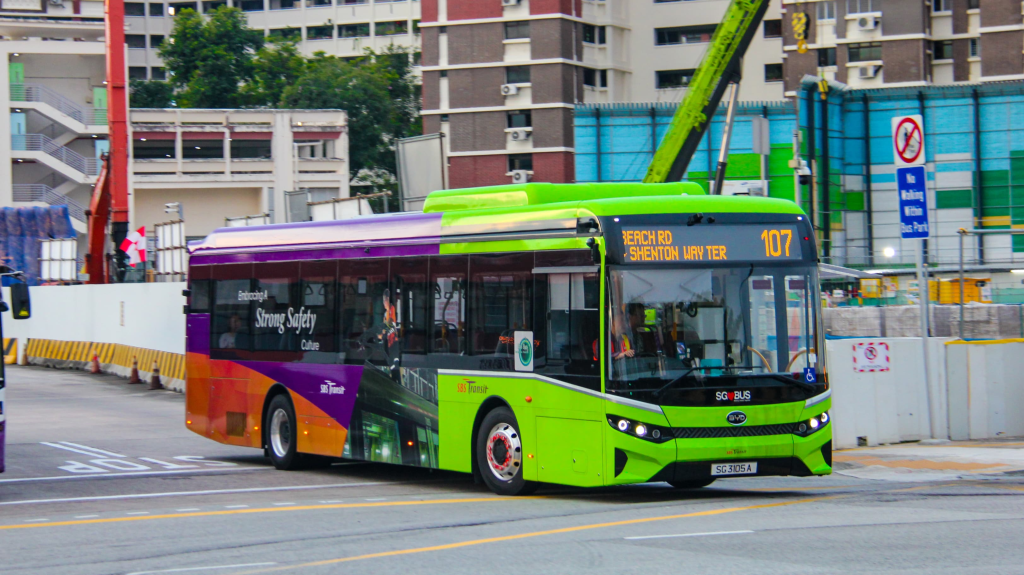
On 2nd December 2024, an era in Singapore’s public bus history finally came to an end, a few years too late perhaps. With the first handful of 300 BYD B12 (production batch) buses entering service on 86, 107 and 159 that day, comes the end of a longer-than-should period where Singapore was merely trying out electric bus samples, uncommitted to full electric fleet operations at scale. Unfortunately, as the shocking title of this post would tell you, things were far from smooth. Don’t get me wrong — things are expected to cock up on the first day because of teething issues that should eventually die down, but what happened that Monday went far beyond the expected failure range to produce a uniquely nonsensical storm fuelled by a concoction of techbro fad, policy ineptitude and operational incompetence. With of course, the typical dash of anti-intellect that characterises much of LTA’s recent bus policies. To call the hyped-up electric bus debut an embarrassment (the refined English translation of “xiasuay”), is to be overly generous and diplomatic.
The saga around these electric buses didn’t begin when the B12s entered revenue service on 2nd December, however. Loads of other incidents in the weeks leading up to this fateful debut only further fuelled the train wreck that became of what should have been our proudest moment in our bus electrification efforts, but unfortunately didn’t. What happened on launch day itself, in light of these preceding events, was merely the cherry topping the icing on the shitcake that tells our public bus electrification story.
More than a month before, the first of those electric buses were unveiled to the public officially, during an official visit to the upcoming Sengkang West bus depot by senior MOT official Murali Pillai. Besides the BYD B12 on display, also present was the Zhongtong N12 (the other model ordered in bulk as part of the 420-bus order), as well as the litany of other features the depot was equipped with, such as the electric bus charging infrastructure and worker dormitories. Mainstream media has happily lapped all that up, and I don’t need to speak more, other than thanking the heavens that infrastructure to support electric bus operations are finally here en masse, to at least support a fleet at scale, rather than just individual demonstrator buses!
What came under the spotlight however were the features showcased on the buses themselves. Both the B12 and N12, as part of LTA’s “future electric fleet”, sported three major differences from existing buses as the public knew them.
- Three doors, instead of the current two.
- Automated ramps, on a fleetwide scale. (This after its trial had supposedly failed years ago…?)
- Removal of rear-view mirrors, and replacement with digital mirrors.
Regarding the third door, I’ve already said my piece with both the double-deck and single-deck variants. Tldr: LTA and the bus operators got to ask themselves what they really want out of this, with the specific operational circumstances they’re facing. Neither do I have much to say about the automated ramps, even though they can be ironically more troublesome to deploy than their manual counterparts. (That being said, why on earth is the ramp’s control panel exposed for all to visibly see? Is LTA literally begging for a repeat of the Jurong East PSD kid incident, but with a bus ramp this time?)
But the mirrors… this particular decision has left many dumbfounded, and even more so when images of the driving cab on these buses were circulated. In short, the officially-sanctioned removal of physical rear-view mirrors from newer buses meant the addition of many more new digital screens in the driving cab, most notably the two large screens that were meant to be virtual substitutes, blocking part of the front view of the bus captain. Together with the numerous other screens facing the bus captain, all these screens (be it that of the digital mirrors, the CFMS or CCTV footage replay) form a ring of light around the BC’s field of vision! Let’s get the obvious out of the way — these digital mirror screens, particularly for the left mirror, block the driver’s field of view. The aforementioned screen blocks the windscreen in a particularly critical location — right smack in the middle of the windscreen, where the BC is expected to pay attention to!
In short, this alone should be a red flag for operational safety, but it gets much worse in practice. Because driving cabins are almost usually dimmed to ensure drivers can see the road well even at night, all the bright lights blaring from these screens (which for some reason do NOT have dimmed brightness???) is not only a distraction (akin to the effect texting while driving has, but more pronounced), it also actively reduces visibility of the road. It defeats the purpose of turning off lights while driving in the first place, and we might as well just run buses at night with all interior lights at full blast. There’s also another caveat, particularly for digital mirrors that project a real-time video feed into the driving cab. Because the bus itself is moving, often at significant speed, it also means the images on the video feed will be moving constantly. Unlike traditional mirrors which are out of the BC’s field of view, what’s basically a live feed of a constantly changing image is subconsciously being fed to the bus captain constantly, who must process them alongside the images of what’s directly ahead of him on the road. This can be disorienting, and a confused driver at the wheel is as dangerous as a reckless one. Additionally, all these conflicting lights, colours and images cause overstimulation, which is another way to quickly tire out already overworked bus captains, even if they have the mental fortitude to constantly reconcile the various sensory input they’re getting.
I’ve even managed to get behind the wheel of one of these buses with such a set-up, at SITCE 2024. Though not identical, this set-up on the incoming Zhongtong N12s should be very similar to what those driving the BYD B12s currently are facing:

To keep it short, all the bright screens forming a halo around my vision hurt my eyes, even for a brief moment sitting there.
In a nutshell, one very simple queshen: Is the person sitting in that special seat on the bus there to drive it to a destination, or look at what’s best described as a kaleidoscopic animation?
LTA’s official explanation for this is that the digital mirrors are intended to be complementary. If this word sounds too chim, it means that this flashy new tech gadget is meant to be used alongside existing, established fixtures (aka traditional, physical rear-view mirrors). Unfortunately, the latter’s absence on the buses showcased in Sengkang West Depot was no fluke — by mid-November, even legacy buses (one Scania K230UB, one Volvo B9TL in Ulu Pandan Depot) were beginning to have their physical mirrors removed as part of an expanded trial. It goes without saying of course, that the B12s that debuted on revenue service did not feature them either. Thus suggests an intent for digital mirrors to replace, not complement existing physical mirrors! Is failing English a requirement for promotion within LTA’s corporate communications? There’s a world of difference between the two words here!
Knowing all of this about digital mirrors, everything that follows below should not come as a shock at all, with high failure rates and unsafe driving. In fact the surprising thing, fortunately, is that despite all the risks of casting so much faith in unproven technology, the B12s haven’t crashed in revenue service, yet. (I’m glad I got proven wrong here, at least)
Fast forward a few weeks to early November, when preparations for the biennial SITCE were underway. With a fleet of the new BYD B12s chartered for operating shuttles from Suntec City to various exclusive site visits, this would be their first passenger runs, ahead of their formal launch on revenue public service.
Lo and behold, on the first day of service during SITCE:

A disoriented bus captain accidentally crashed a spanking new B12 at a traffic junction in Bayfront. Another similar accident with another bus would happen the day after, also due to blindspot issues, the very problem these digital mirrors were supposed to rectify, over their physical legacy counterparts! The irony here is insane. Round of applause, please. Failing on debut day (which also happened, as you’ll see later) is one thing. Failing before entering formal revenue service, to the extent of causing the buses to crash, is a whole new level of failure right here! Thankfully, no one was hurt in both accidents during SITCE 2024.
On a slightly unrelated note to what happened the day we launched the new B12 fleets, another incident occurred during the same SITCE which was frankly, just embarrassing for us. The highlight of the show this year was tragically a whole host of double-decker electric 3 door buses, with samples from BYD, Zhongtong and CRRC on display. I had wished @lemonnarc’s tongue-in-cheek comment of “mouth-watering capacity on an electric 3 door bus” was merely made in jest, but unfortunately, it became a stark reality little more than two years on. The Zhongtong N12D for instance, advertised with a capacity of 120 passengers, was found to have an effective capacity of far fewer than 100 passengers — which could be as easily achieved simply by modifying a single-deck Citaro to have all seats between the front and rear doors removed, without all the extra money spent on “researching and developing” such a convoluted design!
If this is bad enough, there’s more. A survey questionnaire, sent out by LTA through the booths that exhibited such buses, was shamelessly pushing an agenda of 3-door double-deck buses in the question wording:

Notice in particular, question 4, asking respondents if they preferred a 3-door bus design. Note the choices offered to respondents, which ranged between “yes”, “possibly” and “no preference”. In effect, this is a slight of hand from whoever is sending out these surveys, to falsely demonstrate popular support for double-deck 3-door buses, because they could simply use these survey results to claim that “100% of all SITCE participants were in favour of, or did not mind, the 3d2s design”, even though this would be a horribly twisted statement, misrepresentative of sentiment even among industry professionals who were visiting! The question, and the entire survey in general, simply doesn’t let you reject their premise of “3 door buses are superior”! It’s less of a feedback survey, and more of an echo chamber at this point — this survey, instead of collating industry opinion, has instead been crafted with the goal of making the bosses in LTA hear what they want to hear! I can imagine why not many actual industry professionals bothered to even touch this questionnaire — filling it in would be a waste of time, knowing their attempt to disapprove of 3 door buses would somehow be twisted to mean neutrality or even explicit support! Disgusting.
A friendly reminder that the global standard for high-capacity buses, is still the humble bendy bus, and not this flashy techbro bumble that LTA smart alecks over. For what it’s worth, London and Berlin, the only other cities in the world that operate buses with a 3-door, 2-stair layout, are in various stages of phasing them out, either in favour of normal 2-door double-deck buses, or bendy buses. In the case of London especially, the New Routemasters (which inspired the layout on our 3 door 2 stair buses), were found to be incredibly unreliable (and was slammed by the UK’s leading transport journalist as a “safety hazard”), and later exposed as a political sham by then-mayor Boris Johnson to curry brownie points for such a stunt. The question then is, why are we actively diving into trash that the world is throwing out? Nobody else is insane enough to spend more buying bigger buses that carry fewer people, let alone enforce this as a policy for ALL future bus purchases.
It’s even more distasteful to attempt forcing respondents of said survey to explicitly list out benefits of 3-door buses, as the penultimate question did, even when the respondent is much more likely to oppose this convoluted and brainless design than be in favour of it! Frankly, this is reflective of the 3-door ideology that has somehow taken over LTA’s bus assets department. Considering their recent procurement choices, it won’t be surprising if their mantra is “three doors good, two doors bad”! I bet such a slogan is probably printed out somewhere in their office or something, given how our last 2-door bus purchase was already more than half a decade ago.
From interviews with representatives of BYD, Zhongtong, CRRC and even ST Engineering at the exhibition, all of them unanimously confirmed that the incredibly awkward 3-door double-deck bus design was forced by LTA, where these manufacturers were threatened with a ban from being awarded bus procurement contracts if they did not cough up a 3-door bus model. Further unconfirmed reports indicate that multiple electric bus demonstrators were instantly failed by LTA before even commencing trials, simply on the grounds of having only two doors (thus explaining the “missing” registration numbers in the demonstrator bus series, 4008, 4009 and 4011). When MAN launched their Lion’s City 12e product in Singapore earlier this year, LTA was absent from all of the action, despite MAN being a major producer of public buses locally, and despite them having won many large contracts in recent years too! What’s the reason behind the sudden snub after more than a decade of warm relations in the local market? Might I point you to the answer:

It’s just incredibly shameful that our road to bus electrification is marked, not with milestones of accomplishing larger infrastructure modifications to enable better electric bus operations, but instead with such stories of them punishing manufacturers over something so inconsequential, yet with such mediocre results for our public buses! If anything, the bus assets division should have focused their energy on the former like the Chinese did, rather than wage pointless culture wars over door counts on buses. Beyond just making us look incredibly stupid (which I’m sure many foreign industry professionals are laughing at us for secretly already) on an international level, this distinction is a big reason why our electrification efforts took so long to take off. It is already difficult to produce a viable electric bus with sufficient range. Why are we making it even harder to realise our goal of a fully electric fleet by 2040? Wrong priorities anyway — why are we being forced to settle for mediocre products just because they fit some arbitrary “3-door” requirement, instead of aiming for a better fleet that actually satisfies the capacity needs of our bus system?
This isn’t the end of LTA’s fleet choice shenanigans by the way — even more nonsense would crop up when these buses finally debuted on 2nd December.
At last, the big day came, with nearly ten BYD B12 buses (the same ones used during SITCE) being launched into revenue service on services in the northeast. Three buses were assigned to 86, another three to 107, and three to 159/A. On paper, of course. Early in the morning that day, one of the buses on 107 was swapped out even before commencing service, replaced with a diesel bus. Okay, teething issues, expected fare (and probably why SBST chose to deploy multiple buses on each route) for a first day. Another B12, one assigned for 159, failed to show up for service too — expected too, or maybe some scheduling shenanigans. Little would we know, that that wouldn’t be the end of troubles for the new electric bus fleet — it was just the beginning of what would be an incredibly dramatic afternoon filled with operational comedy.
Afternoon rolled around, and these same buses (all deployed to peak-only runs, also known as split shifts) came out again to ferry passengers, after supposedly having been recharged at Seletar Depot in the afternoon. Unfortunately, while the morning was relatively peaceful operationally, things went downhill real quick in the evening. With one B12 on 107 already out of service since the morning, another unit on the same service had to be withdrawn, because lo and behold…

Surprise surprise, a piece of alpha testing software gave up on the bus captain and all the passengers he was ferrying, rendering the bus unuseable. Why on earth was this unproven technology even permitted to run on its own without any form of legacy systems redundancy in the first place? If anything, back when this same digital mirror was being trialled on certain diesel buses, it was almost never enabled, with the bus captains pretty much ignoring them for the reliable physical mirrors still around. But anyway, it’s very disingenuous that there exists the risk of a bus, perfectly movable and in workable condition, having to be forced out of service because a piece of software controlling a flashy gadget replacement of something reliable, breaks due to unforeseen factors.
You know what this sounds like?
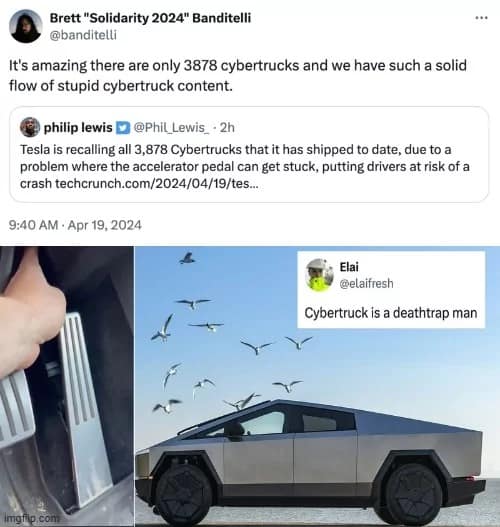
The Tesla Cybertruck, the pinnacle of automotive engineering centered around the insistence on digitalising everything down to the last mechanical button on the car dashboards, with a singular tablet controlling the entire vehicle. Of course, because it’s meant to seem edgy and cool and “futuristic”, it lacks basic fixtures standard on any car, such as door handles (which are unlocked through a mobile app) and rear-view mirrors, because all you need is the power of technology, a bunch of digital screens and some big brain intellect, right? Of course, these techbro gimmicks and their thoughtless design are indefensible, and so is this decision on LTA’s part to put blind faith in unproven technology, in the name of “safety”. On a side note, Murali Pillai, the senior MOT official who inspected the BYD B12 buses at Sengkang West depot as mentioned above, is also the head of a “bus safety task force” convened earlier this year to study how to reduce the number of bus crashes. For him to approve this blatant safety hazard with that major responsibility on his head… I’m speechless. (Lest you wonder if the last unit on 107 did make it through the first day, it befell the same problem too, but not before another unfortunately hilarious policy screw-up from LTA kicked in in full force).
Some sharper eyes may notice the presence of a red sign pasted on the steering wheel in the earlier image. Let’s expand the image.

CAUTION
This bus is NOT ALLOWED in TUNNELS (eg. CTE/KPE/MCE) and BASEMENTS (eg. Changi Airport)
For some godforsaken reason, LTA has this policy strictly prohibiting the operation of electric buses in tunnels. No official reason was ever cited to justify it, but the most commonly claimed reasoning was that electric buses posed fire hazards in tunnels, which were enclosed spaces that would prove fatal for escaping passengers in the event of a fire. (Similar restrictions exist on super-long tunneled rail segments too, although their effects are mainly felt on the design and technical side, mostly not affecting passengers.) And before debut day was over, this rule had been invoked a second time, because of the bus doing exactly what it was supposed to do.
To put in short, picture yourself this scenario. Suppose a schedule for a particular peak-only duty block for 107 requires the electric bus to deadhead from the depot outside the city into Shenton Way, located at the heart of the CBD. Play around with possible routes as you will, but you’ll soon realise that any sane deadhead route to Shenton Way would require passing a tunnel one way or another. If you take the CTE down, the bus would have to at least pass through the CTE’s Kampong Java tunnel to get to Stamford Rd, which then connects to Esplanade and Shenton Way. If you take the KPE down — well the KPE itself is underground for most of its route, so that’s even more tunnel for you. Whatever the case, the bus captain loses the game once he gets his timecard — because the timetabling is in direct clash with this not-very-sound restriction from LTA, as you’ll see later.
The above scenario isn’t some convoluted fiction I cooked up in my mind, as much as I wish it were so. This exact situation befell the final B12 standing on 107 that day — because it was caught deadheading using an “illegal” route, LTA forced the bus to be removed from service, even before it began running its afternoon shift! Thus wiped out the entire electric bus fleet from 107, even before the sun set that day.
It’s… absurd, to say the least. Sure, this rule was invoked before (Go-Ahead was allegedly handed severe penalties for deploying an electric bus on 518, which plied the KPE tunnel after exiting the city, and the bus forcibly withdrawn from service, a couple of years ago), but the extent reached this time is so absurd, it’s very much worth coming back to examine if LTA’s regulations surrounding electric bus operations are even grounded! Superficially, the claim goes that electric buses are prohibited in tunnels and basements because both are enclosed spaces, and electric buses are supposedly fire hazards which get very dangerous in the event of a fire in aforementioned enclosed spaces. The diplomatic way to respond to such reasoning, is to state that whoever invented these rules needs to relearn secondary school chemistry.
Principally, in the context of the B12s alone, their batteries are already designed to be far less susceptible to exploding. The “B” in the B12 name stands for BYD’s Blade battery, a well-known product that famously is designed to withstand all types of external interference, and even guards against battery fires in the event of a crash, demonstrated through the famous “nail penetration test” that anybody involved in the world of electric vehicles should probably have seen by now:
Even if this argument is to be dismissed on the grounds of “corporate propaganda”, the modern industry standard for EV batteries is to utilise lithium compound ion batteries, instead of pure lithium-ion batteries that laypeople are more accustomed to in smaller use cases. That fear of electric bus fires in tunnels stems from a misconception surrounding the chemical properties of various lithium ions — while lithium ion batteries do indeed explode easily given the right conditions, the same is not true for lithium compound ions, which are covalently bonded and react much differently from its lithium component, and is the main battery type used for larger batteries storing more power. Basic secondary school chemistry: Chemical compounds do not react the same way as their individual constituent elements! Or, in meme terms:

Similar to sodium chloride being unreactive, covalent compound ions such as lithium iron phosphate (LFP) are not as readily reactive as the original lithium ion, and is far more chemically stable, all while storing more power in a smaller volume! That’s how BYD’s Blade battery works, actually, and while its contemporaries from other manufacturers appear bulkier, all electric bus batteries by decent manufacturers work along similar principles. If you get a pure lithium-ion battery on an EV, chances are your vehicle is tiny or you’ve encountered a shady EV maker who probably doesn’t give two hoots about electrical safety. With such stringent EV certification in place, it’s ridiculous — if not stupid — to claim that all EV batteries pose fire hazards inside enclosed spaces, simply because that’s what the batteries of a couple unscrupulous bad apples do!
In any case, if these tunnel bans are really made based on grounds of fire risk, perhaps the LTA would like to explain how this is a thing, even till today, in a highly-trafficked tourist hotspot no less:
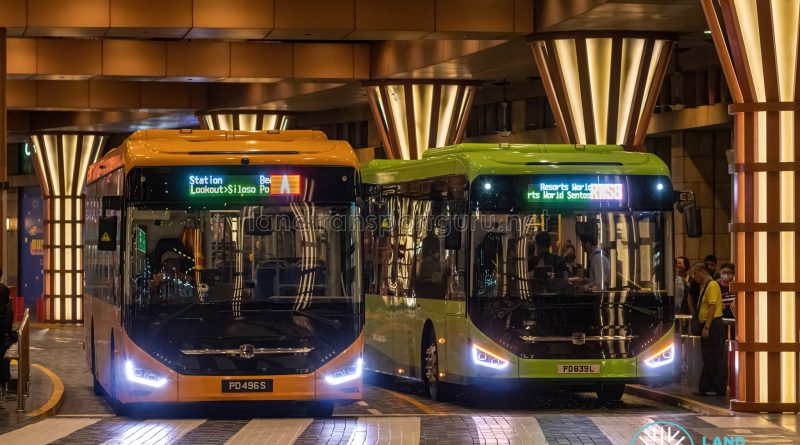
And if electric buses are prohibited in the airport basement (the wrong place to be sending buses into, but I digress) because enclosed spaces magnify a nonexistent fire risk, might I point out that all ITHs that buses originate from (excepting Toa Payoh’s semi-open air design) are also enclosed spaces? By this logic, the electric buses wouldn’t even be permitted to operate on 86 and 159 in the first place, simply because both routes originate from Sengkang interchange, fully enclosed within the Compass One mall. To extend the (lack of) logic further, wouldn’t this also mean installing EV chargers in multi-storey carparks for an incoming wave of electric cars also poses a fire risk in every neighbourhood with those? Hypocrisy much?
If anything, this policy could potentially be the single most destructive one to the entire bus network in the long term. Already, it’s preventing electric buses from being deployed on duties that begin and end in the city, as shown in the case of what happened on the first day. Its full ramifications are a lot worse — not only are a couple of particularly important expressway trunk bus connections going to become “illegal” when our bus fleet transitions to fully electric if these regulations persist (eg 30 across MCE, 518 in KPE), it pretty much shoots in the foot, even LTA’s own initiatives such as the recent spam of City Directs aimed at relieving congestion on the NEL. Fact check: every City Direct, be it currently running or soon to be introduced, passes through a tunnel on their express sector to enter the CBD, excepting those serving the west. Particularly the northeast, as both sane express routes into the city from there requires going through tunnels (either CTE, or KPE, just like the off service electric bus on 107 described above). But I suppose a future with many important expressway bus connections gone is in line with the long-term hub-and-spoke vision LTA has, so…
Conclusion? This restriction is nothing but pure bullshit from a scientifically illiterate paper general who probably read too much anti-EV fearmongering pieces from dubious sources on the internet to know how electric vehicles actually work. Please, for the sake of a functional bus system, lift this ban.
This reminds me of a particularly dumb idea that somebody at Hampshire Road floated, which was made public, and then snubbed by the industry. Way before the B12s even arrived in Singapore, LTA put forth a tender requiring bidders to install “massive water tanks” and “lifting mechanisms”, such that electric buses that catch fire in bus depots would be lifted up and transferred into a water tank large enough to fully submerge a double-deck bus in water for hours to “completely put out fires”.

First, whoever came up with this idea clearly forgot that physical agitation of a burning EV is precisely what makes an electric fire spiral out of control. Secondly, who on earth uses a literal swimming pool to put out vehicle fires? The Chinese have been running fleets of electric buses since 2011, from a time when their products weren’t exactly of the highest quality. Yet, electric bus fires haven’t been common across their vast land, and they certainly didn’t find a need to place swimming pools in every depot for such contingencies! Additionally, this is also based on the ill-founded assumption of pure lithium-ion batteries being used in large commercial vehicles, which is blatantly false in Singapore. Well, that tender allegedly ended with no one responding at all, which hopefully knocked some sense into the people behind this incredulous idea.
If you think only 107 was affected by the electric bus shenanigans on debut day, you’re very wrong. The next bit concerns all the new B12s that ran that eventful day. In the evening, some of the buses assigned to 159 failed to deploy, having to be replaced either with a spare electric bus (yay?) or a diesel bus. While a mechanical failure of some sort that rendered the buses inoperable would be the expectation of a brand new fleet, the underlying problem turned out to be a lot less sophisticated. Through the grapevine, the apparent reason for the buses’ failure was due to improper charging in the depot. On its own, that sounds bad enough, but I promise you, there’s a reason why I called the debut extremely xiasuay.
A bit of important context here first: Services 86, 107 and 159, the three routes the B12s are currently deployed to, are based respectively (as of publication) at the Ang Mo Kio and Hougang bus depots. Because both were relics of the 1980s, neither of them are equipped with charging ports to recharge electric buses. As a result, the current operational arrangement (as of December 2024) involves parking the B12s in their home depots at night, while sending them to charge in Seletar Depot during the midday swing break. But why this peculiar arrangement? You see, all three routes are part of the Sengkang-Hougang bus package, based in Sengkang West Depot (the same one that Murali Pillai visited and casually approved a walking safety hazard at), and will move there once the depot opens in January. For now however, because the depot isn’t “officially” open, buses aren’t allowed to use it for any purpose, be it overnight parking, or battery recharging. Important note: Seletar Depot only has sufficient chargers to handle the initial batch of 25 BYD buses that were introduced prior to the B12’s launch this year. Hence the allegations of the buses being insufficiently charged, making them being deemed unfit for evening service.

What I suspect happened here is a common headache that arises from a lack of dedicated electrical charging infrastructure — midday charging capacity is highly limited due to industrial areas nearby also drawing power from the electrical grid. This means either of two things — a very real risk of causing a widespread blackout from overstressing the power systems, or an inability to charge buses at full blast. In part, this is also why most electric bus charging is done at night, with daytime runs limited to only split shifts usually. It’s been mitigated already in future bus depots like Sengkang West and East Coast — with dedicated power sources to supply the large volumes of electrical energy needed to charge hundreds of electric buses at once. Except, for some godforsaken reason, these power supply works are somehow still not done at time of launch, or LTA just simply doesn’t want to allow the new B12s to move in first to enable better charging for fewer operational interruptions. Either suck up your f**king ego and take the L of delaying the launch of these new electric buses, or simply let the buses move in ahead of time! Why are we letting the electric buses run around without proper recharging arrangements?? Jeez, this is the equivalent of thinking their new car can magically run forever after leaving the showroom, because refueling is apparently unnecessary?
Little rule of thumb: every electric bus launched into service should correspond to one available, operational charging port (or two, if dedicated infrastructure like transformers haven’t been installed, as in the case of Seletar). Also, another reminder that electric buses aren’t some never-before-seen novelty that we’ve never touched before — the same SBST, and the same Seletar Depot in question, have been running a fleet of more than 20 BYD buses of all kinds for at least half a decade already! How did they still mess this up? Do we really have such an acute charging capacity shortage? If so, why are we even rushing to introduce more electric buses before their supporting infrastructure is made available? Yes, service determines infrastructure, but that’s in the planning stage, not the operational stage! How do you even run electric buses on flat batteries. This is just so incredibly dumb I’m out of words.
For representation purposes, even 86 had its fair share of nonsense — again, linked to the digital mirror design unfortunately. Apparently because the bus captains were completely not used to the digital mirror design, many straight up decided to not use them altogether, instead straining their necks to look behind their vehicle, resulting in many instances of reckless driving in places such as Jalan Kayu and the TPE. It’s a miracle nobody crashed, thankfully.

All in all, it was an overdramatic first day of operations marked by lots of needlessly created chaos. Before midnight, almost all of the B12s were grounded for further checks, leaving only one bus to run 86 the next day. Since then, the fleet has more or less re-entered service, hopefully with all the abovementioned mess sorted out. This is just plain embarrassing — in a land where we used to just get things done, it reflects very poorly when the trivial, the nonexistent, and the self-inflicted become excuses for an entirely preventable pot of troubles to ruin what was otherwise a big moment in our electrification journey. Hopefully, it doesn’t happen again.
没有对比没有伤害 (there’s no harm without comparison), right? Well, just across the border, Causeway Link has also been rolling out a fleet of Foton electric buses for use on both cross-border and local bus services within Johor Bahru. With relatively little mishap, they’ve been able to gradually phase out their oldest diesel buses without as much of a fuss, to the extent of being able to confidently operate them on high-demand cross-border routes at scale, long before the first of the 420 new electric buses reached our shores! Their relatively smooth electrification process, against the backdrop of a train wreck debut day we had, really makes me wonder how on earth a privately-run, third-rate Malaysian bus company can manage an electric bus transition far more competently than us here, in a supposed “world-class” public transport system. Heck, all our shenanigans happened over the rollout of just a mere ten electric buses, against the 40-strong fleet across the border! It’s gobsmacking how such a small fleet can cough up enough troubles to form an entire article (I was expecting to have to write a CotD about it, but here’s an entire post instead) — in Singapore too. Why?
I wonder what the thousands of visitors to SITCE in November would have thought, of the bizarrely disastrous debut of those same buses they rode, barely three weeks before. All the promotional packaging promising a brilliant electric future, and then comes the one million and one lines of fine print encoded in archaic books rooted in, I’m sorry to say, pseudoscience. At this juncture, we are our worst enemy when it comes to operating electric buses. We need more logic, and rationality if we want to really catch up with the rest of the world in electrifying our rides. Think less like Elon Musk, and more like Warren Buffet. What really matters? Abundant clean public transportation, not a bunch of rules written by paranoid geriatrics lacking understanding in their field of leadership.
With the first two production batch Zhongtong N12s having been registered last week, let’s hope their entry into revenue service comes with a lot less hiccups this time. We’ve burped too many times over the B12, anyway, in front of an international crowd no less.

Join the conversation here, and don’t forget to press the like button! Thanks for reading STC.
 Singapore Transport Collective
Leave a comment