

Is it possible to operate an islandwide network of bus services with bare minimum resources, while still attracting significant ridership?
Well, LTA decided that the answer to that was a resounding no. To them, they felt there simply wasn’t a way to run night buses that didn’t absolutely incinerate their budgets, or realistically reach sufficient ridership. Thus in June 2022, the pandemic was used as a convenient pretext to delete the entire night bus network in one shot, amidst unconfirmed allegations of pandering to ridehail lobbies.
But what if I tell you that the answer to the above question is not only a yes, but also that the secret sauce isn’t exactly rocket science? Well, here’s the second question: In what situation is a 60-minute wait for the bus more desirable than a 45-minute one?
When the 60-minute wait means zero waiting time for subsequent journeys.
In other words, building a network upon timed connections that enable infrequent services to increase their utility beyond immediate, one-seat rides. Thus, once the first vehicle has been boarded, the rider is guaranteed almost immediate connections to other routes for subsequent trips in the same journey! Some in North America may be familiar with the concept of “pulse scheduling”, while those more obsessed with Europe might have heard of the Swiss “takt” system to build coordinated timetables between trains and buses. They’re all the same thing — at key connection points, buses and trains from multiple routes wait together to enable passengers to change between them, before all departing together. Besides being satisfying to watch these vehicles move in unison (hence the “pulse” name), they potentially hold the key to making night buses semi-viable, at least more than previously. It’s a shame that public transport in Singapore shuts off after 12am, despite a steadily growing demographic who need to get around in the wee hours.
Where does pulse scheduling come into the equation for night buses? It’s helpful to look at our night services that came before, to find out what else killed them besides LTA’s want to cut losses.
Unlike pretty much every other route type in the Singapore bus canon, night bus services remained deeply rooted in a past characterised by the SBS-TIBS duopoly each exercising control over its routes. Two distinct models of night buses emerged — while both started out as local-stopping night trunks, SBS evolved the newer Nite Owls with an express sector, focusing on one town at a time. TIBS (later SMRT Buses) continued to operate their NightRiders in a local-stop fashion. Interestingly, these night routes were also the only case of both legacy operators disregarding well-established territorial boundaries — Nite Owls ran to places like Yishun, while NightRiders extended to faraway SBS towns like Pasir Ris and Punggol back in the day. On average, these routes ran once every 45 minutes, a weird interval to operate them at, but I suppose it was the balance that SBST and SMRT found between ridership and financial viability.
Both are problematic in their own ways however. It’s a lot more apparent with SMRT’s NightRiders — as local stoppertrons that called at every stop from the city to their heartland destinations, they were excruciatingly slow, and with the introduction of OTA (mandated for routes operating at intervals longer than 15 minutes) as part of the BCM’s BSRF, they became even slower with additional mandatory schedule padding. It also didn’t help that this coincided with the rise of ride-hailing, which proved itself a much more competitive option against both taxis and night buses despite their higher price.
Nite Owl services on the other hand, while avoiding the trap of slowness, faced the other problem that all express routes face — overspecialisation. What this means is that the effective catchment of each Nite Owl service was strictly limited to nighttime ridership towards a given town, making the Nite Owl network extremely costly to operate, per rider. The express-route dilemma also manifests slightly here, in the sense that a string of towns in a line from the city would have been served by a singular NightRider, as compared to multiple Nite Owls to each individual town. One’s obviously a far bigger resource hog.
Additionally, many night bus routes had extremely circuitous heartland sectors in a bid to maximise coverage, but for most this meant much slower rides, leaving the night buses only a serious option for those unable to regularly stomach night cab fares. In a sense, many of the newer CDS routes being launched in the northeast are uncannily similar to the Nite Owls of yesteryear, just operating during the peak, and offering service both ways. (It doesn’t need to be said that just like how many of these night services floundered, so will these politically-motivated CDS routes)
But the most severe fault of these legacy night services lies in their service pattern. By the mid 2010s, both NightRiders and Nite Owls were only operating uni-directionally, from the city and ending in the heartlands. They were also overwhelmingly centered upon Clarke Quay, with all legacy night routes (and even the attempted post-Covid reboot NS-1 and NS-2 operated privately) serving Clarke Quay as the focal point of the entire network, with nearly all of them beginning there. Sure, some NightRiders began from Resorts World Sentosa, but they also went to Clarke Quay, and revellers from Sentosa who didn’t live directly along one of those NightRiders would have to transfer to another night bus at Clarke Quay. As you can imagine, there was no guarantee here as to how long the wait would be, when a transfer is required between the night buses of old! The bigger problem here is what was implied in such a thinking — it assumed nightlife to be the sole driver of public transport demand beyond conventional operation hours, and that people are only heading out of the city beyond midnight. With the predominant thinking of night transit being centered around revellers, it’s not surprising that it would struggle to keep afloat, with or without the pandemic. In cynical terms, Nite Owls and NightRiders themselves are specialised, catering to a narrow audience in a timeframe already marked by low demand!
For a 2020s reboot of the night bus system to take off, three supposedly contradictory conditions must be met in order to keep them sustainable, even in a low-ridership environment.
- They must be fast. This takes into account competition pressure from taxis and ride-hailing, which didn’t exist when the old night routes were first launched.
- They must serve as many people as possible. Besides having a large catchment, the more important factor here is to avoid specialisation, which opens up the system to more diverse rider profiles.
- The network should operate with as little resources as possible. Besides limited fare revenue from operating night services, there’s also the problem of insufficient manpower in the wee hours, as well as the potential constraint of having to pay them more.
Using conventional knowledge of bus operations, the likely conclusion most would draw is that two of the three above conditions can be met, at the cost of forgoing the last one. A night bus network could attempt to maximise catchment on limited resources, but it wouldn’t be fast (and this was the choice SMRT made in designing NightRider services). Similarly, it’s possible to have a somewhat fast service on a meagre resource pool, but at the cost of highly limited access per route. (That was what the Nite Owl did with its express sectors) But it’s not feasible to have all three at once. Or is it…?
The problem with using “conventional bus knowledge” (or should I say, average Singaporean bus awareness) to create a night bus network is the limitation posed by the trunk-feeder-express trichotomy in our local lexicon. A long-distance service here is either a trunk (which implies local, although not necessarily be), or an express (incorporating a long nonstop sector). In a sense, there’s also a false dichotomy between access and speed being forced — such a view of buses pitches access and speed as mutually exclusive, when they need not be!
Of course, for longtime readers of this blog, you’d know a third route type exists that reconciles the dual premise between both — rapid services, which stop at longer, regular intervals, thus enabling access to major nodes along the route, while still maintaining speed.

To maintain an extremely low resource usage needed for an expansive night bus network, the hub-and-spoke system is a surprisingly effective tool at achieving that outcome. Yes, I know that’s the very thing this site advocates against, but there’s a fringe case where this may well be a good solution — at very low frequencies, the inefficiencies of HnS systems caused by unidirectional demand are reduced to absolute minimum, reducing their downsides with a barebones network. In any case, this is late at night we’re talking about, so what demand imbalance is there to talk about?
This is where the art of pulse scheduling comes into play. A viable night bus network can be achieved simply by forming a hub-and-spoke system with rapid services as the core backbone of the network, while further expanding coverage with local routes that connect to the rapids! Many long trunk routes, particularly those linking the city to other towns in Singapore, can be upgraded to have their cycle times fit snugly into multiples of 60 minutes after upgrading to rapid-stop. (Cycle time refers to the time taken for a vehicle to make a full trip in both directions, inclusive of layover time) At hourly intervals, these selected night rapids can operate with just two buses (or three for longer crosstown trunks), a drastic reduction from their daytime fleets in the dozens, while still enabling access to as many points along their routes as possible, and keeping the rides fast.
A 60-minute bus frequency at night sounds worse than the night buses of old (which ran 45-minute frequencies), but it’s more than made up for with their greater speed, and the vastly improved access of rapid-stopping. Better yet, because of the coordinated pulses with local routes, you only wait once. There’s an underappreciated significance to this — these rapids are effectively doing the work of multiple legacy night routes, thus combining demand to multiple towns on the same bus and making them a tad more viable. Another significance of setting all routes to operate every 60 minutes is the order that it gives to an otherwise uncertain experience of travelling in the wee hours — termed clockface scheduling, the idea is that all the buses in the network assume the same position at the same point within the hour, thus creating a stable system to bridge the transit void between last bus and first bus. Or, from the passenger perspective, buses depart at the same point every hour.
Maybe the above sounds like too much technical jargon to the lay reader. Let’s demonstrate this in action with an example of a potential night rapid paired with a local service.
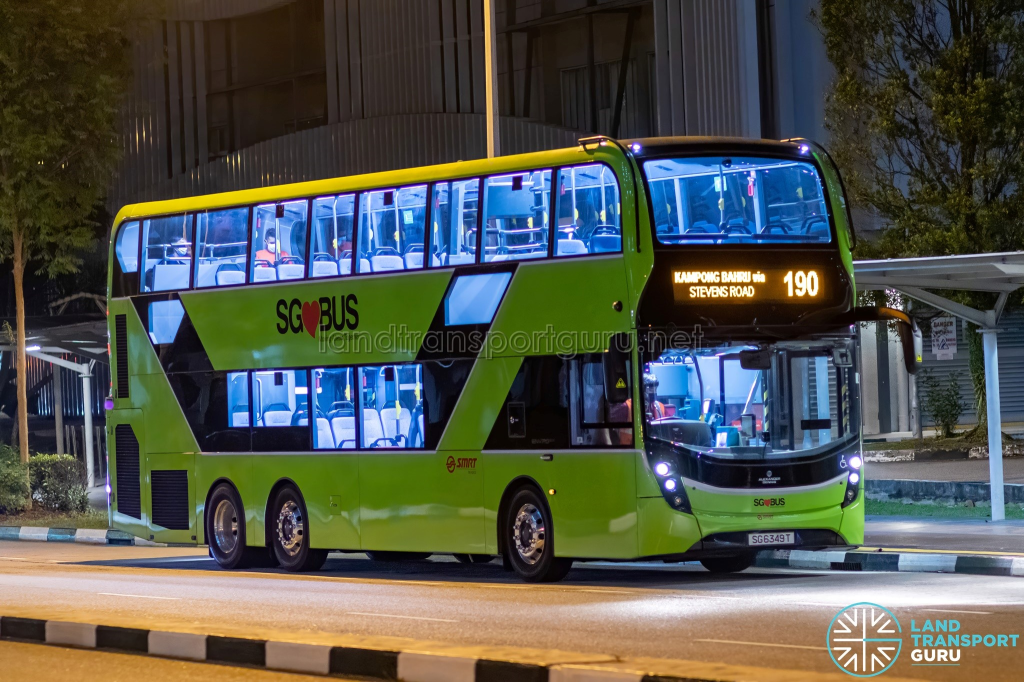
Consider bus services 190 and 979, serving the towns of Choa Chu Kang, Bukit Panjang and Yew Tee. As a service linking many recreational areas in the city (Orchard, Chinatown, Clarke Quay) to the heartlands, 190 is a highly suitable candidate for night rapid service. Author’s note here: Frankly, I think 190 should be operating as a rapid all day to relieve the DTL and its scuffed Bukit Panjang crowds, but I digress. This rapid-stopping 190 calls only at the stops shown below:
| Towards Choa Chu Kang | Towards Kampong Bahru |
| Aft Hosp Dr (Outram Park MRT) | Bef Neil Rd (Outram Park MRT) |
| Aft Chinatown Stn Exit D | Chinatown Stn Exit E |
| Clarke Quay Stn Exit E | Opp Clarke Quay Stn |
| YMCA (Dhoby Ghaut MRT) | Bencoolen Stn Exit B |
| Orchard Stn Exit 13* | Orchard Stn / Tang Plaza |
| Raffles Town Club (Stevens MRT) | Bef Stevens Stn Exit 4 |
| Blk 223 | Blk 270 |
| Blk 184 (Bukit Panjang) | Bukit Panjang Stn / Blk 604 |
| Opp CCK Polyclinic | CCK Polyclinic |
| Choa Chu Kang Int | Choa Chu Kang Int |
However, 190’s utility as a night rapid can be further expanded beyond its immediate catchment in Choa Chu Kang and Bukit Panjang, through a timed connection to 979 at Bukit Panjang (Blk 183/604) that enables Yew Tee residents to benefit from it too!
Suppose the 190 departs Kampong Bahru at 2am. It passes the city sector quickly due to the reduced stop count, and reaches Bukit Panjang at 2.40am. Here, a 979 departs Bukit Panjang interchange to meet the 190, enabling Yew Tee residents to make an instant transfer despite the extremely infrequent service. The 190 would continue to Choa Chu Kang and arrive at 2.50am, while the 979 heads towards Yew Tee. This 190 would depart Choa Chu Kang at 3.05am, then reach Bukit Panjang towards the city at 3.15am.
As 979’s usual route doesn’t connect to citybound 190, a special night variant of 979 can be operated to enable 979 to call at Blk 604. (Who’s going to Hillion Mall at 3am anyway?) By the time the 190 reaches Bukit Panjang again, so would the 979, and the coincidence of both buses enables Yew Tee passengers to connect seamlessly to 190 again. The 190 proceeds on to the city, restarting the cycle on its next departure at 4am. Meanwhile, the same 979 from earlier will be launched again at 3.50am to meet the next 190 coming out from the city. And the cycle repeats, until regular bus service commences at 5.30am.

Granted, the actual product of numerous rapids interacting with their locals and other rapids is bound to more complex then the simplistic “branched” service shown above. In some cases, the connecting local may even connect in both directions, requiring a 4-way pulse between both the local and rapid! Nonetheless, the principle remains the same — hourly frequencies, long-distance rapids forming pulsed connections with local connectors, all running like clockwork.
Some may also notice that unlike the legacy NightRiders and Nite Owls, the proposed network of pulsed local-rapid connections operates bidirectionally too. Besides it being a technical requirement to realise regular hourly connections, running night buses both ways also expands their reach to other demographics who need transit at night beyond just downtown nightclub partygoers. Y’know, there’s people out there who actually commute during these odd hours. They’re more likely to benefit from a night bus network that has a higher chance of offering their commute path. Furthermore, bidirectional night buses are also fundamental in enabling the night bus network to eventually evolve away from its radial origins, in recognition of the many new potential workplaces which would benefit from night bus service too, and not just toward the CBD only.
To realise, and embrace the art of pulse scheduling is to crack the cheat code towards a highly lean, but no less useful or swift night bus system that outshines its predecessors. Together with the power of rapid-stop services (friendly reminder cc. Amy Khor: rapids are not the same as expresses), we can finally answer the very first question above, with a resounding yes. Like its daytime counterpart, a successful night bus system will be built upon connections, made possible even with low frequencies. One can imagine the little dots on the map meeting each other briefly before heading off in different directions, some launching halfway across the island while others relay residents to their doorstep, all in synchronised motion. That would be a beautiful sight, wouldn’t it?
Join the conversation here, and don’t forget to press the like button! Thanks for reading STC.
 Singapore Transport Collective
Leave a comment