

It’s happening again.After the week-long disruption thatleft the East-West Line severed into two, the EWL is set to partially close again, this time deliberately for a planned conversion of the Changi Airport branch to begin works on. Of course, this time round it’s all planned, so there’s much less excuse for poor communication to create mayhem on the ground compared to the September derailment.
To keep everyone in the loop for those unaware, a planned partial closure of the EWL is happening between 7th and 10th December 2024. The focus of this closure is on Simei station in the east, as part of the Tanah Merah Modification Project (TMMP). Train services are to be suspended between Tampines and Tanah Merah stations, with reduced service between Paya Lebar and Tanah Merah during peak hours on the 9th and 10th (relative to typical high peak frequency). This year, the TMMP-related closure is for the commissioning of the new East Coast Integrated Depot (ECID)’s EWL section, by linking it to the EWL mainline. In the broader scheme of things, TMMP is just one part of the puzzle in realising the conversion of the Changi Airport branch line to eventually form the TEL extension through Changi Airport. While that’s still 16 years away in 2040, the Simei closure is now, and having witnessed the chaotic communication between SMRT and passengers in September, it’s worth drawing a few lessons so things go miles smoother in December.
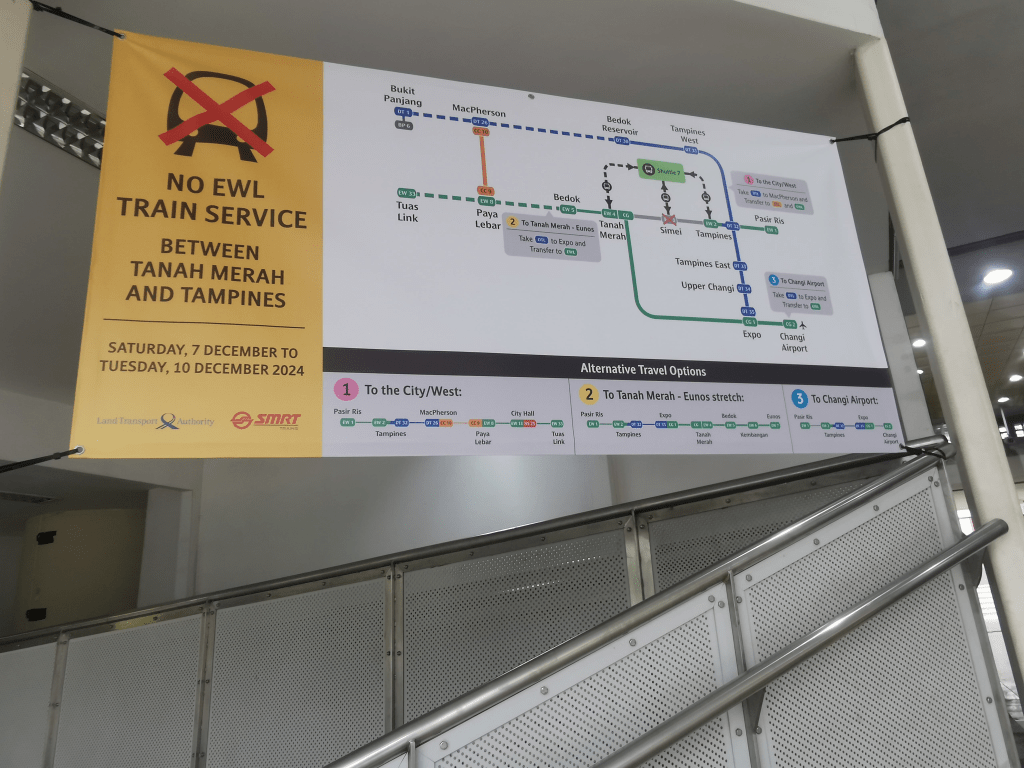
To the credit of SMRT and LTA, they did stuff to clear things up this time round. For one, they’ve been putting up big posters at EWL station entrances (like the one you see above) since mid-November when the closures were announced. Really big posters that show you the “government-ordained” alternative routes to the EWL (aka other rail lines), and even complete with step-by-step instructions in fine print to guide those who really know nothing about the rail map other than the EWL. It seems that, at least when it comes to surface information, LTA and SMRT are going very ham, with the messiness of September still fresh in their minds.
Additionally, boards are also being put up on the half-height platform gates at affected stations, to indicate when trains are plying the “wrong way”, another lesson learnt from the widespread confusion when operating single-track shuttles. These are positive signs — as partial line shutdowns become more common in future (be it for systems renewal or line integration testing), clear messaging of how things are going to work is key to ensuring life goes on even when parts of rail lines aren’t running.
It’s also encouraging to see how detailed service pattern diagrams have been produced for this expected shutdown too — down to exact connections between the various two-station shuttles, as well as with the planned bridging bus (Shuttle 7). These are wildly reminiscent of the various ground-up diagrams produced during the September derailment, which did a much better job communicating separate temporary connection arrangements between shuttle trains and bridging buses than the illegible, haphazard PowerPoint scrawls LTA and SMRT produced. It seems they have taken notes, at least from the Twitter community blasting their ineptitude with the obviously clearer unofficial guides produced. That being said, many more notes weren’t taken, as you’ll see later.
Of course, for every initiative that’s done to help, there’s two or more that didn’t, that could potentially make these partial closures logistically less painful, or heck, even speed up journeys during a disruption period. And because it’s a deliberate one, the suggestions in this post should be considered for deployment, even if not for the TMMP closure this year. Because this is specific to the needs of this particular TMMP closure (2024 edition), I’ll mainly be talking about how things can be done a lot better, but the ideas presented here can pretty be applied to any rail shutdown that may come our way in future, with a few tweaks in the minute details. (If you’re the kind that just breezes through long posts without reading carefully, the main points in disruption management and messaging are helpfully highlighted in header text.) Dealing with those intricacies is what LTA is best at, anyways, once a clear direction has been set.
When commuters are told to consider alternative routes to the EWL in this case, what should come to mind, if not immediately after parallel rail options in the area? Buses, obviously, and it’d be insanely foolish to overlook those as alternative travel options in disruption messaging. So far, the main bus-based parallel option being advertised officially comprises merely the free bridging bus service exactly duplicating the EWL between Tanah Merah and Tampines. Unfortunately, this is a mistake that we made at great cost in September — attempting to handwave a new bus route into existence from nothing, with resources cannibalised from other routes that were actually helpful towards dispersing crowds.
Here’s the problem — by giving preferential visibility to Shuttle 7 only, LTA is reinforcing the cycle of necessity for rail bridging buses, which have been established as ineffective and detrimental towards capacity relief from past practical experience. Like I’ve said before, the reason why FBBs become necessary in a disruption primarily stems from a lack of awareness of the bus network, which forces LTA into having to set up a shuttle bus service that mirrors the MRT’s stopping points. The cost? All bus riders in general, as the buses for these shuttles are ransacked from trunk services, typically routes that also double up as ground zero relief!
The only saving grace for this is probably the fact that half of the Simei closure takes place on weekends — days when the bus fleet is less utilised, allowing more spares to be used for Shuttle 7 without compromising important trunk connections in the area. On the two weekdays (9th, 10th) however, the fun begins — Shuttle 7, expected to consume a couple dozen buses to maintain “3-5 minute headways” as promised, will have serious competition (for resources) with routes like 9 and 118, each boasting mammoth fleets absolutely necessary for the monstrous demand they experience to key employment and education centers.
9, besides serving as Simei’s main link to Bedok, is also the main link to the Changi Airfreight Centre, a massive employment hub necessitating high capacity provisions. (This also explains why 89e bucks the trend of generally low-perfoming express services — sheer demand from CAC alone hard carries its ridership and fare revenue to an extent unimaginable on most other routes). 118 on the other hand, is the main link for just so many schools and business clusters that it’s just crowded at any point in the peak travel direction. Besides tanking demand in Changi Business Park (particularly the feeder connection to Expo MRT), it’s also the lifeline for ITE College East, Temasek Polytechnic and the Tampines Retail Park. Basically, it’s the sole route funnelling residents from north and northeast Singapore to these bustling destinations. For the matter, 31 also serves a vital feeder connection between ITE College East and Tampines/Tanah Merah. In short, however badly Jurong West residents got screwed over when 198’s fleet was cannibalised for a rail bridging shuttle service, it will be felt many times more for those headed for these places in the east should SBST/GAS and LTA elect to use their fleets for Shuttle 7 come 9th December.
LTA’s messaging around alternative bus options ignores the larger variety of different trunk and long feeder connections that could possibly be made across the severed rail connection, playing a dispersive role from the main EWL corridor.
Avoid tunnel vision
I’m not too sure why LTA’s messaging around bus-based rail alternatives repeatedly falls into this trap, but every time they have to tell commuters about potential bus alternatives to MRT lines, they seem to get collective amnesia about anything that leaves the path of the rail line involved. For instance, highly useful trunk/long feeder connections that were the main players in bridging the EWL gap at Clementi, such as 185 and 198, were absent from any officially prescribed lists of alternative travel options, simply because part of those routes involve deviating from the EWL to serve a different catchment. Similarly, many bus services in the context of the Simei TMMP closure have been glossed over that actually offer strong enticing connections across the gap in the EWL during the shutdown period.
It’s like a sort of “tunnel vision” LTA contingency planners funnel themselves into, believing only bus routes that entirely duplicate rail lines can be effective alternatives in the event of a train disruption. This mentality by the way, is what gives rise to the self-perceived “necessity” to invent bridging bus routes that drain resources from high-demand trunks, and overcoming it requires network awareness in designing alternatives, rather than the current point-to-point approach.
Maybe some readers weren’t too clear what I meant when I mentioned communicating “network-based” rail alternatives. Lucky for us, this TMMP closure is perfect for illustrating how alternatives can be found in the trunk bus network.
Tampines and Bedok, two major towns in the east linked by the EWL, form two opposite “vertices” in a rectangle, with the EWL forming two adjacent sides. Logically, it stands to reason that any route using the other 2 sides of said “rectangle” will also form a decent alternative route too, if the EWL isn’t available. As it stands, such a bus route does exist — 67, calling at Tampines, Bedok Reservoir and Bedok stations before plying towards the city and on to Choa Chu Kang.
In fact, specific to the context of this particular closure, I find Shuttle 7 quite unnecessary and redundant — numerous bus routes form a tightly interwoven mesh of lines bridging the gap, forming a viable, ready-made alternative network that simply needs extra fleet injections to meet demand smoothly. Like with what happened in September, many unofficial posters recommending alternative bus services in the area have been popping out:

Obvious station-by-station duplicates, such as 31 and 38, could do well to receive fleet boosts. It’s unfortunate that 38 has fleet restrictions against double-deckers during typical times, but when 20 (which plies an identical route in Simei) also runs them without fault, is it not a hint to allow double-decker deployments on 38 during exceptional times? I doubt the existence of any real constraints that actually make double-deckers impassable in Simei. In any case, even if there is, the value of frequency should be much appreciated — increasing frequency on these EWL duplicate routes does wonders to soak up excess demand.
It need not even be full routes being boosted, if someone makes noise about “wasteful use of resources”, and given clear demand patterns, it’s obvious where we can get to work. In fact, even existing short-trips can be made the most use of, if LTA were a tad bit smarter with how bus bridging is carried out. Currently, short-trip 31A begins from Tampines interchange and ends at Tanah Merah station, only operating in the morning peak as a “last-mile” service for ITE students. With a closure looming, rather than blowing frequency holes in 31 for an arbitrary “Shuttle 7”, the intelligent thing to do is simply to operate 31A throughout the entire day (at 5-8 minute frequencies, which is above what’s currently being run during its limited morning peak span) to connect Tampines residents to the main EWL and airport branch at Tanah Merah!
Lest some say this overstrains SBS Transit, the ideal response of course is to tell the numerous nonsensical regulations under BCM to stick it up their behind, but it’s fortunate that SMRT can help out too, as the operator for Service 67. A more efficient way of operating Shuttle 7 that will not overwhelm it with high demand between the east’s two largest towns, is simply to operate a temporary short-trip “67B”, where some trips from Tampines turn around at Bedok MRT, passing through Bedok Reservoir station. This is a more efficient shuttle set-up than the planned Shuttle 7 — by incorporating the connection to the DTL, it allows part of the otherwise massive Shuttle 7 crowd to be diverted to the DTL at Bedok Reservoir, thus enabling the same limited resources running on both temporary short-trip enhancements to carry more people.

To make it clear for likely clueless passengers, the EDS for 31A and 67B can simply be reconfigured to state only the train stations they cover, making it clear for even the least transit-literate passengers. (There’s a precedent to this — cross-border services 160, 170/X and 950, at various points of their history, ran with the EDS stating only the destination country)
By strategically engineering temporary short trips as real alternatives to a missing rail link rather than the mindless stop-by-stop approach currently used by FBBs, fewer buses can move more people, at less inconvenience to residents of the east who aren’t directly affected by the partial closure! There’s many more possibilities for temporary short-trip enhancements over the next few days (such as extending 5A and 5B to at least Tampines West and beyond), but let’s keep this post as short as possible.
Clarity and primacy
Another major failing observed in September, besides the extremely rushed communication of temporary operating arrangements, was also the lack of clarity and primacy in communicating them to commuters. In less verbose terms, it simply means that despite the information being there, commuters were still unaware of how things worked, either because they didn’t have access to it, or it wasn’t being actively brought to their attention. This matters, when you’re on a platform, with trains running the wrong way, and most commuters aren’t the most well-versed in the various ways in which trains are kept running, despite partial closures.
Since this closure (and basically every TMMP-related one in future) involves some form of single-track shuttles, which almost always trip up the uninitiated, it’d be very helpful to figure out some way to clear the air around short trips. Fortunately for us, an unfortunate circumstance in the area has been allowing SMRT to build up some expertise in crowd management on diverted rail services.
Relatively unknown to most Singaporeans except those visiting the airport by MRT recently, the Changi branch line recently experienced a technical fault at Changi Airport station, forcing the line to operate as two single-tracked shuttles between Tanah Merah and Changi Airport. For the past six weeks, Expo (CGL) has become a testbed of sorts for SMRT to familiarise themselves with handling the much larger-scale TMMP closure down the road. That image of a board displaying the direction of travel on the platform doors above, by the way, came from there — they were introduced to combat confusion amongst passengers. There’s one obvious problem with it — it’s located way below eye level for most, which means… it’s not particularly obvious if you don’t know where to look. As it is, this still appears to be the case, as more often than not, it’s still the calls of the platform staff that guide passengers to board the right trains, not these signs. This isn’t a good sign, because the airport branch is already a relatively quiet corner of the rail network. Repeating this tactic at Tampines and Tanah Merah will definitely overstrain station staff, and their effectiveness under duress isn’t going places.
With the RATIS (the screens on the platform telling you where the next train is headed) so far off for the long six-car platforms on the EWL, what if we employ possibly the dumbest, but most effective method that immediately catches the attention of clueless passengers? Since the same trains (especially on the Pasir Ris – Tampines shuttle) are going to be deployed on the shuttle services for the period of the shutdown anyway, why not paste a huge sticker covering the train door windows, stating the stations which the shuttle train calls at? It’s at eye level, and everyone’s going to see it like it or not. Frankly, this has a greater effect if applied in September — the “mainline” and “shuttle” services clashed at the same platforms at Boon Lay and Queenstown, bamboozling anybody unfamiliar with the EWL’s track diagrams.
Another big hiccup from September was the use of real-time announcements broadcasted from a microphone somewhere, delivering someone’s voice throughout the station. While this is the most flexible approach compared to canned, pre-recorded announcements (pre-loaded audio files, basically), much is lost in transmission literally. As one would expect with radio transmissions, the messages were often garbled beyond recognition, and station staff under stress also weren’t the best at giving clear instructions over the PA system anyway, with broken sentences confusing passengers further.
Perhaps because the Changi Airport crossover track had been broken for long enough, special announcements were added to relieve the job of station staff, which you can hear below:
But there’s another option apparently that exists, and having been used by SMRT in a prior train disruption, really opens up the possibility of using it for a partial rail shutdown. Earlier this year, when a similarly large sector of the NSL was disabled by a lightning strike, pre-existing announcements were spliced to reflect the new terminating point for northbound trains (Woodlands, until the fault was cleared). Similarly, such splicing was also used to produce impromptu destination announcements for the CCL upgrading works (when trains were turned around at Labrador Park and Kent Ridge). The modularity of the audio files used for our destination announcements is an opportunity for clearer communication, and having been done before, it’s only logical to do it again for the EWL.
Leap over bottlenecks
Because of the way “alternative rail routes” are being suggested, I’m left wondering if those suggesting these routes have considered some important realities.
Notice the odd route prescribed for citybound connections on the EWL — take the DTL to MacPherson, hop on the CCL to Paya Lebar, and then continuing on the EWL westbound. This also explains the choice of turning alternate trains around at Paya Lebar (instead of Eunos, where the track crossover is actually located) — the intent appears to be one where Tampines and Pasir Ris residents are bumped off the EWL to the “alternative route” consisting the DTL and CCL, while Bedok and Simei residents are expected to stay on the EWL itself. Some Tampines residents, from the looks of it, are also expected to take the shuttles to Expo and then the DTL back up.
Excepting probably the last group mentioned above, who’ll be making use of a typically underutilised section of the DTL between Tampines and Expo, there are a few too many cracks to make the officially prescribed route sound credible. The most obvious aspect of this lies in the choice of the DTL as the expected main workhorse for Tampines and Pasir Ris residents to get practically anywhere. Anyone who knows that the DTL is a 3-car “LRT” line should be able to see how well this is going to go, particularly during the peak when the DTL3 sectors, already at capacity, are now expected to carry everyone left behind by the missing EWL connection. (There’s also the slight nuance of the EWL having a higher peak frequency than the DTL, which tilts this against the DTL further). SBST has the trains to run better service on the DTL, and for the sake of everyone’s sanity, they should, and hopefully they’re prepared tomorrow with special timetables for more frequent DTL service.
But even with more DTL trains running, the real bottleneck lies with the CCL, expected to join these commuters back to the EWL. My first reaction upon seeing the “officially approved route recommendation” was frankly to wonder why people would even bother to change twice to get to the EWL, when their downtown destination had a higher probability to lie along the DTL, thus congesting the trains all the way, rather than just halfway as officially hoped. (It’s still worth noting that even at 30 tph, up from the current 22.5tph, the DTL would still be struggling to clear half of the EWL’s typical capacity) That aside, the real crunch occurs on the Circle Line, the One Ring of the rail network we all love and hate.
While it’s typically the sector between Serangoon and Kent Ridge that’s often associated with the infamous images of hilariously overcrowded trains and stations on the CCL, the eastern half of the CCL (between Serangoon and Paya Lebar) is no joke either — Tai Seng station sits snugly in the center of a massive cluster of high-rise industrial buildings, with the numerous trunk services passing by amplifying its catchment to include even more industrial buildings along MacPherson Road and Airport Road. As a result, scenes like this are typical fare for workers in the area during their commute:
Very quickly, you realise this isn’t going to be a good idea, when the CCL is already crush loaded (also with passengers from places such as Promenade and Bras Basah, as a helpful reminder) right where it’s intended to act as an alternate pathway to the EWL. This is the key pinch point, and if not handled well, the first victim will be MacPherson station, itself ill-equipped to deal with such massive crowds arising from a partial EWL closure. This arrangement of halving the frequency beyond Paya Lebar, besides forcing Tampines and Pasir Ris passengers into the mess of the CCL, also disbenefits Bedok residents (who will likely have to compete with Tampines East residents coming in from Expo), but their problems are but a scratch compared to those having to experience the DTL throughout this closure.
Coincidentally, something exists to allow Pasir Ris and some Tampines residents to bypass this mess, but it doesn’t exist in sufficient quantity to effectively help at the scale needed: Express service 12e, linking Pasir Ris, Tampines East and Bedok South directly to Bugis, City Hall and Outram Park. Unfortunately, because of the various factors that contribute to the short-livedness of express services in Singapore, its service levels is nowhere near helpful to just how many residents in the east needing alternative travel options. Again, this isn’t rocket science, but may require a bit of bypassing (pun intended) red tape — 12e can and should be made to operate bidirectionally, every 15 minutes between 6.30am and 11pm on the four days of closure expected this week.
Additionally, while the official focus has been to attempt cramming everyone aboard the DTL, the beauty of the east is the availability of numerous parallel rail lines, especially with TEL4 having opened earlier this year. At the risk of sounding like a certain other party, a highly attractive option to ease the load on the DTL would be to improve the bus services linking Tampines to TEL stations. In the context of this closure specifically, Service 10 links Tampines to Bayshore station in a relatively direct route, and travel time-wise, a combo of 10 and TEL is likely to be time-competitive against queuing for Shuttle 7 and transferring to the EWL, or queueing for the DTL. Given how impatient some (including LTA) are to see riders get on new rail lines, this is an opportunity to give the newly-opened TEL4 additional exposure, and heck, we’d be doing everyone in the east a favour even if the TEL trains are filled in their eastern segment for just four days. With the DTL and TEL both built as medium-capacity lines, they were never meant to individually tank EWL relief efforts — it’s surprising LTA hadn’t considered such options, if they were really that desperate for warm bodies on their new TEL trains.
Find the pulse
In what scenario is waiting 12 minutes for an MRT train more desirable than waiting 5? When the initial 12-minute wait guarantees you no further waiting time on all subsequent connecting journeys. Inexplicably, this was a strategy previously employed by SMRT that was shockingly absent from this particular closure.
Sometime earlier this year, when the same crossover at Changi Airport broke itself (jeez, why does it keep breaking?) too, SMRT elected to run a “timed-pair” of shuttle trains on the airport branch, with one train shuttling between Tanah Merah and Expo, and another between Expo and Changi Airport. Just like the planned shuttles for the TMMP closure this week. Except, what SMRT did during that disruption that strangely wasn’t adopted for this, was the practice of timing the trains to meet each other at Expo. While both single-track shuttles ran at 12-minute frequencies, by synchronising arrivals at Expo station, they enabled passengers to transfer to the other shuttle with no additional waiting time! Thus, the effects of the poor shuttle frequency (out of necessity due to the sheer track length to Changi Airport) were mitigated, since total waiting time went down.
This time round, the shuttle train between Expo and Tanah Merah is planned for a 8-minute frequency, while the shuttle to the airport runs at a 11-minute frequency. Arguably, this is the worst combination of numbers possible, because the lowest common multiple of both intervals means that both shuttles only sync up once every 88 minutes, or about twice every 3 hours. If you’re not super lucky, that means twice the waiting time just to get from Changi Airport to the city. I understand that the Expo shuttle had to be run at a higher frequency to handle crowds coming from the DTL at Tampines, but couldn’t they have opted to run the airport shuttle at 12-minute frequencies like they did previously, thus enabling every second or third trip to line up with each other to form a seamless transfer for far more passengers? (LCM of 8 and 12 is 24 meaning you’re 3 times more likely to get a timed connection). At the very least, I hope SMRT takes advantage of math to time the Expo shuttle train with the mainline EWL train at Tanah Merah, thus making the wait less painful for some passengers. Psst… this is helpful, because LTA and SMRT will have to entertain far fewer complaints of infrequent train service. Yes, trains are still infrequent because of the way they’re run, but timed connections make it less painful!
That’s about all I have for tips on making a planned rail shutdown a tad bit less agonising for passengers. It’s a bit rushed unfortunately, but even if it’s too late to implement them for this year’s TMMP closure, I do hope they can be considered for future closures. We do have the resources to manage such hiccups smoothly, and with a bit of creativity, let’s maximise what we can do with the partial networks available! I hope all goes well for the shutdowns starting tomorrow — this will be a test for LTA and SMRT’s ability to plan for controlled rail shutdowns, and a glimpse of what we can expect moving forward.
Join the conversation here, and don’t forget to press the like button! Thanks for reading STC.
 Singapore Transport Collective
Leave a comment