

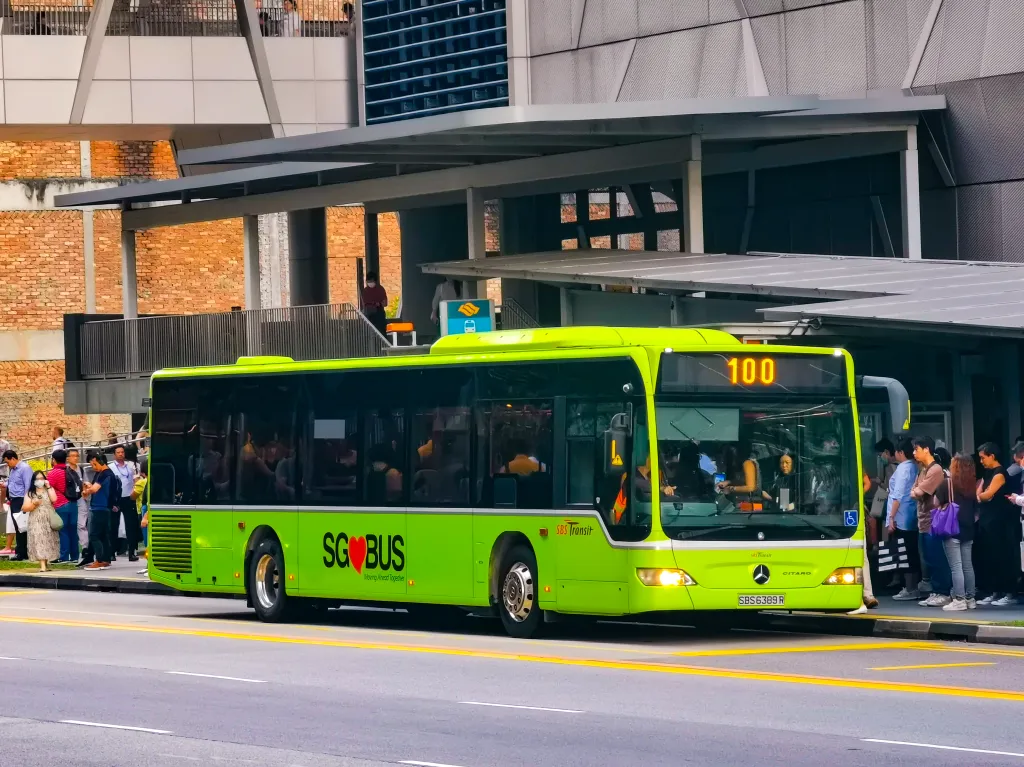
Do more crowded buses on a route necessarily mean higher ridership? This may come as a surprise to many, but the link between bus crowding and ridership is weaker than many assume it to be. To surprise you even more, these ridership differences aren’t even the work of minute capacity differences between bus models, or even different bus frequencies — there’s actually a much more significant factor at work, albeit less obvious to the untrained eye.
Consider the following data from two fictional bus routes. For simplicity’s sake we shall assume perfectly even stop spacing, equal stop counts, and equal provision of bus capacity and frequency on both routes. Total ridership per trip is indicated at the bottom (twice, for both alighting and boarding counts). Bus loading is indicated in the rightmost column. Assume the rated vehicle capacity at 90 passengers.


You may notice that on both routes, the bus maxes out its capacity at some point of its route, indicating full capacity utilisation. In layman terms, it means both buses are extremely crowded at some point, to the extent of crush loading. On an app, you’ll probably see red, to indicate highly limited standing space.
But if you look at the total ridership counts for both routes, the second noticeably serves much more passengers than the first! How does this happen? Isn’t it the same bus, running on similar routes, both being crush loaded at capacity?
You might point out that the second route has more passengers boarding in the middle of the route too, whereas in the first, the general trend is that of one-seat rides from end to end. That’s absolutely correct, and that’s where the concept of demand cycles in. Specifically, their length and arrangement impact ridership stats to a greater extent than their number.
Demand is not a monolith
The first important concept, before I introduce the two key kinds of demand patterns, is to always remember that demand exists in cycles, rather than as a monolith. The reason why many erroneously conflate bus crowding with ridership is likely a misunderstanding in this area — often, discussions of bus service performance is accompanied by comments such as “high demand” and “low demand”. Nothing wrong with big-stroke generalisations of travel patterns, until they’re the only descriptor around, with no further information given.
Let’s start with some basics. Each ride on public transport (when split into its constituent rides) comprises boarding the vehicle, riding it, and then alighting somewhere else. Taken together, this forms the basic unit of demand on public transport services — the demand cycle. Each cycle begins with one boarding passenger, and ends with the same passenger alighting down the line.

When grouped together with numerous other rides made by other public transport users on the same trip made by the bus or train, the full picture emerges, with hundreds if not thousands or tens of thousands of demand cycles arranging themselves to form demand patterns that tell analysts and planners alike where people are going, and when.

*Edit 22/11/2024: horizontal length of each cycle is also affected by travel time too, as the length of the overall graph is determined by runtime.
More astute questions about demand on public transport, such as asking for “key demand patterns” on a certain route for instance, are in fact demonstrating awareness for the aggregates of demand cycles that form the layman’s understanding of “demand”, by seeking to group these cycles into larger “blocks” to show where more people tend towards. This funky pictogram of brackets stacked atop each other isn’t the only way to represent the myriad of demand patterns possible across routes with dozens of stops — numerical representations, such as the sample data shown at the start of this post are possible too, and so are cleaner pictorial representations such as the use of cumulative graphs showing bus loading.
Two big patterns
Now with this awareness of demand being comprised of demand cycles, there’s two major patterns in which demand cycles can arrange themselves across a public transport route in space-time, and each of the two sample data shown above reflect one such pattern.
Cumulative demand, represented by the first set of data, refers to a pattern of generally long demand cycles, with mostly boardings at the start of the route and alightings at the end. Aggregated, routes with cumulative demand usually have only one main demand pattern that spans most of the route’s length. Typically, cumulative demand profiles are seen on express routes, and peak-oriented services, and and are more common on routes with unidirectional demand. (Which these two service types usually are)
Cyclical demand, as the name suggests, involve multiple demand patterns “cycling” through the vehicle throughout the course of the journey, with constant boarding and alighting recorded at various points along the line. This pattern is reflected in the second set of sample data above, where many intermediate stops also see large passenger exchange volumes. Generally, cyclical demand profiles are observed on long feeders (by design) and rapid-stop routes (particularly if they form a network with similar rapids, for example in rail rapid transit). Routes with bidirectional or even multidirectional demand tend towards cyclical demand patterns too. As for local-stopping long trunks, it’s a toss-up depending on the specifics of the route itself — some exhibit cumulative demand patterns due to their predominant use for long journeys, while others create cyclical demand patterns due to the many popular destinations they serve.
Of course, these patterns don’t exist in pure form (nothing does in the real world) — various combinations of these demand patterns exist in real-world routes that we live and deal with in our lives. A trunk service with predominantly cumulative demand may have a strong cyclical countercurrent beneath it as a result of being useful to many passengers alike. Likewise, a long feeder route defined by its strong cyclical demand profile may also have a weak cumulative countercurrent, caused by the occasional joyrider intending to enjoy windy bus rides end-to-end. Some routes may even have both demand profiles side-by-side due to their amalgamated route structure — a long feeder sector with strong cyclical demand followed by an express sector comprising cumulative demand. (168, anyone?)
As observed, cyclical demand patterns allow the same vehicle capacity to serve many more passengers than with cumulative demand, which increases ridership while paradoxically requiring less service! In the case of the routes above, a cyclical demand pattern enables the same bus to carry three times as many passengers with the same capacity provision. (This is also reflected in real-world studies we did — routes with strong cyclical demand like 74 easily outperform cumulative demand routes with similar runtimes like 974 by a factor of 3 or more)
With cyclical demand patterns, each stop along the way is a potential point to exchange passengers, thus increasing the number of passengers served on a single trip, and in turn, increasing ridership to a multiple of the vehicle’s given capacity. I like to call this the “cyclical multipler”, which is a number denoting the number of full cycles in which all passengers on the vehicle are theoretically exchanged, in relation to the vehicle’s original capacity. In the case of the sample data above, the second route has a cyclical multipler of 3.64, which means that on average, the entire bus clears out and fills up 3.64 times, to get the ridership figure of 328 passengers per journey.
The cyclical multiplier is powerful, for two reasons. First, it’s how public transport grows ridership exponentially by developing networks of connective routes that form more useful trips to far more people than a handful of individual lines. Others may refer to a “loading multiplier” to explain the phenomenon of relatively small trains being able to handle large crowds. Besides that, figuring out how cyclical demand can be achieved, even if merely as a countercurrent to predominant cumulative demand patterns, is a life hack for public transport planners and operators to save big on operating costs while serving more people. Call it the ethical way of cutting corners, if you will.
Just exactly how powerful is the cyclical multipler? Well, both the examples I showed at the beginning indicate the bus at full loading, with red and orange loading being the norm for most of the route. Here’s another set of data, showing cyclical demand on a route that only gets the bus to half capacity most of the time:

Even with only half loading being achieved, this service still carries 50% more riders than the first route shown above! Talk about a less crowded bus ferrying more passengers! This is why orbital lines typically can get away with smaller trains — because demand is highly cyclical due to the nature of these lines bridging gaps between radial lines, a smaller train is able to handle larger passenger numbers. Of course, this assumes a perfect orbital line with every station being an interchange, which almost no real-life orbital does (except Moscow’s 5-Koltsevaya), thus making 3-car trains for our Circle Line a huge folly.
That being said, the distinction between cyclical and cumulative demand patterns matters in a lot more things beyond just nerding over ridership stats. To be fair, some of it also involves nerding over other data, but I digress. For one, this shows the importance of making long-distance journeys by public transport faster, especially if they’re carrying a lot of passengers between different towns. Cumulative demand profiles built into the route’s profile often limit ridership of high-demand express services, which from the layman’s perspective means that despite the high bus frequency and capacity provided, they still can’t board because of the seemingly endless crowd waiting to board the bus. Rather than demonstrating expressway buses as a failure as some claim, understanding demand cycles makes the importance of enabling buses to travel faster on expressways more obvious — shortening the demand cycle (measured in time and distance) with faster journeys makes these high-demand expressway services less of a resource sinkhole than they would have been, thus making life a little bit better for operators and commuters alike. Running faster trips is the standard for intercity public transportation, and it doesn’t make sense that we don’t do this for what’s effectively an intercity journey, which many of our expressway buses are.
Demand cycles are also particularly important when analysing fare revenue figures (especially when it comes to measurements of route profitability, which LTA does). As long as fare structures are not perfectly linear with distance travelled, ridership numbers will influence fare revenue, and that’s where special consideration must be taken into account to correct for biases inherent in the metrics used to evaluate route performance. This belongs in a future post, but to give a gist of it, bus services here with cyclical demand do much better in farebox recovery than those with cumulative demand, yet both are equally important. Unfortunately, because of the fixation on financial viability, important connections hang on a thread because of their relative disadvantage in farebox recovery, an innate characteristic which trunk routes cannot be faulted for.
To speak more broadly, understanding demand cycles (particularly where they start and end) is also an important tool in route planning, especially so if rationalisation of some form is being considered. For instance, take the case of a long local stoppertron whose long runtime is unfriendly to smooth operations and bus captains alike. Often, a common solution (if upgrading the route to rapid-stopping is not feasible due to circuitous local segments, for example) would be to attempt splitting the route into two or more segments, or shortening it with the intent to have other routes cover the lost portions (if they aren’t fully utilised yet). How exactly to determine where these routes should be split without angering its riders, is where the analysis of demand cycles comes in. The distinction between cyclical and cumulative demand also has implications on the solution that should be adopted — in very rare cases of long routes with a clear cumulative demand pattern, introducing an express route to bridge both ends of the existing route may be an option considered to relieve the existing trunk route, enabling the latter to be adjusted without the backlash that past (ir-)rationalisations have caused. Of course, express services come with their own bucket of worms, which is best left again to another post in future.
Edit 28.11.2024: Demand cycles also matter in deciding fleet choices for particular routes, and this is more obvious with buses than with trains. Routes with longer demand cycles forming a cumulative demand pattern are better served with double-decker buses (for instance, expressway services!), while bendy buses are much more favoured on routes with much shorter demand cycles. That’s why, excepting the special case of 858 (where double-deckers cannot be deployed in the airport), bendies have historically been allocated to feeder and long feeder services under SMRT first, followed by trunks with a cyclical demand pattern next. Between rigid buses, the distinction between cumulative and cyclical demand also determines when a two-door or three-door layout is more appropriate — both have the same effective capacity, but cumulative demand patterns favour two-door rigids with marginally more seats, while cyclical demand patterns work best with their three-door counterparts, where the benefit of the third door is maximised (together with all-door boarding, the critical ingredient in all efficient bus systems). Note that as routes get changed around and/or demand patterns change over time, fleets need to be adjusted based on real-time conditions too! A similar principle holds for rail, although the ways in which it manifests is much more subtle — cyclical demand rail services (rapid transit) tend towards trains with more doors and longitudinal seating (for faster passenger exchange) while cumulative demand rail services (commuter rail, intercity expresses) tend towards transverse seating, which gives a lot more seating capacity.
Finally, in an age where both buses and trains alike buckle under the immense passenger loads they carry, with little wiggle room for further expansion without costly modifications, understanding demand cycles, particularly where they start and end, is also particularly helpful for constructing useful alternatives that really benefit people who otherwise have little choice for their commute. Understanding where demand cycles clash for limited capacity on buses and trains, coupled with broader understanding of travel patterns across the network, is the key to designing useful and robust alternatives to rail that are well-used (so LTA can quit yapping about “financial imprudence”). For one, actually useful alternatives planned into the bus network can be much more politically fruitful than showpiece amendments that attempt to demonstrate an effort in remedying overcrowding on busy MRT lines, such as the NEL, which the entirety of the northeast has no choice but to rely on due to historical decisions. Again, that’s stuff for another post, in light of recent adjustments announced for the area.
IMPORTANT NOTE: This is not a value judgement between routes with cyclical or cumulative demand — while cyclical demand routes perform better both in ridership and fare revenue, this post is not about promoting one form of route design over another. Both cyclical and cumulative demand services play equally important roles in our network, and their value to commuters should be judged by the access to jobs and amenities they offer. What this post is for however, is to explain how disparities between data and real-world observations of public transport usage arise from differing demand profiles, and how neither can be cast off in favour of the other — understanding demand cycles and how they affect the transportation of people across the city is key to building the full picture that truly includes the daily experiences of public transport users as a stakeholder in transport policy and planning. It’s incredibly ridiculous, for one, to dismiss an important trunk bus route carrying people over long distances simply for carrying barely more passengers per trip than the rated capacity of the buses running on it. That’s unfortunately the bureaucratic “data-driven” approach to planning for you, which comes with these implicit biases built into the standards we measure our bus services with.
As you probably guessed, cyclical demand is made up of shorter trips, either from connecting to other services, or due to the short-haul nature of the journeys being made, while long-haul trips contribute towards cumulative demand profiles. These trips work together to form complete journeys in any network (be it hub-and-spoke or connective), or are applied for different types of journeys, which makes it incredibly foolish to proclaim one type as more valuable than another. Like what’s said elsewhere on this blog, the entire network has to be taken into consideration!
You might have noticed one particular group of bus services has not been mentioned anywhere above. Where do feeders fit on the spectrum of cumulative and cyclical demand profiles? Well, because demand cycle length is governed by trip times, the relatively shorter nature of feeder journeys means that despite appearing as a cumulative demand profile relative to each full trip made by the bus, the time-length of its demand cycles more closely matches the shorter journeys commonly seen on cyclical demand profiles for non-feeder services. Because of this special situation feeders find themselves in, it’s best to class their demand cycles in a separate category — after all, the concept of a “feeder” is also largely an artificial construct created through the expansion of branch shuttle services (which exist outside the cyclical-cumulative demand profile spectrum) to fit the needs of full-scale public transport systems. Put another way, if another route type (long feeder, trunk etc) were to take over the roles of a feeder service (which many of them do in Singapore’s context), these feeder demand cycles would simply form a more amplified cyclical demand pattern on the non-feeder route!
Knowing how demand cycles work is particularly valuable in planning and operating transport networks, and with a bit of skill in operating policy levers, even service types that typically do not perform well can perform better, if that is the intended outcome. Or, by determining where these cycles start and end, targeted solutions aimed at providing robust alternatives in the network (against expectations to cut operating expenditure) can be built. Or at least, identifying where the network needs to be boosted, by hook or by crook.
Join the conversation here, and don’t forget to press the like button! Thanks for reading STC.

 Singapore Transport Collective
Leave a comment