

Slightly edited 28/10/2024 to make some bits a tad bit more palatable to the powers that be, lest I get consumed by their fiery ego over words deemed too uncomfortable.
Crawling out of my hole again for the second time, because damn, I never expected ministers to demonstrate that they know practically nothing about the field they deal with, besides lists of facts prepared by their subordinates in MOT and LTA. How they regurgitate these mindblowingly illogical fallacies so confidently in Parliament amazes me. It’s one thing to not possess expert knowledge on the matter down to the last detail, but it’s another to make entry-level mistakes so basic that even the average Ah Beng wouldn’t make, particularly on a subject that Singaporeans hold dear.
After the dust had (hopefully) settled in the wake of Singapore’s worst train disruption this decade, it was time for the nation’s highest chamber to hear how things would be taken moving forward. A record 31 questions were filed in a single Parliament sitting (more were filed previously), stretching the discussion around the derailment to the tune of more than two hours. Two key figures in the Transport Ministry spoke at the Parliament sitting on 15th October in response to the barrage of questions posed by both incumbent and opposition alike. With 105 paragraphs spoken across two speeches, I must say that the sitting Ministers at MOT have made my day, and not in the right way. And of course, once they were done speaking, the mainstream media swarmed to expand upon their individual comments, producing articles after articles elucidating their holy words.
Increasingly, I’ve come to see the MOT website — particularly their press releases containing ministerial statements — as a regular source of free entertainment, either through shocking demonstrations of incomprehension, or the reliable flow of misconceptions that even the most senior office holders in the field fall for. As much as it’s funny that such beginner-level mistakes can be made by the top officials of our transport system, it’s unfortunate that it’s the same few individuals making the decisions that matter, and even more so that these fallacies are shared by the general public, hence making the process of trying to put things back together, a lot harder than initially expected.
The questions left no stone unturned regarding the derailment of 25 September, covering topics ranging from maintenance of the 35-year old legacy trains, provision of alternative transport arrangements, the impacts had on commuters, compensation for the hundreds of thousands affected, and even the robustness of the overall public transport network! Transport Minister Chee Hong Tat delivered, in response to the litany of questions filed in the days prior, his ministerial statement on the events of the disruption. It’s riddled with lots of holes, and that’s why you’re reading this post. Towards the end of the Parliament sitting, the issue of the overall network’s robustness, particularly in the west, was raised again, prompting Amy Khor, Senior Minister of State for Transport, to deliver yet another speech on realising the LTMP 2040 vision of a “45 minute city”. Together, both ministers spoke for about half an hour in total, in what could be described as some high quality, unadultered yapping, peppered with fallacious statements at best, and outright misinformation at worst.
You can find their speech transcripts on the MOT press releases website here, as I cite the quoted paragraphs later on:
Exact paragraph numbers will also be indicated in quotes pasted here for your reference too. Any text formatting (bold, italics or both) are mine.
Before I deep dive into book reviews of the two speeches, I think it’s particularly noteworthy to mention one other figure in that parliamentary sitting, who hammered home a particularly important point that is finally being brought to attention with the derailment last month. In particular, for recognising certain facts about the state of public transport in western Singapore that, up till 25 September, were not widely recognised.
In his adjournment motion, NCMP Leong Mun Wai of the PSP highlighted how connectivity in the west is still found severely lacking, a flaw exposed when hundreds of thousands scrambled to find their way home on demonstratably inadequate alternative options, due to the weaker public transport network, especially at points west of Jurong East. In his words, the derailment and its fallout served as “an unwelcome reminder to Singaporeans living in the west of how reliant they are on the East-West Line”. For longtime STC readers, this should be no surprise to you, given how we’ve pointed out this structural flaw in our network as far back as three years ago. Additionally, he also demonstrated how this lack of connectivity also results in much slower journeys by public transport, by putting many residents in the far west out of reach of the CBD, by the 45-minute targets set in LTMP 2040. It was in the context of this expose by NCMP Leong that prompted Amy Khor to deliver her speech, and with it, her lack of understanding about how public transport works.
On a side note, the PSP also put forth an eye-catching suggestion to improve connectivity in the west. While the proposed JRL extension to Haw Par Villa is typical humdrum that’s been repeated for the past decade or so, their other proposal — a nationwide network of “skip stop” bus services calling only at the highest demand stops in each town — does it sound familiar? Essentially, the PSP advocates the implementation of rapid-stopping buses to complement the MRT in the west! I wonder if they’ve been reading our blog 🤔 If they have been indeed, a big thank you for publicising the idea of rapid buses!
With that out of the way, let’s look at Amy Khor’s response first, a mix of confused chatter about someone unfamiliar with public transport, and some potentially concerning revelations about upcoming developments.
4. Let me begin with our rail network, the backbone of our public transport system. Today, besides the Bukit Panjang LRT, residents in the West are served by the North-South Line, East-West Line and Downtown Line. While Mr Leong has claimed that the East is “far better” than the West, with all due respect I think this is not a fair comparison, as there are differences in geographical characteristics, stage of development, and travel patterns. With planned expansions to the rail network, we are on track to having 8 in 10 households in the West within a 10-minute walk of a train station by the 2030s, which is aligned with our target for the entire island.
5. Complementing the rail network are bus services that provide first- and last-mile connectivity to key transport nodes, and alternative options for commuters. More than one-third of our bus routes ply in the West, including express bus services that connect residents in the West directly to job centres in the Central area.
Right after the preamble acknowledging the many who posed similar questions, the first fallacy hits. Amy Khor called NCMP Leong’s comparison of transport connectivity in the east and west “unfair” due to “differences” in a whole host of factors highlighted in bold above. I’m not sure how fair such an assessment by Amy Khor is, as the fundamental duty of public transport, alongside other forms of transport, is to bring people to their destination. And as long as people don’t live directly next to the stuff they need to get to, such as work, education, food or entertainment, then this need will continue to exist. It is highly dishonest for her to claim that just because of very nuanced differences between East and West, that the quality of public transportation is completely disconnected from its quantity. It’s not a perfect correlation (a mistake that she also makes in the next paragraph), but Amy Khor’s wording implies that there is no connection, which is fundamentally wrong when you’re looking at a service that counts patronage in the millions per day.
However problematic it is to cross between the east-west corridors spanning the east, the fact remains that almost every apartment block there (excepting maybe those on the fringes of Pasir Ris) is well within the 45-minute isochrone from the CBD. Unfortunately for most westies, particularly in a large chunk of Jurong West, this remains a luxury, and they’re even further removed from other amenities beyond downtown! I mean, when “Pulau NTU”, named as such for its “ulu”-ness, is right behind your backyard, that’s a sign that what little long-haul public transport that exists for them isn’t making the cut for adequately serving their needs. So yes, it is very much fair for NCMP Leong to conclude that in terms of public transport connectivity, East side best side, West side backside.
Next, Amy Khor makes an incredibly common fallacy when discussing public transport. She cites how the west has “1/3 of all bus routes in Singapore”, as if that is a meaningful indicator to show that buses are supposedly more abundant to make up for the disparity in rail service. Number one misconception in the world of transit planning: number of routes means nothing without the greater context of how these routes interact with each other! Often, an increase in bus route count without a corresponding increase in service catchment means one of two things:
- The new routes introduced exist with heavy duplication to existing routes
- This is not necessarily a bad thing, if capacity requirements cannot be met reasonably with fewer routes. The BSEP last decade focused on introducing long feeders that played this role, with varying results. Where this isn’t justified, good bus rationalisation exercises (a different case from irrationalisation, which LTA has been conducting in recent years) consolidate routes and strengthen service.
- Alternatively, given geographic limitations, duplication is inevitable in some parts of the network in order to provide long-corridor access, or for a longer bus route to more efficiently serve two markets at once.
- Or, the new routes introduced are feeder routes, which consume large amounts of operating resources without providing additional access benefit to a correspondingly high population.
Let me illustrate this point with an example from her new constituency, Tengah.
Presently, she boasts that Tengah is very “well-connected”, with three bus routes up and running already. Service 992 links Tengah to Bukit Batok in a semi-relay fashion, 870 links Tengah to the regional hub at Jurong East, and 871 takes a long, meandering route to Beauty World, where residents can connect to the DTL after a 45-minute ride. We didn’t make the last bit up: go ride it for yourself to see, it’s baked into the timetables partially due to the detour via Bukit Gombak.
Of the three routes, two of them (871 and 992) duplicate each other fully in Tengah. 871 also duplicates a large braid of five other trunk and long feeder services (61, 66, 157, 174, 852) between Bukit Batok East and Beauty World, while providing little additional access on the other end of this network bottleneck. Presently, all three Tengah services operate at a 15-minute frequency outside the peak, which is not very impressive by Singapore standards. Along the combined sector at Tengah Drive, that gives a midday frequency of about 8 buses per hour, and the high demand that these routes receive is an indicator that they can do a lot better. As a side mention, 852 currently operates at 18-min frequencies throughout the day too.
On a side note, suboptimal public transport connectivity in Tengah has also been holding back transit-inclined residents from moving in, thus perpetuating a more car-inclined atmosphere. A similar case played out with Tampines North about two years ago, which resulted in residents’ pressuring public transport to be deprioritised. Obviously we don’t want that to happen in Tengah, which exists at a much larger scale than Tampines North, so what can be done?

Looking at their routes on a map, it’s not hard to see that an obvious axis exists along which these routes can be consolidated for better service! What if, instead of these duplicative routes existing next to each other (and causing LTA to whine non stop about “high operating costs” of buses), we could just create a single route that has the demand to justify a high bus frequency all day, thus improving travel time for Tengah (and Bukit Batok West) residents! Suppose that 852 was extended to Tengah via the route in blue above, replacing the duplication created by 871 and 992. Instead of bus frequencies of 15 min or worse, this new route could very well justify (alongside additional demand for elsewhere served by 852) running 8-10 minute off peak frequencies! Residents of the area, besides benefitting from shorter wait times, also benefit from faster rides along a more direct route, as well as access to farther destinations on the same ride!
Now this means that Tengah now has only two routes, instead of the current three. But in this case, having fewer routes paradoxically means better service for residents! Notice how quality of public transport has increased, despite the decrease in quantity? Oh, and it’s still serving the same number of residents in the same catchment area, at least within Tengah!
So now we go back to her claim, that the West is fine because it contains a disproportionately large number of routes. By now it’s obvious that that claim is bunk, and getting around the west by bus is still a lot less smooth than in the east. Because connectivity is measured by how the routes in your network interact with each other, rather than the absolute number of routes that exists. Or, put another way, a few long routes, when done right, are much more valuable than many short routes.
It’s worthy to point out that route counts for western Singapore are grossly inflated by the numerous feeders of various kinds that radiate out from the bus interchanges around the EWL, especially by the Jurong Industrial Services, which exist to serve a very different purpose from the residential routes that MPs typically focus on. What’s the problem, you may ask? Well, feeders are not useful access unless your destination also lies on their routes, because ultimately they’re designed solely to bring you to the MRT, which leads us back to the fundamental problem of insufficient rail connectivity in the west.
The next time anyone quotes route counts as an authoritative measure of connectivity without network context, please feel free to slap them with this post, or this one from Jarrett Walker, who debunked the same myths years back:
Perhaps that’s why room-temperature initiatives like mindless feeder spam are part of the agenda in the recently-announced BCEP, when the bus network actually requires a serious reform around providing better access, beyond just the nearest MRT station?
10. The Jurong Region Line, or JRL, will be a game changer for the West when it opens in stages between 2027 and 2029. With 24 new stations and spanning 24km, it will serve areas such as Tengah New Town and Jurong Lake District, and also connect residents across the entire Western region to growing employment centres in Jurong. With three interchange stations at Choa Chu Kang, Boon Lay, and Jurong East, the JRL will connect to the North-South Line and East-West Line, and enhance resilience across the system.
15. Beyond these projects, we are also planning for the next bound. As Minister Chee mentioned earlier, LTA has been studying a West Coast Extension in tandem with further developments in the area, which will connect the JRL to the Circle Line, and further improve rail connectivity and resilience for the West.
Reading this speech and the one from TM Chee, I’m convinced: both ministers shouldn’t speak until they’ve thoroughly studied a map of Singapore, and a map of upcoming rail projects. Just how on earth do things like the Jurong Region Line “boost resilience” across the rail network in the West? Recap: the JRL is a complex long feeder rail service that does primarily two things:
- Improving connectivity within Western Singapore, particularly to serve upcoming regional hubs
- Connect more of western Singapore to the NSEWL, thus providing them with a “feeder rail” connecition.
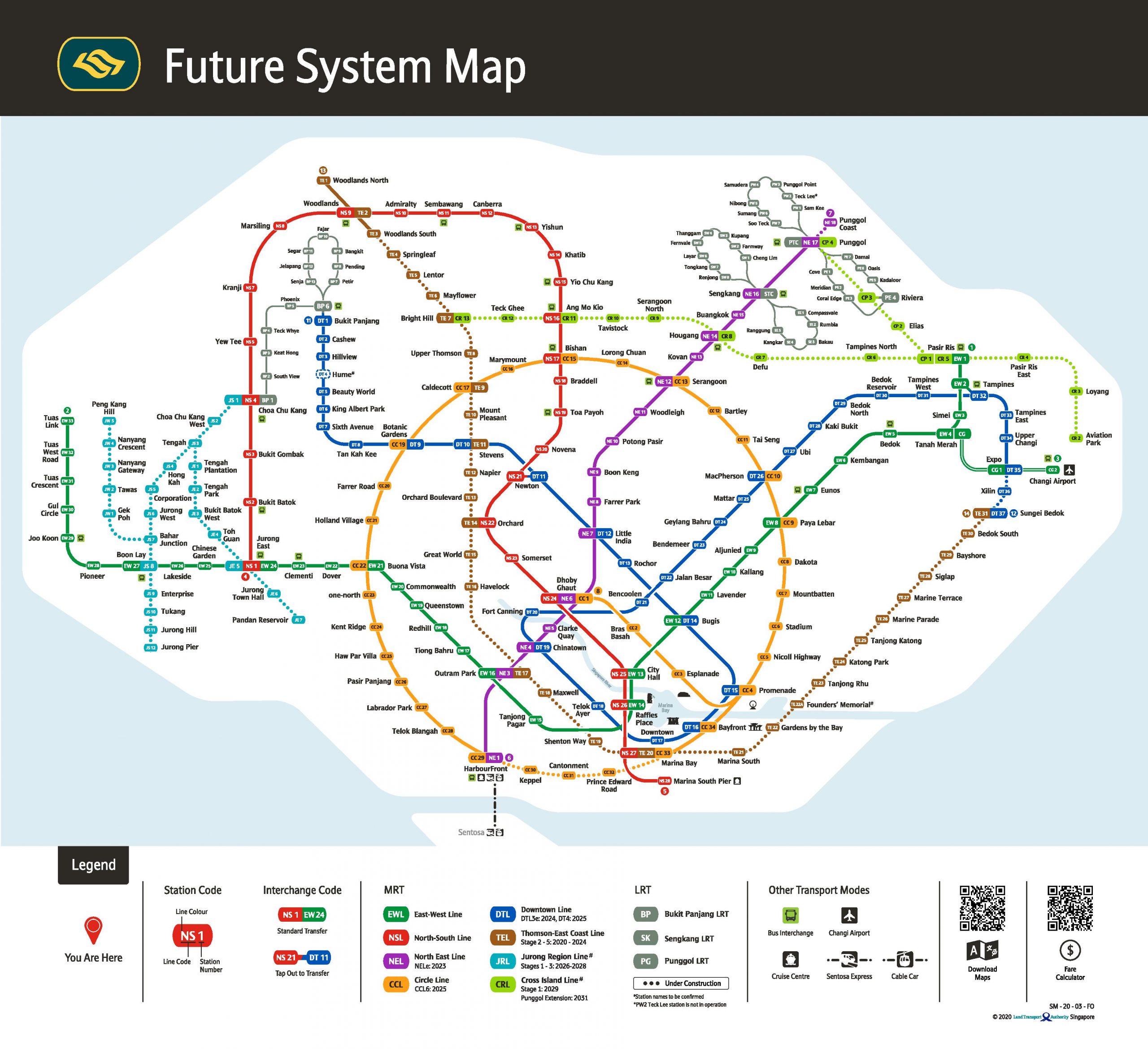
Neither of these suggest that the JRL is capable to take over the heavylifting of transport needs in the West, even if train capacity and frequency is maxxed out in the event of another catastrophic disruption similar to 25 September. Fundamentally, the JRL does not extend beyond the west! Plans have been suggested to extend the eastern branch (from Tengah to Jurong East to Pandan Gardens) further through West Coast to Haw Par Villa, but as NCMP Leong mentioned in his speech, this did not appear in LTMP 2040. Even after accounting for timeline differences in building elevated vs underground, the West Coast extension, if announced today, will not be completed even after the CRL goes to JLD. So until the day JRL reaches Haw Par Villa, the JRL will essentially be a feeder line to the EWL, exacerbating the overcrowding on it!
In any case, the JRL was planned as a light rail (in the proper sense of the word) from day one, and this locks its capacity to be around just 1/3 that of the East-West Line that it’ll be expected to relieve, someday, and only if the West Coast extension happens. Before concrete plans for those are finalised, it’s utterly stupid to cite the JRL as an example of “rail redundancy” for western Singapore. Hell, I hate to say it but, citing JRL pre-West Coast as “EWL redundancy” makes the individuals demanding west side residents to cram the DTL when the EWL goes down sound reasonable by comparison!
By the way, Amy Khor isn’t the only one making this shockingly amateur mistake — Chee Hong Tat repeated the same illogical claims in his ministerial statement beforehand. Our ministers, particularly TM Chee, would save themselves a lot of embarrassment if they actually looked at a map before blabbering about something that they have no idea about. It’s also why it’s of utmost importance that the high horses in MOT and LTA actually use public transport — you’d never catch Khaw Boon Wan saying something this dumb about the rail network, would you?
By the way, the CRL’s ability to provide EWL relief is also highly limited — it intersects the EWL at only Clementi, which is one station after Jurong East. Coincidentally, that was also ground zero for the 25 September derailment, so even the CRL’s presence would barely be an improvement over the week-long chaos we experienced. And of course, the CRL doesn’t touch the NSL, so that’s a bummer for residents staying in towns along the former Branch line.
12. For the connection between the Jurong Town Hall station on the Jurong Region Line, and the Jurong Lake District station on the Cross Island Line, or CRL, Mr Leong will be pleased to know that there will be good pedestrian connectivity between the two stations.
A bit of context behind this: When the CRL2’s alignment was released in late 2022, then transport minister S Iswaran assured the public by stating that LTA would study options to bridge the cap between the CRL and the three rail lines at Jurong East station next door. We also did a proposal for LTA to consider regarding this, by having the NSL take over the Pandan Reservoir leg of the JRL, and re-routing the JRL to the JLD. Since then, there has been radio silence about this purported LTA study. NCMP Leong questioned the non-connectivity between the CRL and JRL in his adjournment motion, thus finally compelling an official answer to be given.

And so, we learned of the outcome of that study on 15 October. We’re told that there would be “good pedestrian connectivity“, whatever the hell that means, between the CRL’s Jurong Lake District and JRL’s Jurong Town Hall stations, to bridge the aforementioned gap. Which is to say, they basically did nothing. By LTA’s increasingly slipping standards, even a normal sheltered footpath on street level would count as “good pedestrian connectivity” too, even though it’s basically a wholesale repeat of the Rochor debacle, except this time you cannot just stay on the train for a much longer time to skip this unwanted, undesirable lack of connection! I suspect, based on the way URA marketed the JLD as a pedestrian-friendly district with robust infrastructure for walking and cycling, that LTA and MOT just took the opportunity to free-ride URA’s initiatives so they didn’t need to properly address this critical missed connection in the west. And what’s the probability that people actually will attempt this connection, given that for numerous similar situations that occur downtown today (particularly the DTL’s missed connections with other lines), these out-of-station connections are not accompanied by proper wayfinding signage. Translation: you’re on your own trying to navigate the underground labyrinths there. Is this going to be applied for what’s arguably the most significant connection point in the west?
Why should NCMP Leong be pleased (sic.) to hear about what’s basically blowing hot air? Let’s not forget the elephant in the room — NSL residents remain unconnected to the JLD because there has been no mention of any connection between the JLD and Jurong East stations. For what it’s worth, the distance between Jurong East and the JLD stations is sufficient to establish an entire relay bus route, bringing passengers from the NSL to the JLD without having to contribute to the crowds on the EWL for 1 stop just to get to Clementi. But why waste the buses on such a connection, when the entire situation could have been avoided altogether with a proper, heck even a semi-proper rail connection? And the buses for such an absurd relay feeder, which will probably number in the dozens, could have been invested towards bolstering trunks that bridge gaps in the rail network in the west!
The fact that LTA has planned nothing of value for future JLD inhabitants, in terms of connectivity to the NSL, is nothing but disappointing. I seriously hope that was a slip of tongue on Amy Khor’s part, and that something is actually being planned, but knowing the same LTA that defies conventional transit planning wisdom, can I be optimistic…
17. That is why we have taken further steps through the recently announced Bus Connectivity Enhancement Programme. Some measures include introducing more peak-hour express bus services for faster connection to the city, as well as new “express feeder” services, which will bypass stops to take a more direct route to connect residents in farther away estates to existing transport nodes and town centres. Mr Leong’s suggestion for buses is no different from this.
From the exchange between Leong Mun Wai and Amy Khor, it’s obvious who understands what they’re talking about, and who doesn’t, and it’s not because I’m biased against the ruling party. I highly recommend you to watch the full adjournment motion read by NCMP Leong, because many of the details that he cites in his speech, which the abovelinked PSP Facebook post doesn’t capture, show that he understands what rapid-stop buses are, in contrast to Amy Khor’s confused attempt at projecting from initiatives under the BCEP.
It looks like it’s not just local bus enthusiasts, too used to the trunk-feeder-express trichotomy of bus route classification here, that struggle to understand the concept of rapid stopping. Even a minister for transport is also unable to grasp this concept, despite what I consider to be very detailed explanation on NCMP Leong’s part. It certainly reminds me of that conversation I had with another bus enthusiast where I suggested upgrading 43 (Punggol – Upp East Coast) to rapid-stop, only for the other party to think I was attempting to entirely replace 43 with 43e. Bruh.
What shows that NCMP Leong knows what he’s talking about? Well, he suggested a route “871e”, calling once each at Tengah, Bukit Gombak and Beauty World. I don’t agree with such a route, but it shows that at least he grasps the concept of a consistently wider stop interval. On the other hand, the City Directs that Amy Khor suggests are “no different” from the rapid bus proposal, are expresses, as they generally incorporate a long non-stop segment, while stopping at every stop on both ends of the route. I’m not saying the City Directs don’t have a role to play — they certainly do, and if only LTA allowed more ad-hoc trips to be run during the week-long shutdown the pain could have been a lot more manageable for west side residents.
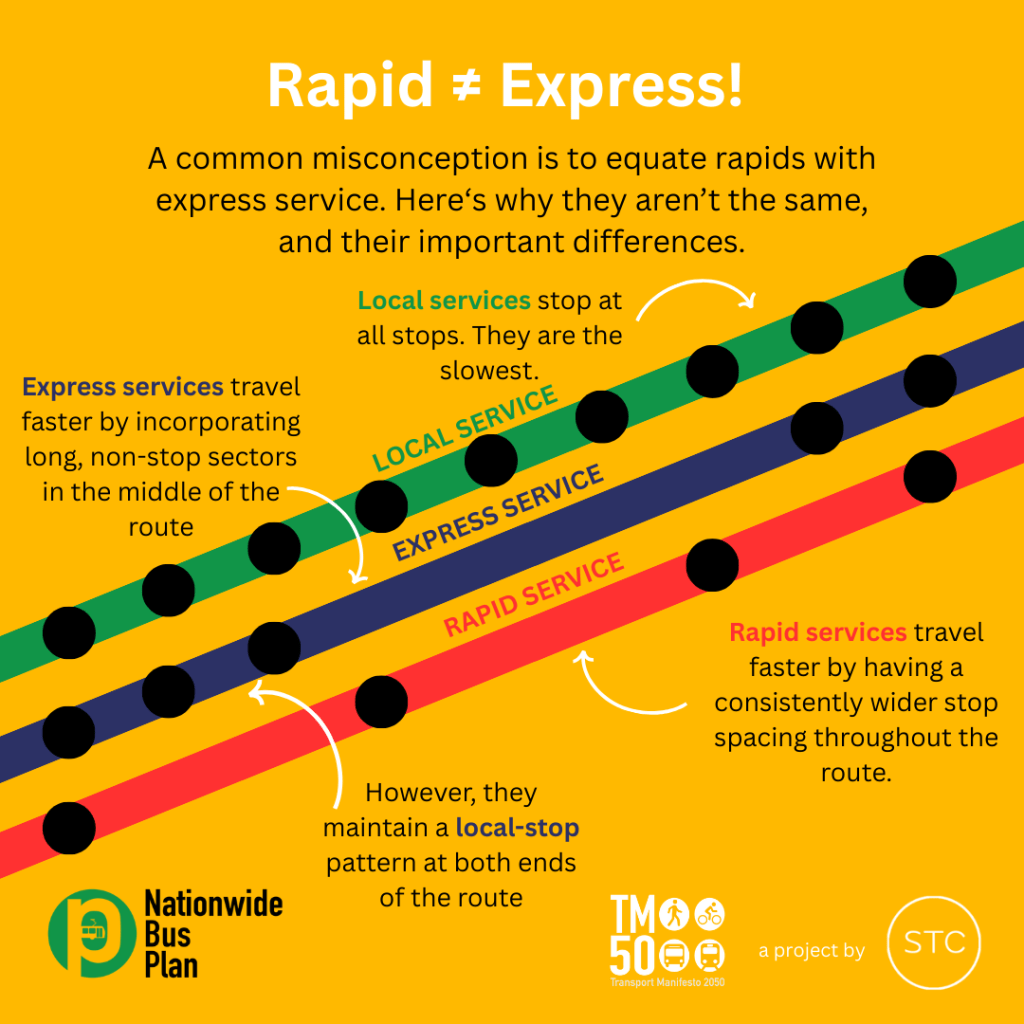
It’s worth hammering the point home again: Express routes are faster due to their long nonstop segment. Rapid routes are faster due to longer stop spacing. If it’s still unclear: the MRT is faster than the local bus in Singapore because relative to the bus service, the MRT is a rapid-stopping network (with exclusive rights-of-way) that has a much wider stop spacing than the bus. There’s no reason why buses can’t do something similar, while reasonably avoiding direct duplication of course.
Yet, when the concept of rapid-stop buses was brought up in Parliament for perhaps the first time ever, Amy Khor claimed that it was “no different” from the BCEP initiative of introducing new City Directs, which are express routes! Gosh… even if she wasn’t aware of the concept, at least pay attention to what NCMP Leong said? It’s frankly mind-boggling how people can still mix up the concepts of rapid and express, despite the very stark differences in outcomes that they produce!
Side note: besides just Amy Khor being confused about rapids and expresses, I had another stable genius from a rival Discord server telling me to “look for private-sector premium express buses” when I mentioned introducing rapid-stop buses here. Just, what…??
18. We will also speed up the pace of introducing new trunk and feeder bus services and improving bus frequencies, to improve connectivity for the early batches of residents who move into new estates like Tengah. LTA is progressively identifying these enhancements in consultation with stakeholders.
19. Beyond improving transport connectivity, we are also bringing jobs closer to residents. With the development of regional centres like the Jurong Lake District and Jurong Innovation District, residents in the West will have even more employment opportunities close to home.
Frankly, seeing the caliber of new bus routes launched in recent years, Amy Khor should offer a clarification: how exactly does LTA define “trunk” routes? By the proper definition of a trunk route, which means a major network element that serves long-distance trips, then we haven’t seen a new trunk service pop out in a very long while. The last new bus service that could be considered a trunk would be 974 (Joo Koon – Bukit Panjang) in 2018. The word “trunk” loses its meaning when nonsensical routes of all kinds are parked under its nomenclature, including but not limited to:
- Feeders such as 114
- Loop circulators such as 84G/W and 115
- Route stubs with minimal utility such as 146
- Long feeders such as 861
So when Amy Khor says that more “trunks” will be introduced, she says nothing about the connectivity that is offered to residents of new estates like Tengah. (By the way, 870 871 and 992, the three aforementioned Tengah routes, are all long feeders branded as “trunks”, bringing passengers no further than MRT stations in the region) And it’s on LTA’s part, for devaluing the word “trunk” by muddying the waters with their archaic, boundary-based planning.
Important note: decentralisation does not necessarily bring workplaces closer to you. Amy Khor claims that the development of the Jurong Innovation District and Jurong Lake District will bring jobs closer to homes. Not necessarily, and a clear distinction has to be made for that statement to stand. New regional hubs only bring jobs closer to homes if they are of generic purpose, rather than specialised in a specific field. Specialised regional clusters select employees based on talent, who will inevitably be distributed everywhere. For the JID, more geared towards innovative enterprise, it’s unlikely that their employees will move closer to Tengah just because their office moved. If this is card played to justify underinvesting in robust public transport in these new regional hubs, then we’re in for trouble. Changi Business Park, a cluster specialising in IT, struggles with its existing public transport offerings — overcrowding on 20 and 118 is a routine, and that’s with the presence of a heavy rail line (Expo MRT) and a generous offering of premium expresses to relieve the load. JLD and JID, served mainly by the light rail JRL, will not be as lucky.
It’s surprising that these realities are not obvious to someone who was formerly a Manpower Minister. That being said, given Singapore’s lackluster record in labour rights…
That’s a wrap for Amy Khor’s speech. Honestly, there are times where a response really shouldn’t have been given, because once she opened her mouth to reply to Leong Mun Wai’s adjournment motion, out came misconception after misconception, as well as misinformation about the suitability of existing plans to meet emerging travel demands in western Singapore. LTMP 2040 was caught very lacking, and it’s not a hill to die on defending. Frankly, given how the stuff they yap in Parliament is prepared by officials in the statutory boards that their ministries oversee, I wonder how much different things would be if representatives of the statutory boards also sat in Parliament to address queries by MPs. After all, they are the ones directly engaging with the subject matter, and despite the nonsense policies created, they have a better idea of what’s going on compared to the Minister. At least, for transport matters.
There’s ignorance, and there’s weaponised stupidity
If Amy Khor’s speech gives brain damage from all the confused chatter about basic concepts in public transport (that’s why the Basics page exists, for readers to not be misinformed), Chee Hong Tat, in his usual style, never fails to irk the public with his holier-than-thou attitude, on top of confused yapping. On the bright side, his ministerial statement also admits some very obvious facts, albeit in a indirect fashion. I’ll spare you the technical bits of how the train derailed (even the SMRT leadership can tell you grandmother stories about that), so here goes:
15. Later in the day, when heavier crowds were observed at Buona Vista station, SMRT adjusted bridging bus operations to focus on the critical stretch between Buona Vista and Jurong East stations that was without train or shuttle services. By the evening peak, the number of bridging buses had also progressively increased from 39 before the peak period to 70, with an average interval of 3 to 8 minutes, quicker than the stipulated service standards of 12 to 15 minutes for bridging bus services. To support these services, additional spare buses were deployed and some bus captains on rest days were recalled.
16. Mr Don Wee and Mr Leong Mun Wai asked about whether other bus services were affected. Due to the scale of bridging bus operations, some buses and bus captains had to be redeployed from other lower-demand services. Bus operators determined these redeployments based on ridership and frequencies of their other services, in order to maintain service standards and minimise inconvenience to commuters.
Indirectly, Chee Hong Tat admits that free bridging buses (FBBs) are not a viable strategy for handling alternative travel options during train disruptions. While he was attempting to show how FBBs were made available in a timely fashion, what he also described was the immense cost of hand-waving a new bus route into scratch that simply makes them unsustainable for a train disruption, let alone one lasting six days.
Besides the obvious toll on bus captain welfare (because there’s only so much spare manpower to keep around for the unexpected), he cited the need for redeployment of buses from “lower demand services” to maintain FBB service, which supposedly performed ‘better than the stipulated service standards”. There’s just so many things wrong in these two paragraphs that I could spend an entire day ripping apart this heinous mix of lies, misinformation, and tacit manipulation.
In the earlier post on the derailment, we posted numerous examples of the fate that befell the bus services from which FBBs were taken from. We’re posting it here again for everyone to see:
Is the Transport Minister colour-blind? Can he not see the sea of red and orange spanning the entire western Singapore that ensued during that chaotic week? And even so, is he unable to see the abnormally packed buses in the west, or at the very very least, did his LTA handlers supply him with information on bus loading? (PSP’s Hazel Poa filed a question asking which routes saw the highest demand during that week, which Chee Hong Tat conveniently did not answer)
How on earth did Chee Hong Tat look at all the red-loaded buses, crush-loaded beyond capacity to ridiculous lengths, and unironically blurt out in Parliament that these were “low demand” routes?????? Was 198 “low demand” when passengers were being constantly left behind in Jurong West, Buona Vista and West Coast as a result of buses being removed to supply the FBBs? Was 99 “low demand” when buses were departing Clementi above rated capacity, while still leaving behind countless passengers!?!??!?? Was 174 “low demand” when buses were crush-loaded at 10pm?????? Were trunk buses in western Singapore running “empty”, as he claims, when City Direct 651 was full to door, with passengers literally crammed against the bus doors on the expressway? It’s purely sickening to see how the Transport Minister is denying the harsh realities on the ground, whitewashing the (borderline deliberate) inadequacy in alternative travel arrangements, while still attempting to give the status quo a pat on the back. Let’s hope his car breaks down during the next major train disruption, so he has to experience what Singaporeans don’t have a choice in not experiencing. As always, touching grass is a surefire way to stop oneself from spouting nonsense incessantly whenever one opens their mouth.
I can’t help but note the irony here — while a former opposition MP faces trial (which began also on Oct 15) for lying in parliament, the obviously factually incorrect statements made by the minister from the ruling party is sanctioned, despite it being a far more gross misrepresentation of an important facet of life for far more people. And Chee Hong Tat should be thankful that Singaporeans are in general apathetic about political debates in Parliament, or do not even touch the MOT website at all — I doubt residents in western Singapore would take his claims very kindly, especially after having to bear such a massive inconvenience for a full week, on top of being gaslighted to accept further fare increases in the name of “catching up with operating cost”. Spreading this post around helps, if readers believe Chee Hong Tat to be truly incompetent and sufficiently malicious to be deemed unfit and unacceptable for helming the Transport Minister position, and maybe we might see some results in the next general election, which should be happening really soon.
Additionally, it’s also important to highlight (again) that while major trunk and long feeders responsible for heavy-lifting across the shut down section of EWL had their fleets cut for the FBB, feeders with nonexistent demand continued to be relentlessly spammed with buses, many of which were less than half loaded. Why weren’t buses taken from these services instead, so that the parallel regular trunk buses could focus on better relieving affected passengers? Oh right, the Bus Contracting Model and it’s numerous ridiculous silo restrictions on FBB service provision.
And did he just state that the service standards for FBBs were… 12 to 15 minute frequencies??????? Please, for his own sake, Chee Hong Tat should stop yapping, because the more he yaps the more he embarrasses himself and the statutory boards he represents. What kind of service standard is that?? Like, he had the gall to state that buses have much lower capacity than trains, *and then turns around to state that the acceptable service standard for a rail replacement bus is… 6 times less frequent than the rail service it replaces?????* Was he even using his brain when preparing, or delivering his speech? Whatever the case is, it does show that the entire practice of running FBBs during a train disruption is simply unhelpful to the situation at hand. Perhaps by this shocking revelation, it’s shown that FBBs have just been a mere farce, a wayang session all along to show that LTA remotely bothers to do something when trains break down and passengers get caught in the crossfire.
Whatever the case, we’ve been saying this (and getting it right) all along — real rail replacement comes in the form of a strengthened regular bus network that is capable of distributing passengers away from single points of failure to their destinations more directly. And the Transport Minister, in his address, came so close to figuring this out.
36. There are a few clarifications which I would like to make in response to Members’ questions.
37. Let me start with the first-generation KHI trains. Mr Gerald Giam and Mr Dennis Tan asked about their operations and maintenance. The structural integrity of the trains was assessed by an independent assessor in 2012, who concluded that the trains have a total service life of 38 years.
38. The reliability of a train depends on several factors, and not only on its age alone. Trains that remain reliable can continue to be used, if they have not exceeded their service life.
Now that’s news — where did said “assessment by independent assessor” of the KHI trains in 2012 come from? I find it rather unbelievable that this was not made widely known soon after the assessment more than a decade ago, but rather only after a major structural failure had occurred on one of these trains, far after this assessment reportedly happened. It’s strange that no sources offer any mention of this 2012 audit, besides a passing mention on LTG, which still did not mention how “38 years” was derived, unless my math is wrong, and somehow 30 plus 30 equals 38. Paragraph in question (and its source) highlighted below.
“As reported by the International Railway Journal, the C151 trains had a design lifespan of 30 years, and SMRT’s own engineering assessments also concluded that the C151’s car body structures were structurally sound for another 30 years. Therefore, comprehensive renewal of these important components would help to extend the service life of C151 trains.”
Now I’m probably not old enough to recall what exactly transpired during the COI after the 2011 twin breakdowns (in which the supposed 2012 KHI fleet audit likely took place as part of), so if anyone could point me to a source detailing the supposed 2012 audit that Chee Hong Tat mentions, with additional explanation of how the “38 years” figure was derived, I’d be more than happy to take a look and amend the above statements. For now, and most likely, this really sounds like something he made up on the spot, with the source being “trust me bro”. A very hard sell to convince the sharper-eyed, when you’re the most hated minister in the cabinet who’s made the worst possible policy decisions in land transport this decade.
I notice that Chee Hong Tat mentioned “several factors” affecting the reliability of a train, besides its age? Care to elaborate more? Or would it expose a horrifying tale of undermaintenance (we’ll go to that later) and overcrowding on trains, caused jointly by structural failures and deep-seated cultural issues (to quote a former SMRT CEO) in the institutions planning managing our rail network?
41. Next, I want to address the questions from Mr Gan Thiam Poh and Ms Hazel Poa about compensation for affected commuters. Train commuters exiting at stations between Boon Lay and Queenstown stations were not charged for their rail journeys. Bridging bus services and regular bus services along this stretch were also provided at no cost to commuters. SimplyGo has been processing refunds in cases where commuters were charged for two journeys instead of one, due to them exceeding 45 minutes for transfers between train and bus services, or between different bus services. Commuters may approach SimplyGo for assistance if they have specific queries about their fares.
Another admission, although not necessarily of the failure of FBBs. During the disruption period, both FBBs and regular buses serving as backups for the rail network encountered unprecedented congestion on roads previously thought to be empty (such as the section of Commonwealth Ave West outside the Ulu Pandan depot where the train derailed). Did people switch to driving or ride-hailing as the EWL was severed in two? Maybe, but whatever the case, the sudden surge in traffic further delayed buses to the extent that even it took more than 45 minutes to cover a very short distance between Jurong East and Buona Vista stations!
Of course, we also factor in wait times for bus services, which were severely delayed. FBBs were stuck in traffic resulting in massive bunches, while regular trunk services had degraded frequencies, further dragging out travel time. Of course, because Singapore refuses to implement all-door boarding, dwell times at every stop are incredibly high due to the large crowds boarding them!
And LTA finds this still insufficient reason to implement bus priority, even in the midst of a train disruption approaching national crisis level? Ridiculous.
(I walked the ground at affected areas during the week-long disruption, and in the comments of that Twitter post you’ll find a little story of mine that shows just how badly LTA mismanaged bus priority for free and regular bridging buses alike. Click in!)
43. PTC had previously studied whether fare reviews should be linked to service levels and disruptions and decided not to adopt this approach, as there are other measures in place to ensure service standards are met. For service disruptions, LTA would establish the cause and accountability, and mete out penalties where necessary. In addition, when operators do not meet reliability targets, they will also not receive payments under our incentive schemes.
To quote a comment I read online about the current transport minister, he is notoriously known for his glaring lack of empathy on transport issues, so much so even S Iswaran (now in jail) was a far preferable figure to helm the Transport Ministry portfolio. And it’s not surprising why people would come to such a conclusion about him, reading statements such as the one above. Seriously, Chee Hong Tat lacks the situational awareness to realise that he was speaking on a completely different frequency from the MPs who posed the question on the link between fare increases and rail reliability. Yes, on an ideal professional level, fare levels should remain independent from train disruptions. But we don’t live in a world of spherical cows, and when the MRT has been repeatedly failing on commuters, it is nothing but tone-deaf to push through with a fare increase at the end of the year, and worse still, double down and defend such a position with rhetoric that reeks of his signature manipulation and gaslighting that we’ve seen before numerous times.
While the MPs who questioned the fare increases (scheduled for end-2024) spoke for the concern of public transport users who were heavily affected (Leong Mun Wai in his speech noted how some residents in the west took three hours to commute home during the disruption!), and how the welfare of commuters hit by repeated disruptions should be taken care of, Chee Hong Tat and his lack of empathy for affected commuters chose to view it from a dollars and cents, administrative bureaucrat perspective, believing that this was a matter of punishing SMRT for underperformance. It’s not, put simply, and this babbling about administrative incentives and disincentives shows that he’s either terrible at comprehension, or that he’s so high up his horses he can’t be bothered to care about affected passengers. Both is the likely answer.
45. Fares are collected for the entire public transport system, including buses and trains, to ensure that the public transport system remains financially sustainable. If our fares are not adjusted to reflect rising operating costs, the persistent shortfall would have a chronic impact on service quality and reliability over time. Or if we want to continue topping-up the shortfall via Government subsidies, it means that taxpayers will have to foot a higher bill.
46. Finally, Mr Leong Mun Wai, Ms Poh Li San, and Mr Sharael Taha asked how the costs of the disruption will be covered. Regardless of the investigation outcome, SMRT will bear the costs of providing the free bridging buses and regular bus services, the foregone fare revenue during the disruption, and the repair works. This requirement applies to both rail operators should they encounter a disruption along their respective lines. As for Mr Edward Chia’s question about compensation for workers, LTA and SMRT staff that worked overtime will be given overtime payment accordingly.
Re. paragraph 45: please kindly FUCK OFF if all you have to say to affected commuters, is this steaming pile of manipulative drivel aimed at shaming the general public into paying more for less reliable public transport! Like what I’ve said with regard to Walter Theseira’s false dichotomy between reduced service or higher fares, funding accessible, connective and reliable public transport is more political a matter than economic, determined by the government’s willingness to build better cities for its inhabitants, free of the shackles associated with car ownership and use.
I believe that when the MPs mentioned questioned the timing of the fare increases, they were seeking some form of compensation for their constituents who had suffered losses in time as a result of a week-long cessation of train service. While it’s hard to quantify these time losses, the least that MPs and angry netizens alike sought, was a symbolic concession that acknowledged the suffering of Singaporeans for six days. And most weren’t even seeking fare reductions — just a deferment of this year’s fare increases! I’m disgusted that I have to explain a perspective that should come intuitively to the average man — it just shows how utterly out of touch Chee Hong Tat is, despite helming the ministerial position requiring the most touching grass!
A comparative example from Hong Kong instructively shows the difference. In February 2007, a pantograph on a KCR West Rail train exploded in a tunnel, disrupting services and cutting off the New Territories towns for half a day. The chairman of the KCRC, as an apology gesture, gave free rides on the West Rail Line a week after the incident.
Up till this point, Chee Hong Tat had been yapping about the PTC’s fare formula and justifying fare increases on public transport for five consecutive paragraphs, without answering the question of how restitution would be made to affected commuters. Is he going to give us free MRT rides for just one day even? If not, quit yapping.
Probably the only thing of value in this entire speech was the MKBF update of the various rail lines in Singapore. Note: the EWL’s MKBF was about 5 million km in August 2024.
56. Mr Dennis Tan asked if we could publish the MKBF figures for our MRT network. MKBF statistics are tabulated regularly, and publicly reported on LTA’s website, on a per line basis. The MKBF figures up to end September 2024 have yet to be published, but the estimates show that all the MRT lines have achieved our target of at least 1 million train-km.
a. East-West Line – 2.03 million;
b. North-South Line – 1.42 million;
c. North East Line – 2.05 million;
d. Circle Line – 1.04 million; and
e. Downtown Line – 8.11 million.
And then comes Chee Hong Tat’s turn to show that he has never seen a map of Singapore before:
63. LTA will press on with the planned expansions in our rail network over the next decade. This will increase our capacity to meet daily commuter travel demand, provide more transport options, and further improve our rail resilience.
a. In 2026, when we “close the circle” with Stage 6 of the Circle Line, commuters in parts of the West will have another route to travel to the Downtown area.
b. The Jurong Region Line, which will open in three stages from 2027 to 2029, will also improve connectivity in the West, and offer more alternative interchanges with the North-South and East-West lines at Choa Chu Kang, Boon Lay, and Jurong East stations.
c. By the early 2030s, the Cross Island Line will significantly improve connectivity among the West, East, and North-East regions in Singapore. With almost half of its stations as interchanges, commuters island-wide will have more alternative travel routes. This includes commuters in the West, who will be able to access the Cross Island Line via the Jurong Lake District, West Coast and Clementi stations, and connect to every other radial line in our MRT network.
d. In the mid-2030s, the new Sungei Kadut interchange station between the North-South Line and the Downtown Line will provide commuters in the Northwest a more direct transfer to the Downtown Line.
64. These additions to our network will enhance rail connectivity and resilience, especially in the West, and better connect the Western region to other parts of Singapore.
In what way do things like Circle Line Stage 6 and Sungei Kadut MRT station contribute to rail redundancy in the west???? Does he unironically expect Tengah residents to take the NSL to Sungei Kadut and take the DTL down when the EWL offs itself again?
And the JRL should never be mentioned in the same breath as complementing the EWL, unless in the specific context of the West Coast extension. I’m shocked how a line operating fully within the limits of the NSEWL in the west is unironically being touted as “EWL relief” by an individual who supposedly is meant to be the figurehead of the entire field. But to possess that contextual awareness requires spatial intelligence, a quality that PAP ministers in ivory towers lack.
Let’s not even talk about the CRL. Leong Mun Wai had highlighted a “bottleneck” at Jurong East. Does the CRL address this “bottleneck”? No! For as long as no other rail line, or robust road-based rapid transit exists, to bridge areas west of Jurong East and east of Clementi, the bottleneck problem will fail to be resolved. And it will continue to be the time bomb that holds hostage every western Singapore resident by the collar. Does LTMP 2040 address this adequately? No? Zero marks for comprehension it is then.
66. That said, buses cannot fully replace rail capacity in the event of a rail disruption, even with the injection of bridging buses. Rail is still the most efficient mode of public transport. A six-car train on the East-West Line can carry more than 1,000 commuters and runs at 2–3-minute intervals during peak hours, and at speeds of up to 80km/h. In contrast, a double-deck bus carries up to 120 passengers and typically runs at much lower speeds based on traffic conditions. Hence, even with up to 80 double-deck bridging buses deployed per day, these were unable to match the full capacity of the East-West Line. During the disruption from 25 to 30 September, alternative routes using other lines and regular bus services were necessary too.
Ironic, how in his own ministerial statement, Chee Hong Tat pointed out the irony of operating FBBs — buses, each with much lower individual capacity, cannot realistically expect to entirely replace a severed rail connection. And he admits that it is necessary to have all hands of the regular bus network on deck to maximise the carrying capacity of the bus network during the rail disruption. Then why the heck was the decision to bolster the trunk bus network, instead of guttering it for an ineffective FBB route, not made instead during the days of the disruption? This isn’t funny, but it was comedic to witness the Minister contradict himself by suggesting ridiculously low service standards for FBB service, when he had acknowledged the capacity limitations of buses as a mode of transport! Did the dots not join in his head? It reflects extremely poorly of his ability to serve as transport minister, if he cannot even express coherent ideas of public transport operations. I don’t know about you, but this convinces me that FBBs are a great farce, and we’d do much better if we focused on what we already had, and made them stronger in response to train disruptions instead.
The conclusion from his speech? Thanks for telling us all about the limitations of our existing alternative transport arrangements during train breakdowns, but besides that little else he said was truly valued by Singaporeans, either because he demonstrated that his knowledge of public transport is limited to just the script prepared for him, or because his words do little to assuage raw wounds for many affected residents who went a week with significantly increased travel penalties! On a serious note, Chee Hong Tat’s speeches may one day be used in PR training to instruct public-facing spokespeople of important institutions of power of what not to do. Displaying ignorance and contradicting oneself is one. Not answering legitimate queries from fellow members of parliament is another. Worst of them all, it is extremely foolhardy to attempt to force one’s own agenda on the public while they’re reeling from the shock of the nation’s worst train breakdown in a decade! Not only does it demonstrate terrible leadership, it also reflects extremely poorly on one’s individual character, and it could well be the defining moment where the public sees his appalling lack of compassion, particularly for the very countrymen he serves.
One parliament sitting, thirty-one questions, two speeches about the most significant train disruption of the 2020s. A good reference of how not to embarrass oneself when talking about public transport, be it through heaps of common misconceptions, or just taking on the wrong attitude in viewing public transport management in general. Our two ministers for transport didn’t clear their challenge well on October 15th.
Bonus content, ft. SMRT chairman (again)
While we’re on the subject of the ministers’ verbal antics, it is timely to bring in another key figure caught in the crossfire during the derailment last month. It was to have been mentioned in the previous post but somehow didn’t make it in, so here goes.
In June last year, ST conducted an interview with SMRT’s chairman Seah Moon Ming, in which he was quoted saying that the company did not want to “overmaintain” their trains, citing the need to balance costs. Those comments raised some eyebrows when initially published, but were largely forgotten until they were dug up again in the wake of the derailment, when netizens drew the connection between these statements and what was believed to be a severe maintenance lapse on SMRT’s part.
That comment must have aged really well after an axle box quite literally broke off a train running on the mainline, fortunately when not in revenue service. I wonder what Seah Moon Ming thinks of that comment he made now, with the furore over questioning SMRT’s maintenance procedures squarely in the public consciousness.
Anyways, Chee Hong Tat’s terrible takes in Parliament did not just stop at gaslighting the agitated public into accepting fare increases. He even went on a crusade against those who called out the “overmaintenance” comment, claiming that everyone who expressed concern over Seah’s comments suggesting compromised maintenance quality was “selectively quoting” the SMRT chairman.
Firstly, it’s terrible optics to have someone else coming out to speak for you, and considering how deep of a rut the current Transport Minister is in, impressions-wise, having him of all people speak out on your behalf is arguably the worst PR nightmare for any senior executive in the field. And it’s a terrible reflection of accountability, by having someone else cover your back to deliver your statement.
Next, it’s worth examining if Seah was indeed “selectively misquoted”, as Chee Hong Tat claimed. The full quote, which supposedly contains some nuance that changes the meaning of Seah’s words, is as follows:
We never want to undermaintain because in the past, it was an issue. But neither do we want to do overmaintenance.
The gist of the statement, put in the most neutral way possible, is that a “balance” should be struck in conducting maintenance of rail assets. But “balance” is a highly subjective word, and without precise definition, it can mean anything from walking a thin tightrope to letting corner-cutting slide, or worse still, heck caring. Ultimately, what constitutes a fair balance between cost and maintenance is still a matter of priorities, and for a private entity with profit interest still in mind, this balance will not tip very far in the direction of the public interest. Despite the semblance of a “balance” being struck here, reading between the lines still suggests the implicit intent to mask a slipping standard of rail workmanship behind a subjective “balance” that would be met. Thus, it’s fair for many to be wary of SMRT’s potentially slipping maintenance standards in light of such a comment from their group chairman, because by introducing cost counterweights into the decision-making matrix, it’s tantamount to letting it get in the way of more reliable train rides. No, Seah was not “selectively quoted”.
And in the context of 35-year old KHI trains, past their initial rated lifespan, I think it only makes sense that they receive the utmost tender loving care, especially while they’re the main workhorse on the NSEWL while awaiting the arrival of new R151s to replace the remaining legacy stock, all 106 of them. By the way, more legacy trains have been removed from service than new R151s introduced, so in such a precarious situation, the need for keeping our old KHI trains going is necessary, at least until sufficient new trains arrive to completely handle demand by then without the need for backup.
On the other hand, by officially endorsing this “balance” that SMRT claimed to strike, Chee Hong Tat and his MOT colleagues open themselves up to scrutiny when things literally fall apart. It’s simply ludicrous that he is allowed to praise the “optimal maintenance” approach for being “sensible” in fair times, but the general public is not allowed to question this balance when things go awfully south. Double standards much?
In light of the derailment last month, LTA has convened an expert committee comprising key engineers from prominent urban rail systems around the world to investigate its cause. Hopefully, answers can be found.
Final notes: it’s been 24 days since the derailment, but official sources are still refusing to acknowledge it as one, even as this is increasingly clear among the people. I’m done here, hopefully nothing astonishing pops out in the meantime while I attend to more important matters in life…

Join the conversation here, and don’t forget to press the like button! Thanks for reading STC.
 Singapore Transport Collective
Leave a comment